A Note from Joan:
My dear,
Tell me — did you watch that grand military parade everyone was speaking about with such enthusiasm? I must admit I would be curious to meet someone who actually did.
Everything was there: flags, uniforms, tanks… and even a few polite rounds of applause. A choreography meant to be grand, celebrating a glittering regime. Judging by certain beatific faces, the spectacle seemed to have its effect on a few of the already convinced.
But something was missing. And it still bothers me.
The picture would have been clearer if they had added what almost always accompanies war: a few coffins. Nothing excessive — just enough to remind everyone of the principle. Nicely aligned, clearly visible, draped in flags as they should be.
After all, when sacrifice is spoken of so generously, it is sometimes useful to clarify whose sacrifice is meant — and to remember that those invoking it are not always the ones asked to make it.
You can imagine the effect.
With all my affection — and a thought for those who confuse spectacle with memory.
Joan
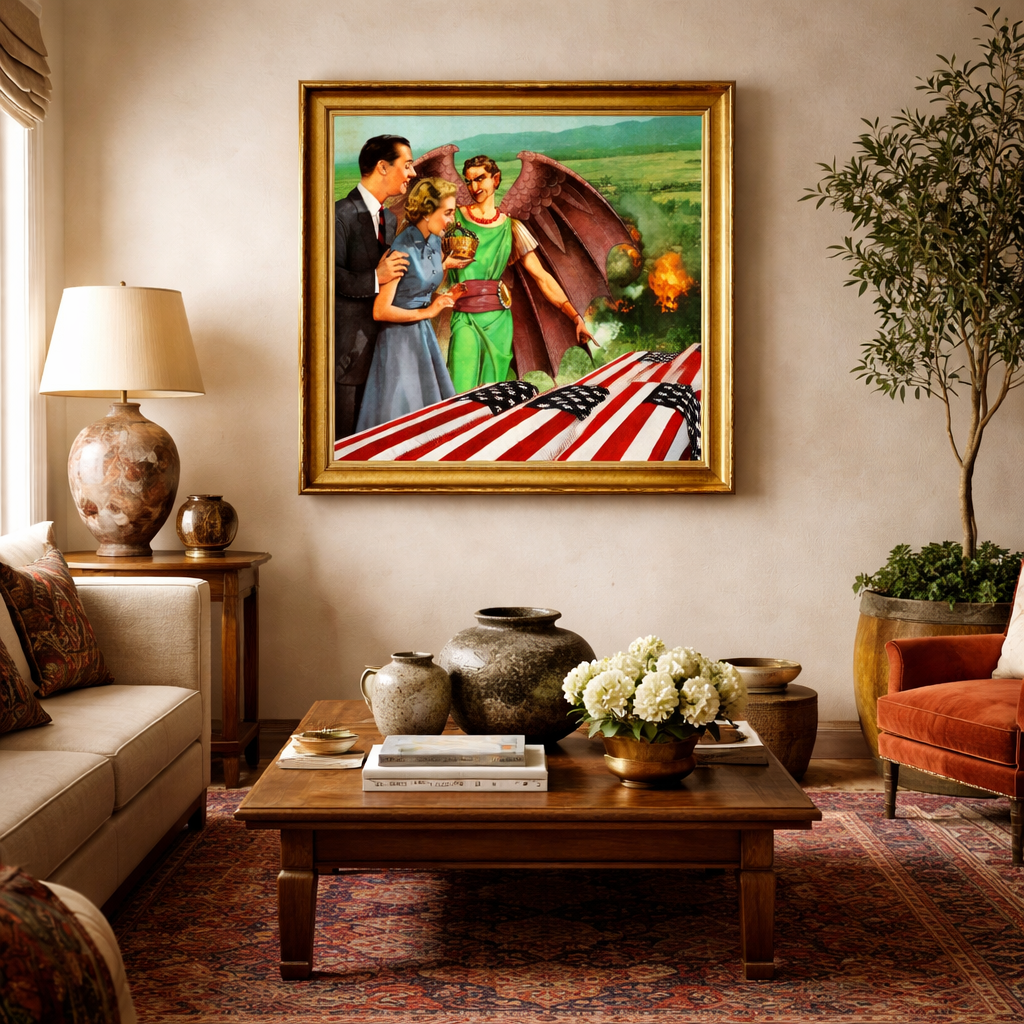
In The Magnificent Parade, Joan Seed subverts patriotic imagery and the visual codes of propaganda to reveal what the spectacle of power prefers to keep out of sight. The scene unfolds in a pastoral setting — a countryside that evokes both the comforting familiarity of traditional imagery and a “campaign” of another kind altogether: a military one.
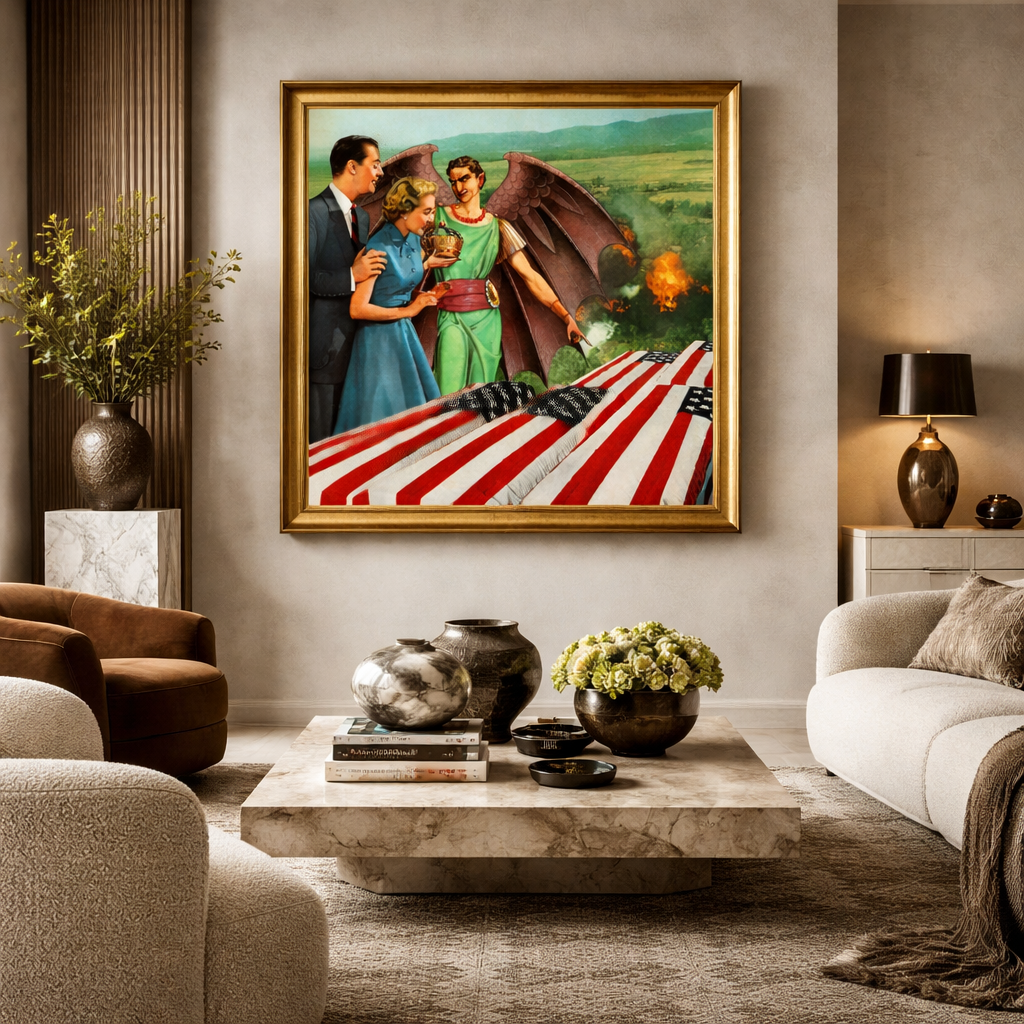
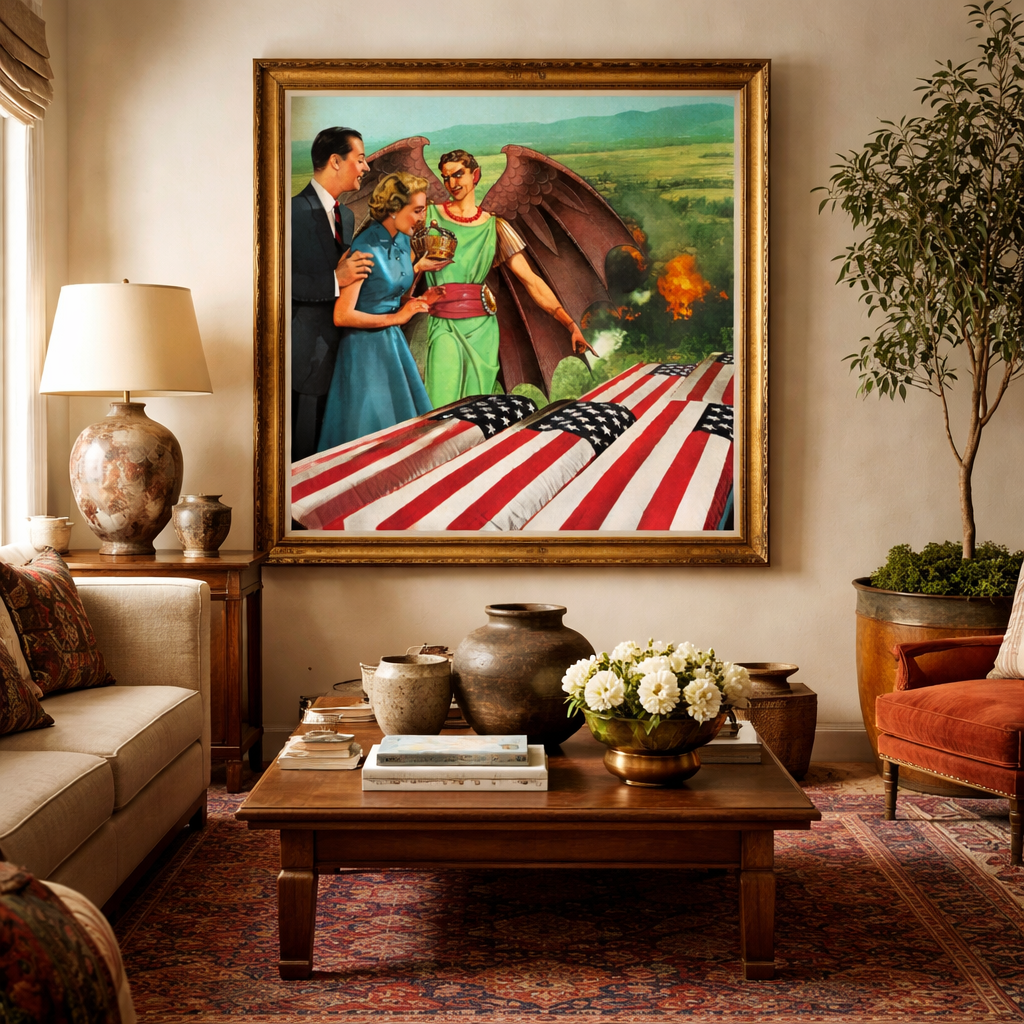
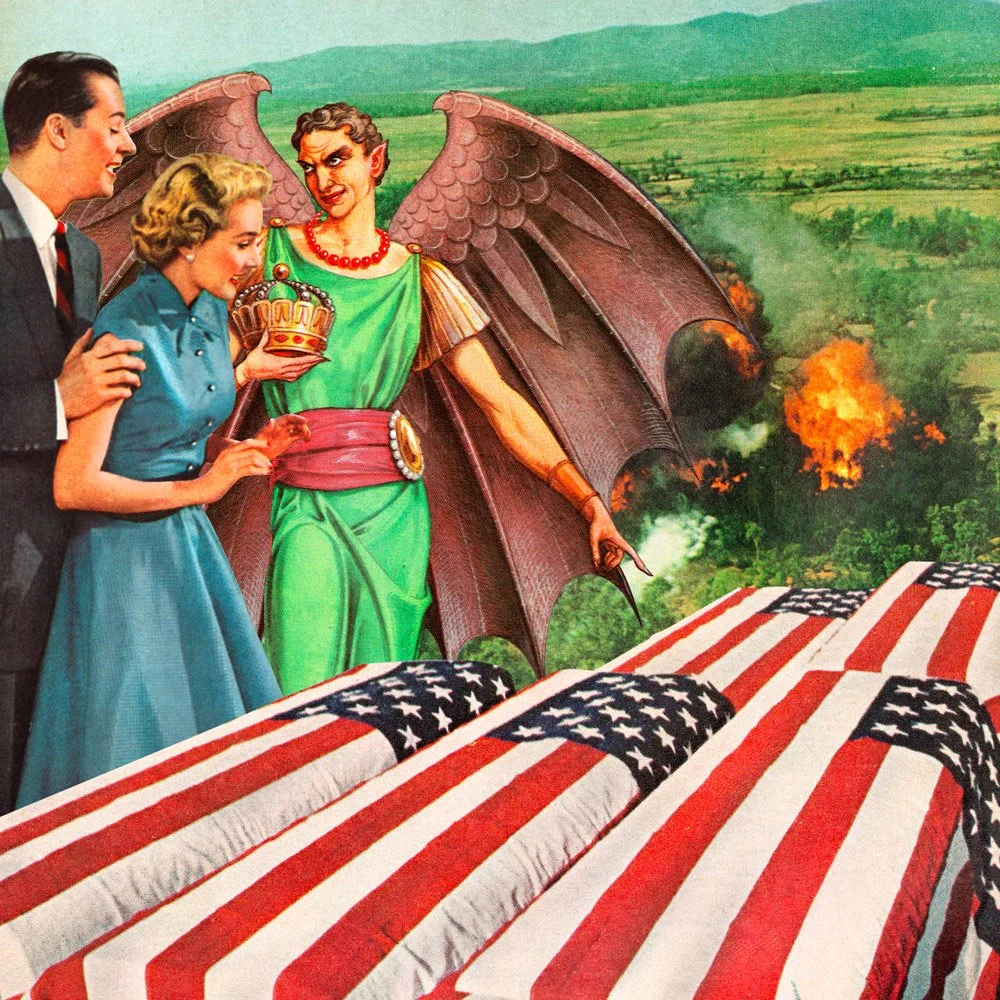
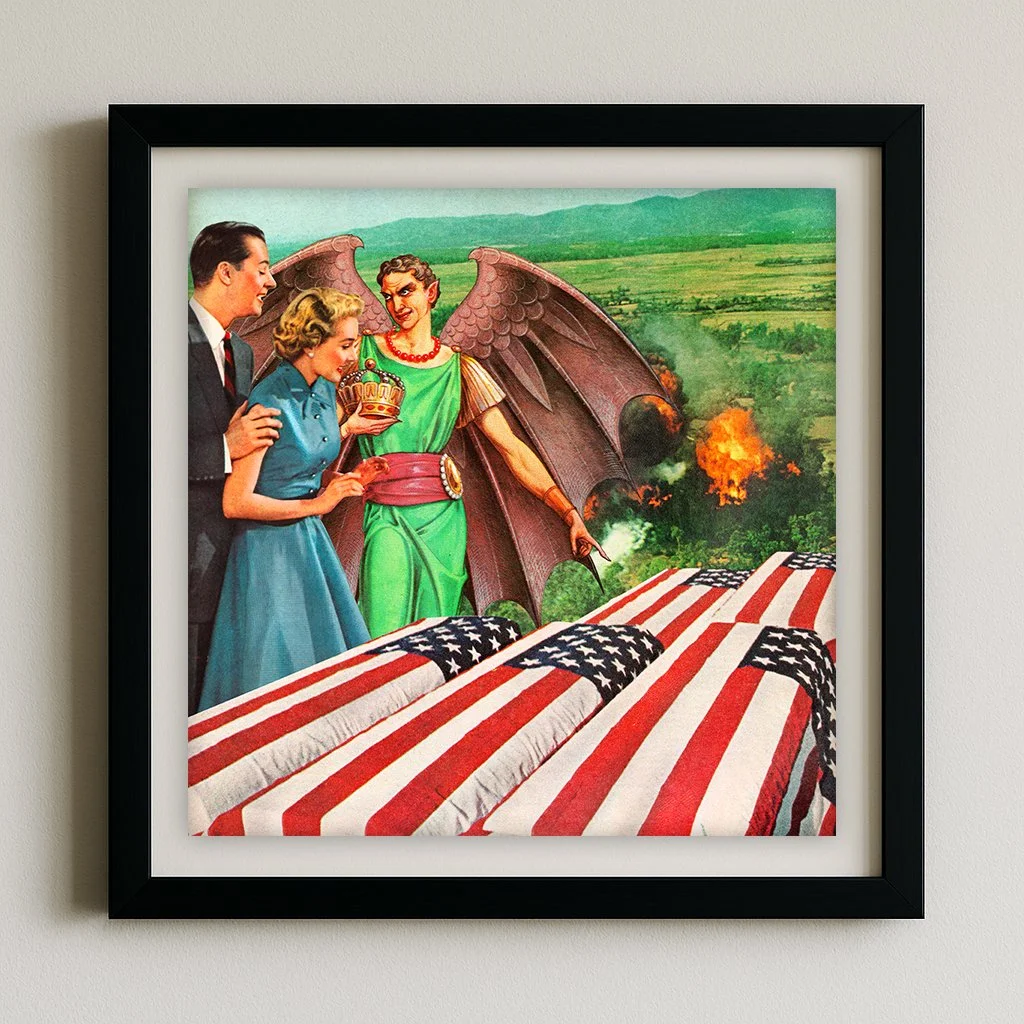
In the foreground, a well-dressed man and woman observe the scene with quiet satisfaction, as though attending a carefully orchestrated performance. Before them, the flags do not cover a grandstand or a triumphant parade; they cover a row of aligned coffins. The sacrifice invoked by patriotic rhetoric appears here in its most literal form — yet nothing in the spectators’ demeanor seems to disturb the serenity of the moment.
A demonic figure presides over the scene, seemingly guiding the spectators’ gaze. Half master of ceremonies, half angel of death, it turns the funeral procession into a carefully staged spectacle. In this bucolic setting, its presence evokes a strange parody of religious iconography. The crown it brandishes adds another dimension: that of a power that stages, celebrates, and sanctifies itself. In the distance, flames consume the horizon — a quiet yet relentless reminder of war, and perhaps of the hell it produces. A hell from which the strange winged messenger itself seems to have emerged.
By adopting the reassuring visual language of mid-century illustration while introducing a subtle but persistent unease, Joan Seed exposes the gap between the heroic narrative of war and the lives it ultimately consumes.
With The Magnificent Parade, Joan Seed examines the images through which power stages its own grandeur — bringing to the foreground the human cost that such imagery usually prefers to keep out of sight.
Through digital collage, Joan Seed explores systems of power through their visual narratives — political propaganda, advertising, and popular iconography. By reassembling fragments drawn from twentieth-century imagery, she reveals tensions and contradictions often concealed beneath familiar and seductive images. Her work draws on the tradition of surrealist collage and politically engaged visual art, where humor, irony, and incongruity become tools of critique.
Title: The Magnificent Parade
Artist: Joan Seed
Medium: Mixed Media Collage
Limited edition prints, hand-signed and numbered
Material: Museum-grade giclée print on archival, textured cotton paper
Size Options:
• 30 × 30 inches (76.2 × 76.2 cm)
• 60 × 60 inches (152.4 × 152.4 cm)
Shipping: Flat rate of $175 CAD per order.
For acquisitions, inquiries, and commissions: emailjoan@joanseed.ca
© 2026 Joan Seed. All rights reserved. This artwork and its images may not be reproduced, copied, or used in any form without prior written consent of the artist.
A Note from Joan:
My dear,
Tell me — did you watch that grand military parade everyone was speaking about with such enthusiasm? I must admit I would be curious to meet someone who actually did.
Everything was there: flags, uniforms, tanks… and even a few polite rounds of applause. A choreography meant to be grand, celebrating a glittering regime. Judging by certain beatific faces, the spectacle seemed to have its effect on a few of the already convinced.
But something was missing. And it still bothers me.
The picture would have been clearer if they had added what almost always accompanies war: a few coffins. Nothing excessive — just enough to remind everyone of the principle. Nicely aligned, clearly visible, draped in flags as they should be.
After all, when sacrifice is spoken of so generously, it is sometimes useful to clarify whose sacrifice is meant — and to remember that those invoking it are not always the ones asked to make it.
You can imagine the effect.
With all my affection — and a thought for those who confuse spectacle with memory.
Joan
In The Magnificent Parade, Joan Seed subverts patriotic imagery and the visual codes of propaganda to reveal what the spectacle of power prefers to keep out of sight. The scene unfolds in a pastoral setting — a countryside that evokes both the comforting familiarity of traditional imagery and a “campaign” of another kind altogether: a military one.
In the foreground, a well-dressed man and woman observe the scene with quiet satisfaction, as though attending a carefully orchestrated performance. Before them, the flags do not cover a grandstand or a triumphant parade; they cover a row of aligned coffins. The sacrifice invoked by patriotic rhetoric appears here in its most literal form — yet nothing in the spectators’ demeanor seems to disturb the serenity of the moment.
A demonic figure presides over the scene, seemingly guiding the spectators’ gaze. Half master of ceremonies, half angel of death, it turns the funeral procession into a carefully staged spectacle. In this bucolic setting, its presence evokes a strange parody of religious iconography. The crown it brandishes adds another dimension: that of a power that stages, celebrates, and sanctifies itself. In the distance, flames consume the horizon — a quiet yet relentless reminder of war, and perhaps of the hell it produces. A hell from which the strange winged messenger itself seems to have emerged.
By adopting the reassuring visual language of mid-century illustration while introducing a subtle but persistent unease, Joan Seed exposes the gap between the heroic narrative of war and the lives it ultimately consumes.
With The Magnificent Parade, Joan Seed examines the images through which power stages its own grandeur — bringing to the foreground the human cost that such imagery usually prefers to keep out of sight.
Through digital collage, Joan Seed explores systems of power through their visual narratives — political propaganda, advertising, and popular iconography. By reassembling fragments drawn from twentieth-century imagery, she reveals tensions and contradictions often concealed beneath familiar and seductive images. Her work draws on the tradition of surrealist collage and politically engaged visual art, where humor, irony, and incongruity become tools of critique.
Title: The Magnificent Parade
Artist: Joan Seed
Medium: Mixed Media Collage
Limited edition prints, hand-signed and numbered
Material: Museum-grade giclée print on archival, textured cotton paper
Size Options:
• 30 × 30 inches (76.2 × 76.2 cm)
• 60 × 60 inches (152.4 × 152.4 cm)
Shipping: Flat rate of $175 CAD per order.
For acquisitions, inquiries, and commissions: emailjoan@joanseed.ca
© 2026 Joan Seed. All rights reserved. This artwork and its images may not be reproduced, copied, or used in any form without prior written consent of the artist.