A Note from Joan
My dear,
The other night I thought I witnessed something strange.
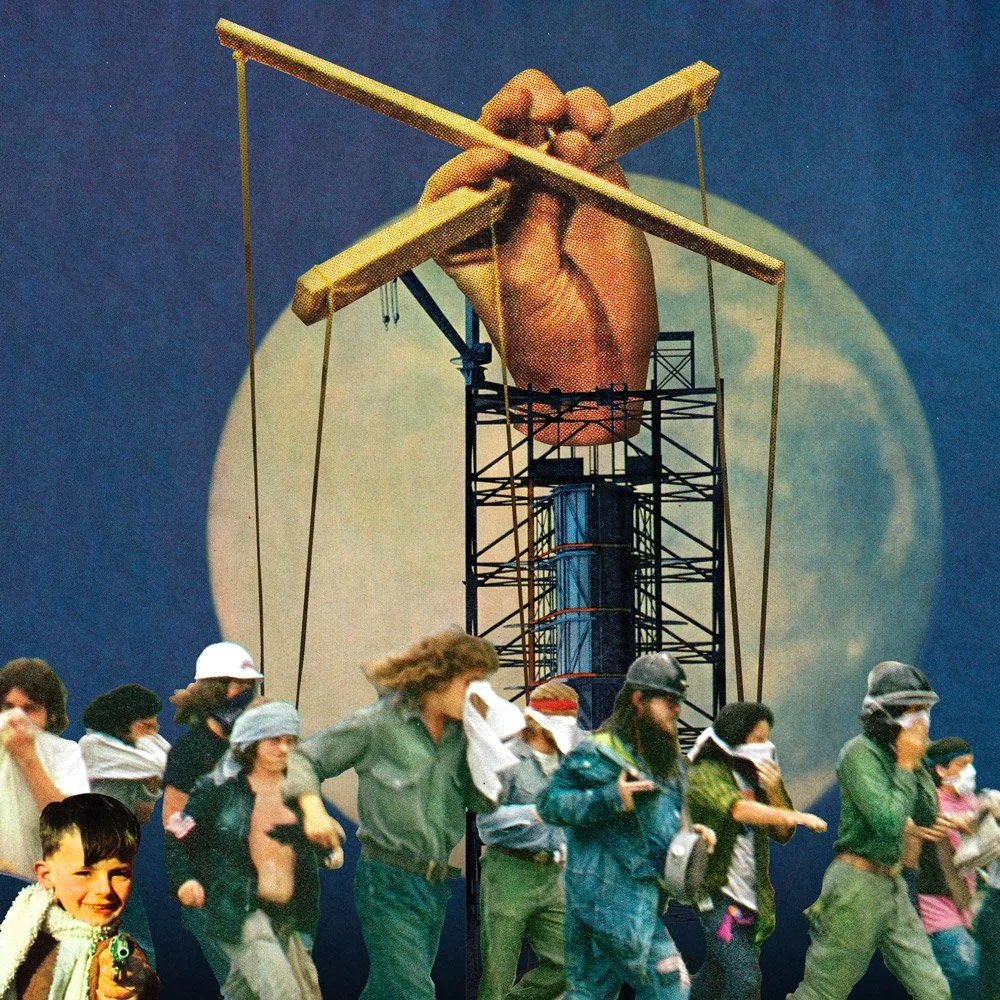
A crowd was moving beneath the full moon. Some were running, others walking quickly, their faces covered — as if the air had become difficult to breathe, or as if some now preferred to move forward without being recognized.
Above them rose a large metal structure — a tower, perhaps a machine. From that architecture descended an enormous hand.
Long strings connected that hand to the moving bodies below.
At first it seemed they could not see them. Then I had the impression that some of them were beginning to look up. As if the light of the night suddenly made certain things harder to ignore.
And one thing became clear to me: systems that live on oppression always appear solid… until the day those they hold begin to see their inner workings.
The voices of revolt have been repeating it for a long time: when the strings appear, history changes direction. And sometimes history turns faster than we imagine.
Until the strings snap,
Joan
—————————————————————————————
A Closer Look
In The Machinery of Oppression, Joan Seed stages a nocturnal scene that feels both like political allegory and surreal theatre.
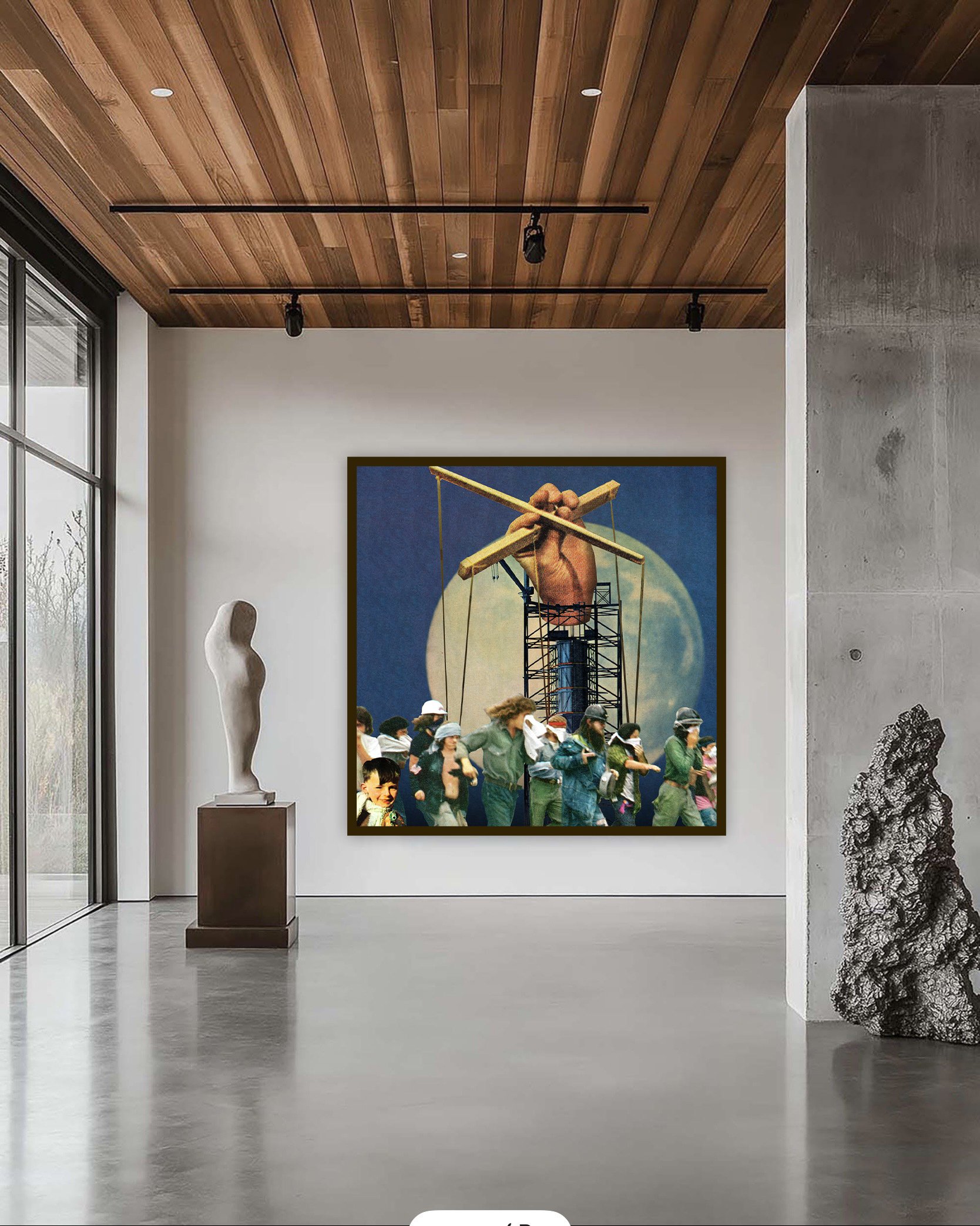
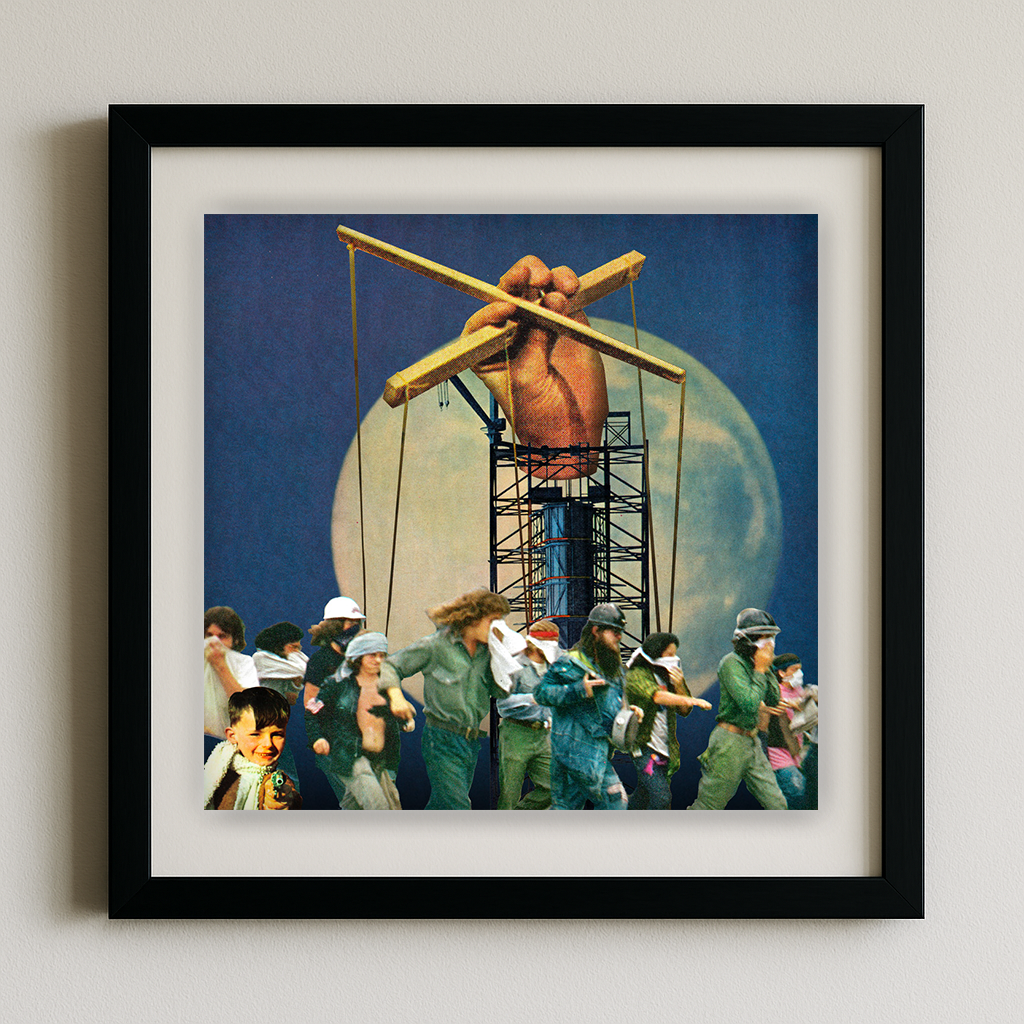
At the top of the image rises a metal structure evoking both an extraction tower and the exposed skeleton of an industrial machine too vast to be grasped in its entirety. From this apparatus emerges a gigantic hand manipulating, like a puppeteer, the strings attached to a crowd of anonymous figures below.
The scene suggests a system that does more than rule: it extracts, exploits, surveils, and shapes lives. Like the industrial machines it recalls, this architecture appears to function by turning bodies and lives into raw material, leaving behind a social and environmental landscape worn thin.
The crowd moves in an uncertain rhythm — a march, a flight, or perhaps simply an attempt to survive. Most of the figures wear masks. Are they protection against a world that has become unbreathable, literally as well as politically? Or are they the first signs of a revolt still unfolding in secrecy? Joan Seed leaves the question open.
Above the scene hangs an oversized full moon, a sign that a transformation may be near. Its cold light illuminates the night just enough for certain things to cease being invisible: the strings connecting the crowd to the mechanism that governs it.
One detail, however, deeply unsettles the composition. In the lower left corner, a small boy turns his weapon toward the viewer.
Has he already absorbed the violence of the system surrounding him, repeating its gestures without understanding them?
Or is he addressing us — those calmly observing the scene — urging us to choose a side, to step out of our indifference, perhaps even our passive complicity?
At that moment the image seems crossed by an older echo: the calls for freedom that, for centuries, have resonated through factories, mines, barricades, and everywhere people have risen to challenge the established order.
As if those distant voices still reached us, reminding us that the strings of power never hold for long once those who endure them begin to see them.
As is often the case in Joan Seed’s work, the outcome remains uncertain. Yet one thing slowly comes into view: power behaves less like an individual than like a mechanism. Like any machine, the machinery of oppression eventually exposes its gears.
Context
With The Machinery of Oppression, Joan Seed continues her exploration of the invisible systems that shape relations of power in contemporary societies.
Through digital collage and the appropriation of archival imagery, the artist composes scenes in which industrial symbols, human figures, and political gestures meet in an ambiguous space between satire and allegory.
Drawing on the tradition of surrealist collage and twentieth-century critical imagery, Joan Seed reworks the visual language of cinema and vintage propaganda to create politically engaged visual art, where manipulation, exploitation, and resistance become elements of a broader reflection on the mechanisms of power.
————————————————————————————————————
Artwork Details
Title: The Machinery of Oppression
Artist: Joan Seed
Medium: Mixed media digital collage
Edition: Limited edition prints, hand-signed and numbered
Material: Museum-grade giclée print on archival textured cotton paper
Size Options:
• 30 × 30 inches (76.2 × 76.2 cm)
• 60 × 60 inches (152.4 × 152.4 cm)
Shipping: Flat rate of $175 CAD per order
For acquisitions, inquiries, and commissions:
emailjoan@joanseed.ca
© 2026 Joan Seed. All rights reserved. No part of this publication or artwork may be reproduced, stored, or transmitted in any form or by any means without prior written permission from the artist.
A Note from Joan
My dear,
The other night I thought I witnessed something strange.
A crowd was moving beneath the full moon. Some were running, others walking quickly, their faces covered — as if the air had become difficult to breathe, or as if some now preferred to move forward without being recognized.
Above them rose a large metal structure — a tower, perhaps a machine. From that architecture descended an enormous hand.
Long strings connected that hand to the moving bodies below.
At first it seemed they could not see them. Then I had the impression that some of them were beginning to look up. As if the light of the night suddenly made certain things harder to ignore.
And one thing became clear to me: systems that live on oppression always appear solid… until the day those they hold begin to see their inner workings.
The voices of revolt have been repeating it for a long time: when the strings appear, history changes direction. And sometimes history turns faster than we imagine.
Until the strings snap,
Joan
—————————————————————————————
A Closer Look
In The Machinery of Oppression, Joan Seed stages a nocturnal scene that feels both like political allegory and surreal theatre.
At the top of the image rises a metal structure evoking both an extraction tower and the exposed skeleton of an industrial machine too vast to be grasped in its entirety. From this apparatus emerges a gigantic hand manipulating, like a puppeteer, the strings attached to a crowd of anonymous figures below.
The scene suggests a system that does more than rule: it extracts, exploits, surveils, and shapes lives. Like the industrial machines it recalls, this architecture appears to function by turning bodies and lives into raw material, leaving behind a social and environmental landscape worn thin.
The crowd moves in an uncertain rhythm — a march, a flight, or perhaps simply an attempt to survive. Most of the figures wear masks. Are they protection against a world that has become unbreathable, literally as well as politically? Or are they the first signs of a revolt still unfolding in secrecy? Joan Seed leaves the question open.
Above the scene hangs an oversized full moon, a sign that a transformation may be near. Its cold light illuminates the night just enough for certain things to cease being invisible: the strings connecting the crowd to the mechanism that governs it.
One detail, however, deeply unsettles the composition. In the lower left corner, a small boy turns his weapon toward the viewer.
Has he already absorbed the violence of the system surrounding him, repeating its gestures without understanding them?
Or is he addressing us — those calmly observing the scene — urging us to choose a side, to step out of our indifference, perhaps even our passive complicity?
At that moment the image seems crossed by an older echo: the calls for freedom that, for centuries, have resonated through factories, mines, barricades, and everywhere people have risen to challenge the established order.
As if those distant voices still reached us, reminding us that the strings of power never hold for long once those who endure them begin to see them.
As is often the case in Joan Seed’s work, the outcome remains uncertain. Yet one thing slowly comes into view: power behaves less like an individual than like a mechanism. Like any machine, the machinery of oppression eventually exposes its gears.
Context
With The Machinery of Oppression, Joan Seed continues her exploration of the invisible systems that shape relations of power in contemporary societies.
Through digital collage and the appropriation of archival imagery, the artist composes scenes in which industrial symbols, human figures, and political gestures meet in an ambiguous space between satire and allegory.
Drawing on the tradition of surrealist collage and twentieth-century critical imagery, Joan Seed reworks the visual language of cinema and vintage propaganda to create politically engaged visual art, where manipulation, exploitation, and resistance become elements of a broader reflection on the mechanisms of power.
————————————————————————————————————
Artwork Details
Title: The Machinery of Oppression
Artist: Joan Seed
Medium: Mixed media digital collage
Edition: Limited edition prints, hand-signed and numbered
Material: Museum-grade giclée print on archival textured cotton paper
Size Options:
• 30 × 30 inches (76.2 × 76.2 cm)
• 60 × 60 inches (152.4 × 152.4 cm)
Shipping: Flat rate of $175 CAD per order
For acquisitions, inquiries, and commissions:
emailjoan@joanseed.ca
© 2026 Joan Seed. All rights reserved. No part of this publication or artwork may be reproduced, stored, or transmitted in any form or by any means without prior written permission from the artist.