


Retro sociopolitical homosexual in denial artwork.
Darling,
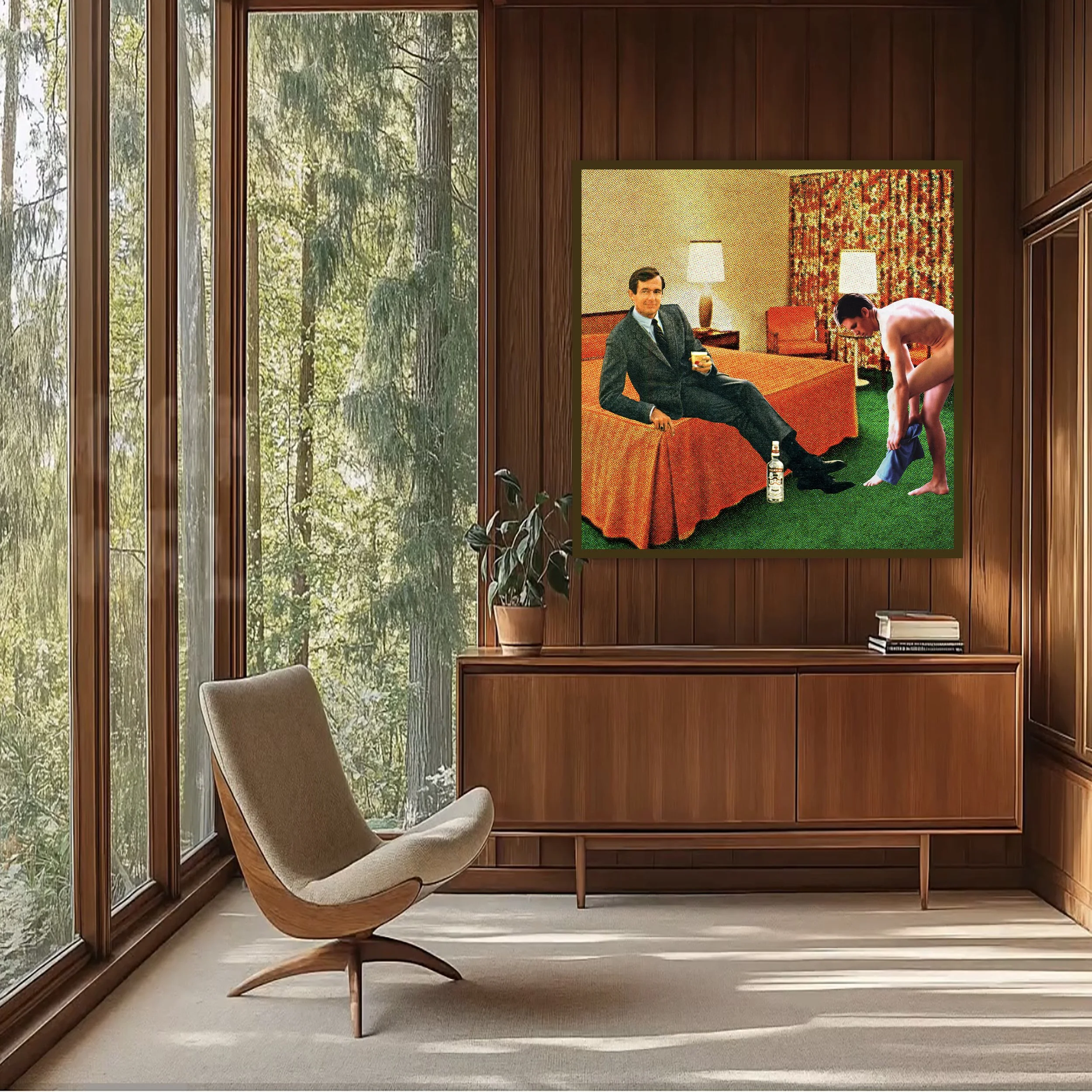
It all started with a man in a suit, a bedspread the color of regret, and a boy far too beautiful to be left to the mercy of Human Resources. I call it The Job Interview. But let’s be honest: the hiring decision had clearly been made long before any application was submitted.
Ah, the 1960s. A time when curtains were louder than protests and silence was practically treated as a sexual orientation. They preached “don’t ask, don’t tell.” I’ve always preferred a different approach: look, darling — and gasp.
This piece is a love letter to every boy who dared to press his slacks before an appointment with a man pretending not to look. It’s for the drawn curtains, the vodka served too cold, the silences that lasted too long — and the heat that, somehow, always found a way through the walls.
Hang it above your sofa, your bar cart… or your conscience.
Discreetly yours,
Joan
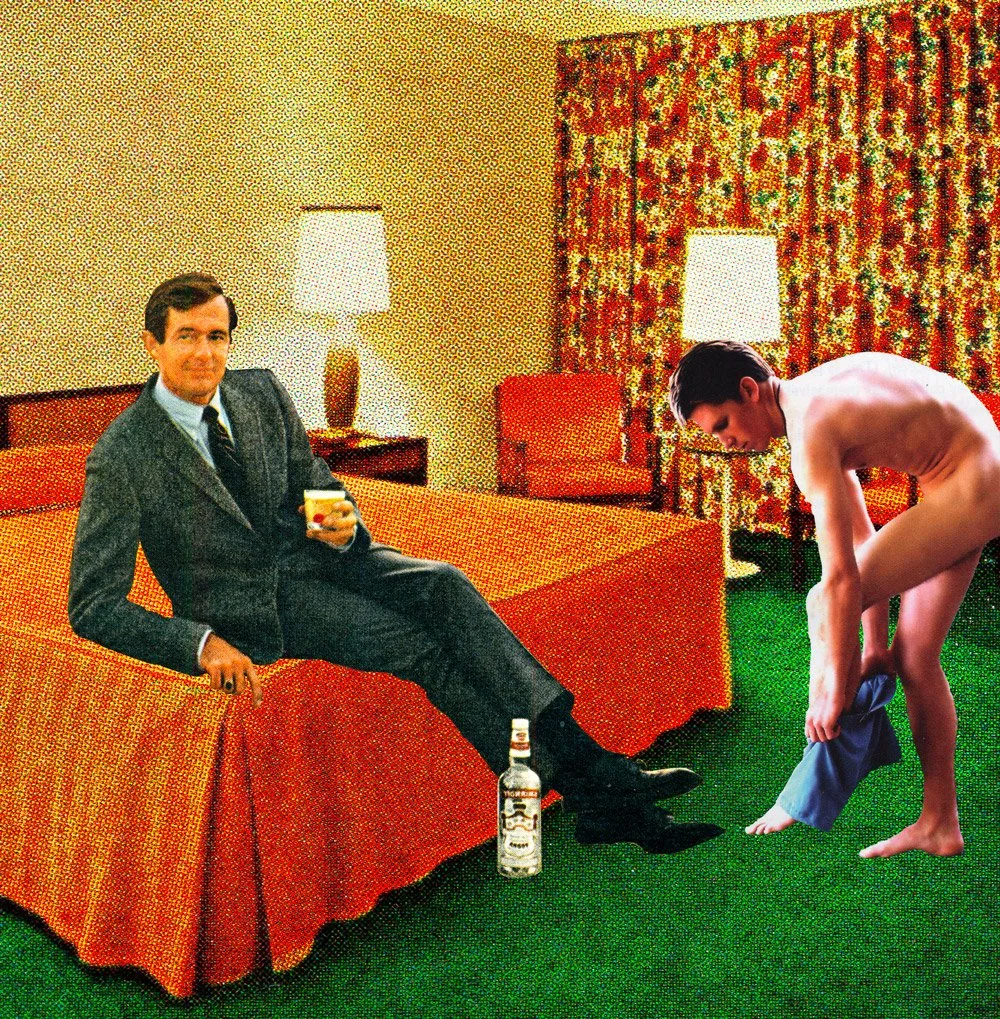
In If Walls Could Talk, Joan Seed turns a motel room straight out of a 1960s advertising fantasy into a quiet theater of desire and denial.
The space is saturated with artificial color — unreal green carpet, blazing bedspread, shrill curtains — as if the era’s immaculate visual language were trying to cover something it preferred not to name.
At the center of the scene, a suited man sits comfortably, drink in hand, radiating the calm assurance of respectable masculinity. At his feet, a bottle of vodka suggests the evening involved more than polite conversation. The gesture is calm, almost routine — as if this kind of interview took place here more often than anyone would care to admit.
Nearby, a young man dresses again — an ephebe, almost an Adonis, whose beauty feels both offered and condemned.
At first glance, the image might read like a mischievous visual joke, a sly wink at the infamous closet. Yet the composition quietly reveals something more troubling.
Each man, in his own way, seems to be paying the price of this moment.
The older figure embodies perfect respectability — tailored suit, composed posture — yet behind him one can imagine a carefully partitioned life: perhaps a wife, perhaps children, certainly a world that must never know about this room… or one that politely pretends not to.
The younger man brings the only currency society has left him: youth, beauty, availability.
They each obtain what they came for — a fleeting moment of freedom, perhaps even tenderness, with the promise of something more tangible running just beneath the surface. But that freedom must be rented by the hour, behind carefully drawn curtains — the very curtains ensuring that the walls themselves will have nothing to say.
The vodka helps, of course. It loosens gestures and eases the encounter. But it also dilutes something else: guilt, shame, the fear of being seen, and the quiet sense of betraying rules neither of them truly chose.
Joan Seed’s acid wit pierces the surface of this almost ordinary scene. For while the image may amuse, it also points to a harder truth: negotiating one’s desire behind closed curtains has never been a comedy.
Even when the entire performance is carefully staged to look like one.
Through her digital collages, Joan Seed repurposes the polished imagery of mid-twentieth-century popular culture to reveal the tensions hidden beneath its immaculate surface.
Advertisements, domestic interiors, and archetypes of respectable masculinity become, in her hands, the props of a social satire where desire, power, and hypocrisy quietly intersect.
By recomposing these visual fragments into deliberately ambiguous scenes, the artist brings into view what these images once worked so hard to conceal: strategies of survival, imposed silences, and the parallel lives that long shaped queer experience.
Title: If Walls Could Talk
Artist: Joan Seed
Medium: Mixed Media Collage
Edition: Limited edition prints, hand-signed and numbered
Material: Museum-grade giclée print on archival textured cotton paper
Size Options:
• 30 × 30 inches (76.2 × 76.2 cm)
• 60 × 60 inches (152.4 × 152.4 cm)
Shipping: Flat rate of $175 CAD per order
For acquisitions, inquiries, and commissions:
joan@joanseed.ca
Darling,
It all started with a man in a suit, a bedspread the color of regret, and a boy far too beautiful to be left to the mercy of Human Resources. I call it The Job Interview. But let’s be honest: the hiring decision had clearly been made long before any application was submitted.
Ah, the 1960s. A time when curtains were louder than protests and silence was practically treated as a sexual orientation. They preached “don’t ask, don’t tell.” I’ve always preferred a different approach: look, darling — and gasp.
This piece is a love letter to every boy who dared to press his slacks before an appointment with a man pretending not to look. It’s for the drawn curtains, the vodka served too cold, the silences that lasted too long — and the heat that, somehow, always found a way through the walls.
Hang it above your sofa, your bar cart… or your conscience.
Discreetly yours,
Joan
In If Walls Could Talk, Joan Seed turns a motel room straight out of a 1960s advertising fantasy into a quiet theater of desire and denial.
The space is saturated with artificial color — unreal green carpet, blazing bedspread, shrill curtains — as if the era’s immaculate visual language were trying to cover something it preferred not to name.
At the center of the scene, a suited man sits comfortably, drink in hand, radiating the calm assurance of respectable masculinity. At his feet, a bottle of vodka suggests the evening involved more than polite conversation. The gesture is calm, almost routine — as if this kind of interview took place here more often than anyone would care to admit.
Nearby, a young man dresses again — an ephebe, almost an Adonis, whose beauty feels both offered and condemned.
At first glance, the image might read like a mischievous visual joke, a sly wink at the infamous closet. Yet the composition quietly reveals something more troubling.
Each man, in his own way, seems to be paying the price of this moment.
The older figure embodies perfect respectability — tailored suit, composed posture — yet behind him one can imagine a carefully partitioned life: perhaps a wife, perhaps children, certainly a world that must never know about this room… or one that politely pretends not to.
The younger man brings the only currency society has left him: youth, beauty, availability.
They each obtain what they came for — a fleeting moment of freedom, perhaps even tenderness, with the promise of something more tangible running just beneath the surface. But that freedom must be rented by the hour, behind carefully drawn curtains — the very curtains ensuring that the walls themselves will have nothing to say.
The vodka helps, of course. It loosens gestures and eases the encounter. But it also dilutes something else: guilt, shame, the fear of being seen, and the quiet sense of betraying rules neither of them truly chose.
Joan Seed’s acid wit pierces the surface of this almost ordinary scene. For while the image may amuse, it also points to a harder truth: negotiating one’s desire behind closed curtains has never been a comedy.
Even when the entire performance is carefully staged to look like one.
Through her digital collages, Joan Seed repurposes the polished imagery of mid-twentieth-century popular culture to reveal the tensions hidden beneath its immaculate surface.
Advertisements, domestic interiors, and archetypes of respectable masculinity become, in her hands, the props of a social satire where desire, power, and hypocrisy quietly intersect.
By recomposing these visual fragments into deliberately ambiguous scenes, the artist brings into view what these images once worked so hard to conceal: strategies of survival, imposed silences, and the parallel lives that long shaped queer experience.
Title: If Walls Could Talk
Artist: Joan Seed
Medium: Mixed Media Collage
Edition: Limited edition prints, hand-signed and numbered
Material: Museum-grade giclée print on archival textured cotton paper
Size Options:
• 30 × 30 inches (76.2 × 76.2 cm)
• 60 × 60 inches (152.4 × 152.4 cm)
Shipping: Flat rate of $175 CAD per order
For acquisitions, inquiries, and commissions:
joan@joanseed.ca
Retro sociopolitical homosexual in denial artwork.