
The Apocalypse Has Been Postponed Due to Poor AttendanceJoan Seed, the Underworld, and the Fine Art of Watching Everything Fall Apart
On civilization's final curtain call, the peculiar pleasures of catastrophe, and why the end of the world might be the best show in town.
There is something terribly reassuring about the apocalypse. For one thing, it puts an end to the tiresome business of making plans.
No more dinner parties with people you dislike. No more pretending to understand contemporary politics. No more being told that everything happens for a reason by people who have never had anything particularly dreadful happen to them.
The end of civilization has its inconveniences, naturally. But one mustn't overlook the advantages.
In the surreal, deliciously disreputable universe of Joan Seed, the apocalypse is less a biblical reckoning than a social engagement gone spectacularly wrong. The guests are overdressed, the scenery is on fire, and nobody seems particularly interested in locating the emergency exits.
Which is just as well. They were probably decorative.
American Gothic 2: The Neighbors Have Become Unbearable
Featured artwork: American Gothic 2 — Joan Seed
Civilization has always relied rather heavily on appearances.
A respectable home. A well-maintained lawn. A husband with a pitchfork. The sort of woman who knows precisely which fork to use when condemning a stranger.
In American Gothic 2, Joan Seed revisits the wholesome American countryside and discovers that something has gone dreadfully wrong with the neighborhood.
An elderly couple stands beneath a sickly green sky. A pink trailer offers the dubious comforts of temporary civilization. In the foreground, a horned, skull-faced figure cradles a crying infant.
Naturally, everyone assumes the creature is the problem.
This is the wonderful thing about respectable society: it can recognize a monster at fifty paces, provided the monster looks sufficiently different from itself.
The pitchfork, meanwhile, is apparently a gardening implement and not a cause for concern.
Joan's darkly comic reworking of American innocence raises an uncomfortable question: are monsters born, or are they simply people who have failed to meet the neighborhood's aesthetic requirements?
One suspects the homeowners' association has already reached a verdict.
The Aftermath: Champagne, Catastrophe, and Other Minor Disappointments
Featured artwork: The Aftermath — Joan Seed
The trouble with catastrophe is that it so rarely arrives at a convenient moment.
One might be enjoying a perfectly satisfactory afternoon, considering an unsuitable romance or the purchase of an expensive chair, when suddenly the machinery of civilization decides to collapse.
In The Aftermath, Joan Seed stages the collision between human desire and mechanical destruction beneath a blazing, post-apocalyptic sky.
It is a world in which passion and disaster have become indistinguishable.
This seems entirely reasonable.
Human beings have always demonstrated an extraordinary talent for confusing excitement with impending ruin. We fall in love with unsuitable people, invest in doomed enterprises, and applaud technological progress while quietly wondering whether the machines might eventually develop better judgment than their owners.
The modern world has perfected the art of manufacturing disasters and then selling tickets to watch them.
We call this entertainment.
Joan understands that destruction possesses a certain vulgar glamour. The wreckage glitters. The spectacle seduces. Even as everything collapses, humanity remains determined to make an entrance.
There is something almost touching about our refusal to abandon vanity.
The world may be ending, darling, but someone will still complain about the lighting.
Queen of the Desert: Her Majesty Regrets Nothing
Featured artwork: Queen of the Desert — Joan Seed
Every civilization eventually produces a queen.
Some inherit their kingdoms. Others marry advantageously. A few simply refuse to acknowledge that the kingdom has disappeared.
Joan Seed's Queen of the Desert belongs firmly to the last category.
Here, a reclining woman presides over a landscape of cinematic absurdity. A silver trailer promises the comforts of the American dream, an explosion decorates the horizon, and a humble cracker achieves an importance entirely disproportionate to its nutritional value.
It is the American frontier as imagined by a Hollywood publicist suffering a nervous breakdown.
The queen remains magnificently indifferent.
This is not necessarily foolishness. There is a certain dignity in refusing to let circumstances dictate one's disposition.
After all, history is full of empires that collapsed while their rulers continued discussing the upholstery.
Joan's desert is a kingdom of artificial promises: glamour without substance, luxury without security, and the peculiar conviction that happiness can be purchased if only one finds the correct accessories.
The explosion is unfortunate, of course.
But it does wonders for the composition.
Welcome to the Underworld. Please Mind Your Manners.
The underworld has suffered from a rather unfortunate reputation.
For centuries, it has been described as a place of punishment, darkness, and unspeakable torment.
Frankly, this sounds suspiciously like certain dinner parties.
In Joan Seed's visual universe, however, the underworld is not necessarily beneath our feet. It is already here, flourishing in the familiar landscapes of modern life.
It inhabits the respectable farmhouse, the roadside trailer, the glamorous disaster, and the endless human appetite for spectacle.
Its citizens are not exclusively demons and monsters.
They are ordinary people who have developed extraordinary methods of avoiding reality.
Joan's surreal collages expose the absurdity beneath civilization's carefully maintained surface. Through retro imagery, dark humor, cinematic references, and unexpected visual collisions, she creates worlds in which nostalgia becomes sinister and the familiar turns delightfully strange.
Her work is not merely about destruction.
It is about the elaborate performances we stage to convince ourselves that destruction is happening somewhere else.
The apocalypse, after all, has always been someone else's problem.
Until it isn't.
The Last Laugh
There is an old human habit of imagining that the end of the world will arrive with appropriate ceremony.
Trumpets. Fire. Great pronouncements from the heavens.
But perhaps the apocalypse will be considerably less organized.
Perhaps it will arrive while we are shopping for furniture, arguing about politics, or trying to remember the name of someone we have met six times.
Perhaps nobody will notice immediately.
In Joan Seed's world, civilization does not end with a solemn declaration.
It ends with a spectacle.
A grotesque little comedy in which everyone insists on playing the leading role.
And if there is a lesson to be learned from these gloriously unsettling images, it may be that humanity's greatest talent is not survival, invention, or even self-destruction. It is our astonishing ability to remain ridiculous under pressure.
The curtain is falling.
The scenery is burning.
Someone has misplaced the champagne.
And the audience, naturally, is demanding an encore.
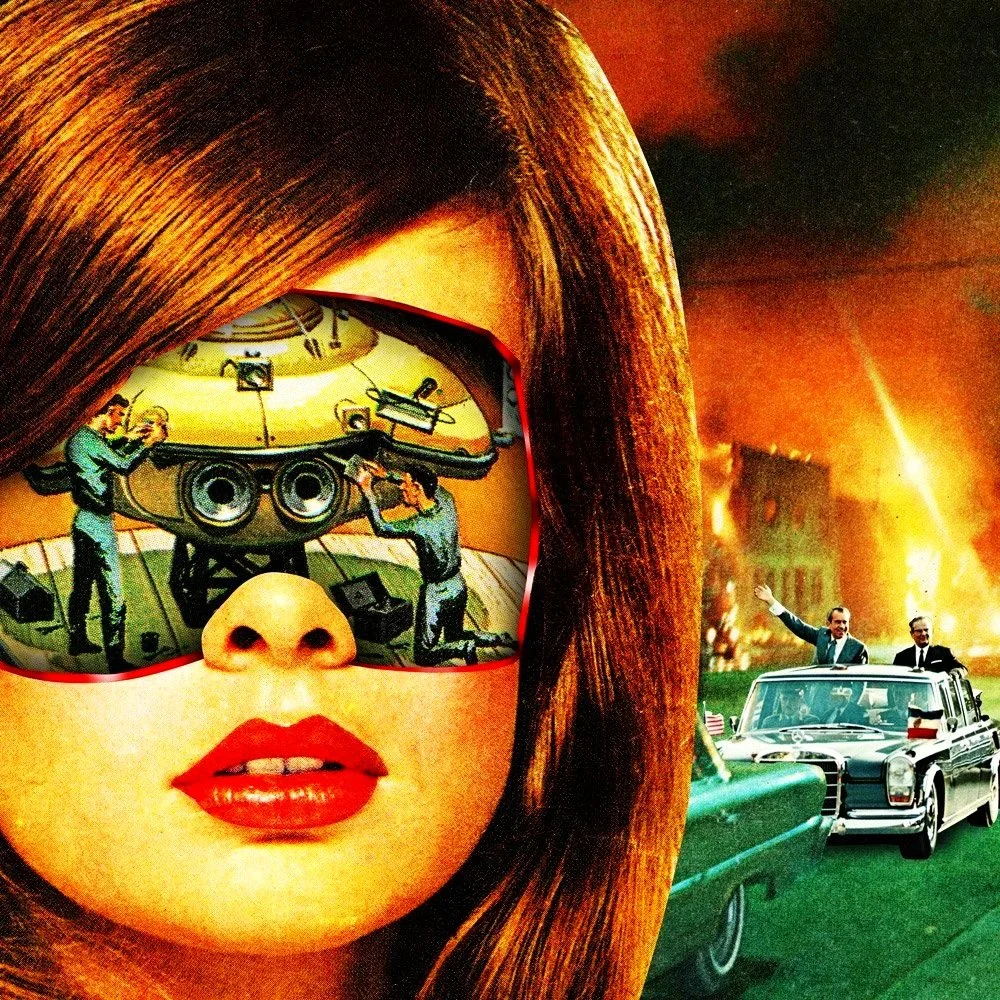

Joan's surreal collages expose the absurdity beneath civilization's carefully maintained surface. Through retro imagery, dark humor, cinematic references, and unexpected visual collisions, she creates worlds in which nostalgia becomes sinister and the familiar turns delightfully strange.
Her work is not merely about destruction.
It is about the elaborate performances we stage to convince ourselves that destruction is happening somewhere else.
The apocalypse, after all, has always been someone else's problem.
Until it isn't.