A Love Letter from Joan
Dear Friend,
I finally discovered the secret to a successful life.
I run every morning. I do yoga. I smile for the camera. I have become exactly the person I hoped to be.
For the sake of efficiency, I even added a crank.It was an excellent idea.
At first, I turned it myself. A quarter turn to be more productive. Another to attract attention. A little more to look happy.
Then it became a habit.
Nowadays, I sometimes hear the mechanism activate on its own.
I am not overly concerned. The most reliable systems are the ones that no longer require supervision.
Besides, I am almost certain there is a stop button somewhere, even though I no longer remember installing it. I just hope I will be able to recognize it when I find it.
Just in case.
Joan
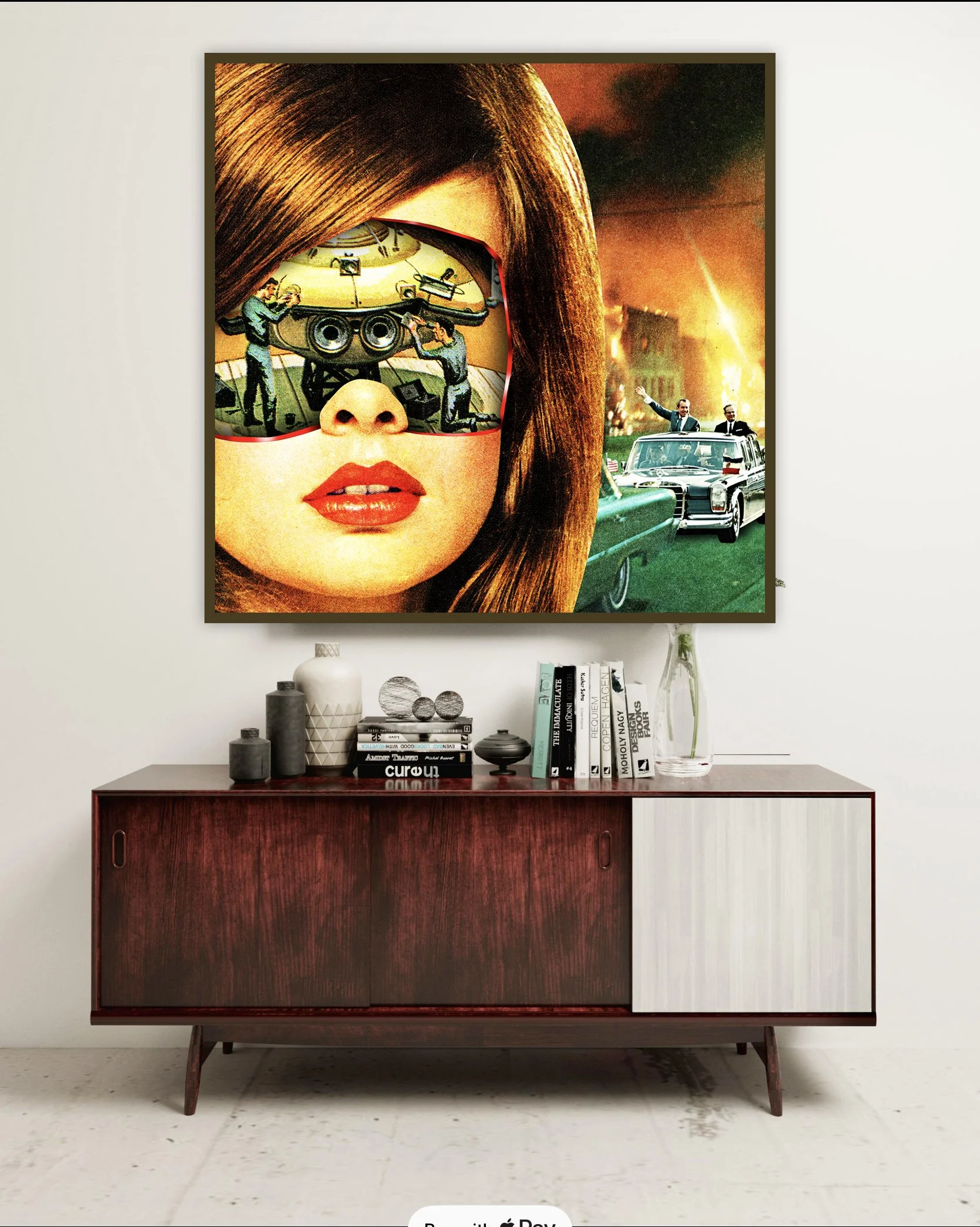
At first glance, The Invisible Minotaur appears to belong to a future imagined by the past. Its retrofuturist aesthetic evokes an era when technological progress promised to solve every problem. Yet the overall impression is one of unease that is difficult to shake.
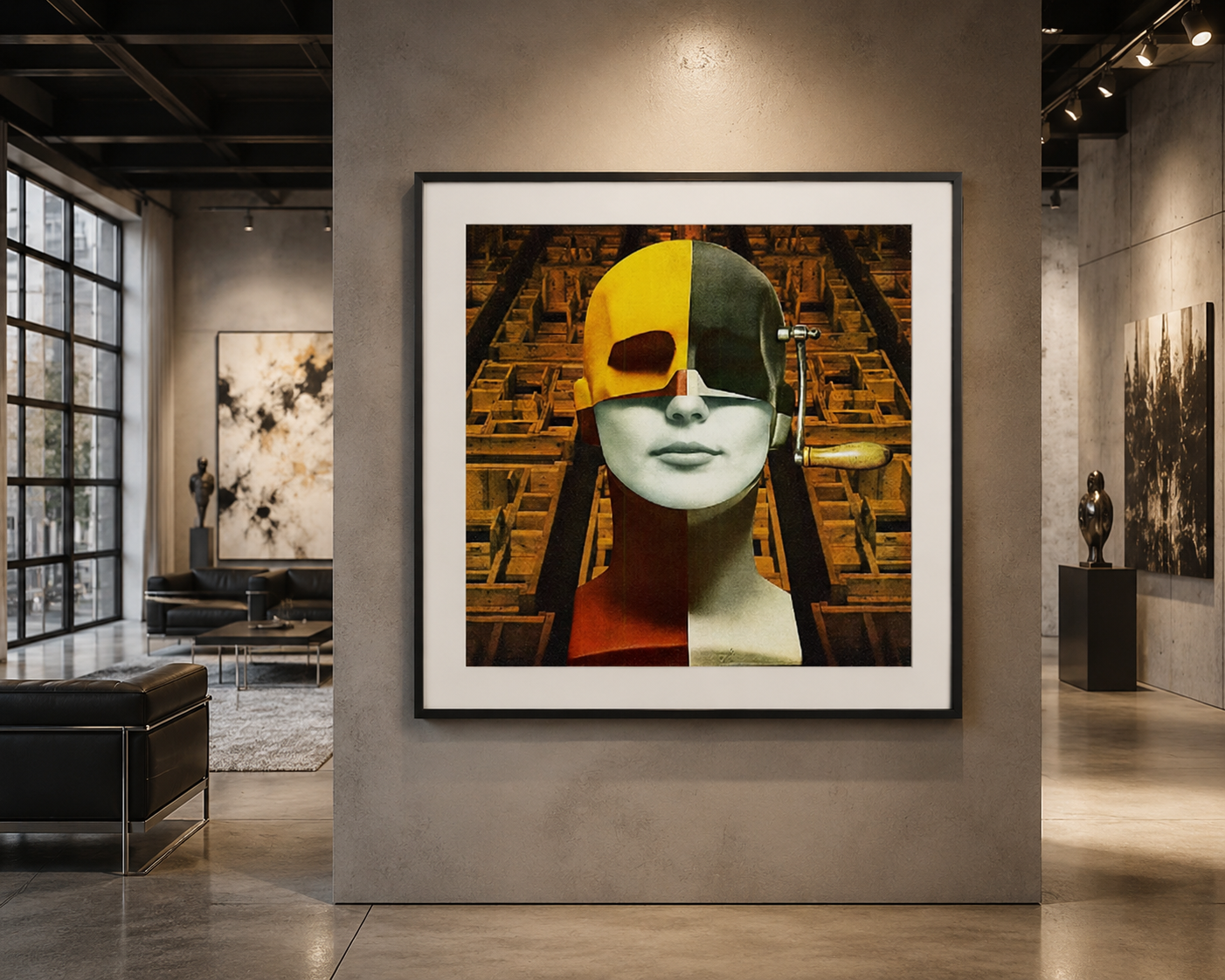
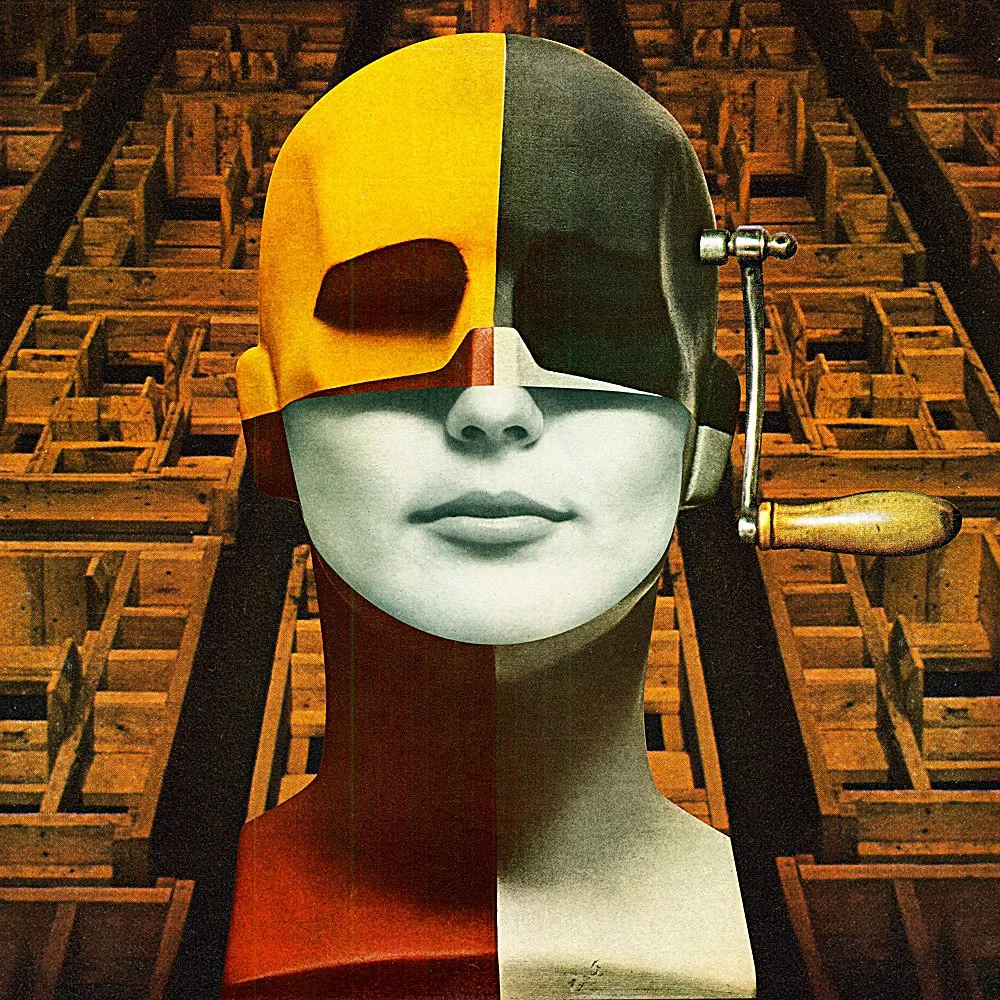
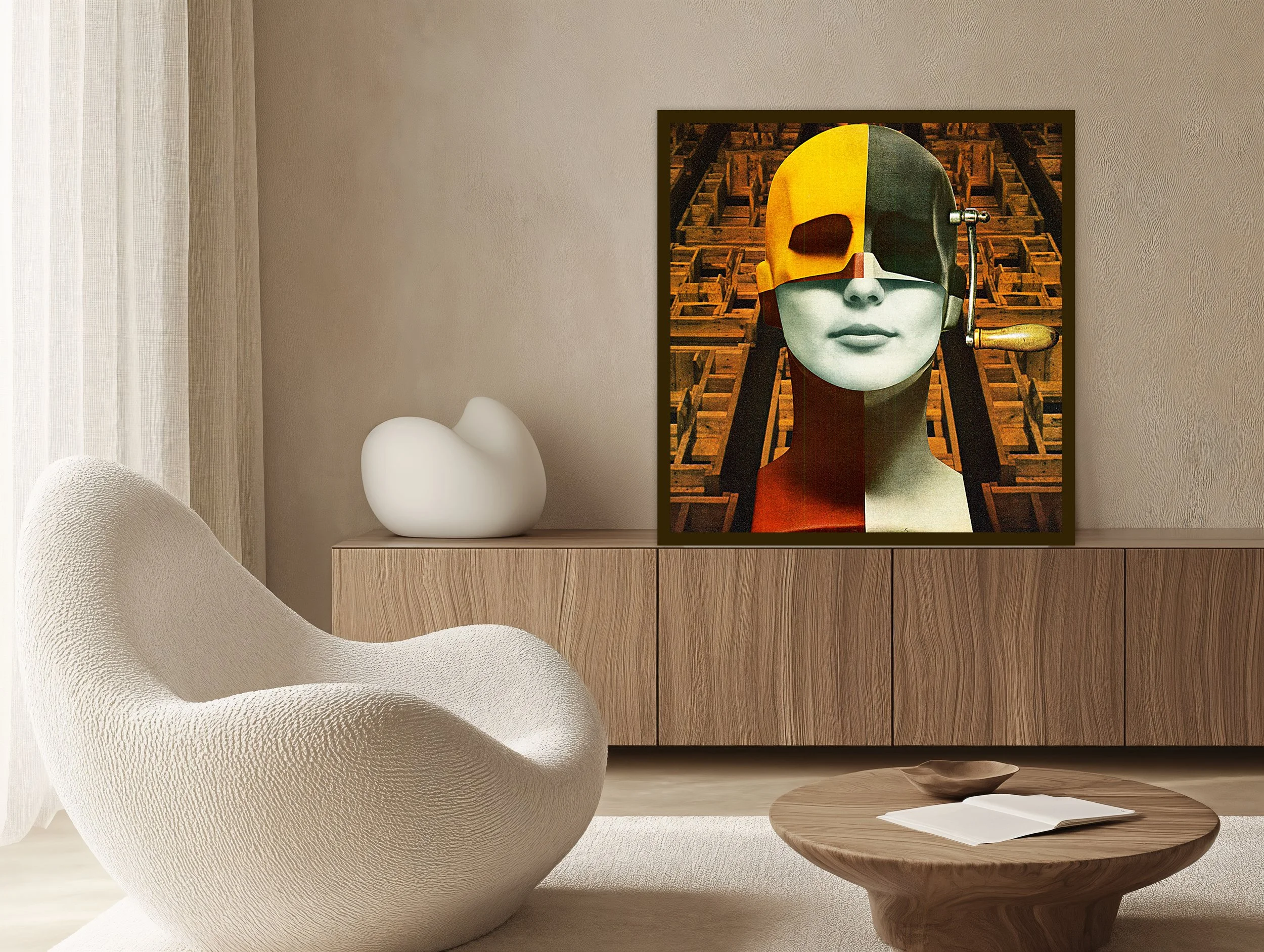
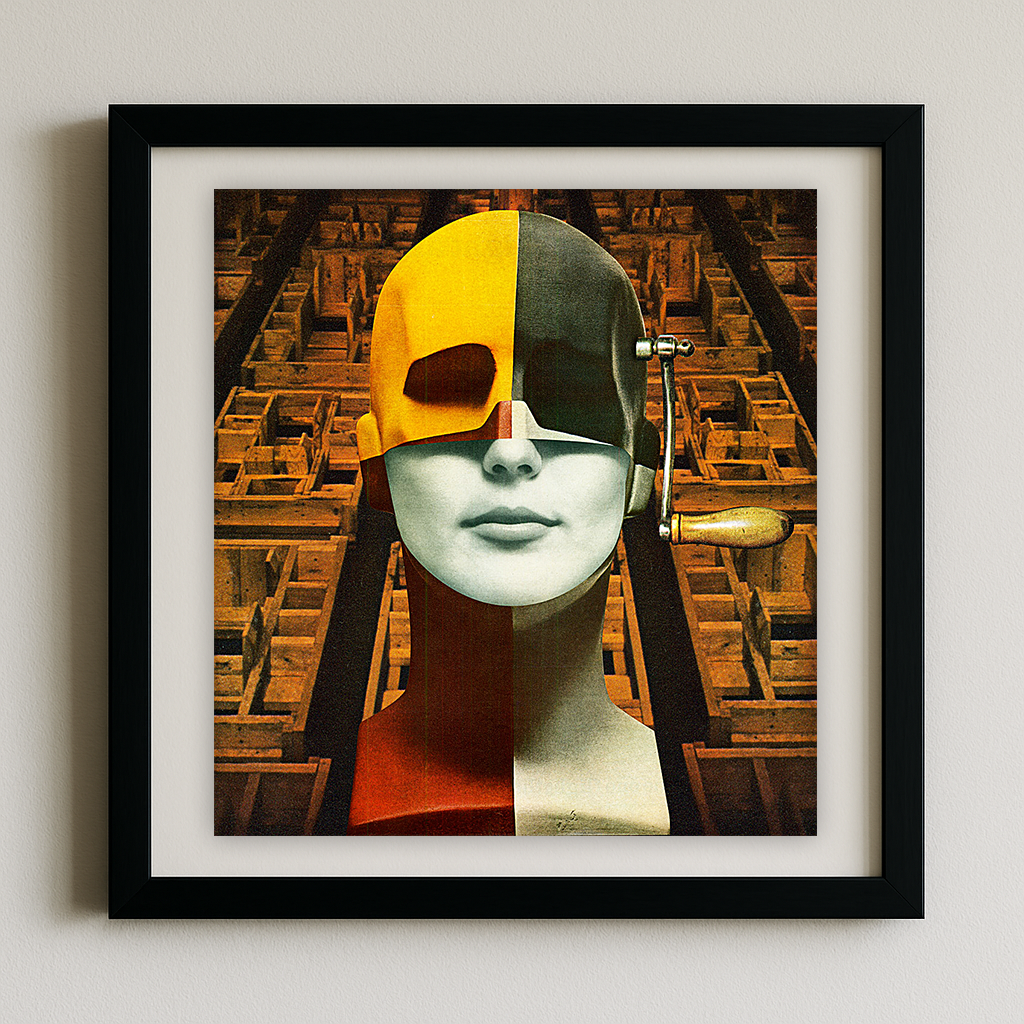
At the center of the composition is a fragmented face that seems designed to function rather than to live. A crank is attached to its head. Behind it stretches a structure whose purpose remains uncertain. Workshop, bureaucratic apparatus, administrative system, or labyrinth: its true nature remains elusive. Nothing opens onto the living world. Nature is absent. Human intimacy is absent as well. All that remains is an architecture of function in which presence seems to gradually dissolve.
This vision recalls concerns that have run through modernity for more than a century. The absurd bureaucracies described by Kafka, the forms of alienation analyzed by Marx, and the society of engineered happiness imagined by Huxley in Brave New World all find a troubling resonance here. In each of these worlds, the danger lies not only in what acts upon us from the outside, but also in the way we come to inhabit the environment these forces help shape.
The work does not merely denounce a system. The crank suggests a more complex reality. The solutions devised to meet our needs and desires can gradually redefine our relationship with ourselves. What was meant to serve us can end up occupying all available space. As this movement intensifies, something is lost: our presence to ourselves, to others, and to the world.
The labyrinth inevitably recalls that of King Minos, with one important difference: the Minotaur remains nowhere to be found. In the myth, the danger was twofold: becoming lost in the labyrinth or falling prey to the Minotaur. Here, the two threats seem to merge. It has neither a face nor a fixed location. Instead, it seems to blend into the entire apparatus. This absence raises an essential question: is the true monster hidden at the heart of the maze, or does it reside in our difficulty recognizing the forces that shape our lives and what we sacrifice to them in return?
This question resonates strongly today in environments where visibility, performance, and attention occupy an ever-growing place. Without belonging to any specific era, The Invisible Minotaur reminds us that the most influential structures are not always the ones that openly constrain us. More often, they are the ones we embrace enthusiastically before forgetting they exist because they come to seem entirely natural.
Perhaps all is not lost. The presence of a crank suggests that a movement has been set in motion, but also that it could be interrupted. Like Ariadne’s thread discreetly hidden within the image, this possibility opens a space for freedom. Escape can sometimes take the form of renewed clarity. For what distances us from ourselves is not always imposed upon us. Recognizing it may already be a way of finding our way again.
— Louis Morency
The Invisible Minotaur belongs to a long tradition of works fascinated by the promises of technological progress. Its retrofuturist aesthetic evokes those moments in the twentieth century when progress seemed capable of solving humanity's greatest challenges.
The geometric stylization of the face recalls certain modernist experiments of the early decades of the last century, particularly those associated with the Bauhaus and its ideal of a society organized according to the principles of reason and function. From modernist optimism to the dystopias imagined by writers such as Aldous Huxley, this faith in systems has inspired both hope and anxiety.
Today, as new forms of automation continue to shape our habits and interactions, these questions remain strikingly relevant. The work reminds us that the most influential forces are not always those that openly constrain us, but often those we embrace enthusiastically. In this reinterpretation of the myth, the danger may no longer be being devoured by the Minotaur, but gradually forgetting what we sacrifice as we venture deeper into the labyrinth.
Title : The Invisible Minotaur
Artist: Joan Seed
Medium: Mixed Media CollageEdition Limited Edition Prints
Hand-Signed & Numbered
Material: Museum-Grade Giclée Print on Archival Textured Cotton Paper
Available Sizes • 30 × 30 inches (76.2 × 76.2 cm)• 60 × 60 inches (152.4 × 152.4 cm)
ShippingFlat Rate Shipping: $175 CAD per order
Inquiries & Acquisitions joan@joanseed.ca
© 2026 Joan Seed. All rights reserved. This artwork and its images may not be reproduced, copied, distributed, or used in any form without the prior written permission of the artist.
A Love Letter from Joan
Dear Friend,
I finally discovered the secret to a successful life.
I run every morning. I do yoga. I smile for the camera. I have become exactly the person I hoped to be.
For the sake of efficiency, I even added a crank.It was an excellent idea.
At first, I turned it myself. A quarter turn to be more productive. Another to attract attention. A little more to look happy.
Then it became a habit.
Nowadays, I sometimes hear the mechanism activate on its own.
I am not overly concerned. The most reliable systems are the ones that no longer require supervision.
Besides, I am almost certain there is a stop button somewhere, even though I no longer remember installing it. I just hope I will be able to recognize it when I find it.
Just in case.
Joan
At first glance, The Invisible Minotaur appears to belong to a future imagined by the past. Its retrofuturist aesthetic evokes an era when technological progress promised to solve every problem. Yet the overall impression is one of unease that is difficult to shake.
At the center of the composition is a fragmented face that seems designed to function rather than to live. A crank is attached to its head. Behind it stretches a structure whose purpose remains uncertain. Workshop, bureaucratic apparatus, administrative system, or labyrinth: its true nature remains elusive. Nothing opens onto the living world. Nature is absent. Human intimacy is absent as well. All that remains is an architecture of function in which presence seems to gradually dissolve.
This vision recalls concerns that have run through modernity for more than a century. The absurd bureaucracies described by Kafka, the forms of alienation analyzed by Marx, and the society of engineered happiness imagined by Huxley in Brave New World all find a troubling resonance here. In each of these worlds, the danger lies not only in what acts upon us from the outside, but also in the way we come to inhabit the environment these forces help shape.
The work does not merely denounce a system. The crank suggests a more complex reality. The solutions devised to meet our needs and desires can gradually redefine our relationship with ourselves. What was meant to serve us can end up occupying all available space. As this movement intensifies, something is lost: our presence to ourselves, to others, and to the world.
The labyrinth inevitably recalls that of King Minos, with one important difference: the Minotaur remains nowhere to be found. In the myth, the danger was twofold: becoming lost in the labyrinth or falling prey to the Minotaur. Here, the two threats seem to merge. It has neither a face nor a fixed location. Instead, it seems to blend into the entire apparatus. This absence raises an essential question: is the true monster hidden at the heart of the maze, or does it reside in our difficulty recognizing the forces that shape our lives and what we sacrifice to them in return?
This question resonates strongly today in environments where visibility, performance, and attention occupy an ever-growing place. Without belonging to any specific era, The Invisible Minotaur reminds us that the most influential structures are not always the ones that openly constrain us. More often, they are the ones we embrace enthusiastically before forgetting they exist because they come to seem entirely natural.
Perhaps all is not lost. The presence of a crank suggests that a movement has been set in motion, but also that it could be interrupted. Like Ariadne’s thread discreetly hidden within the image, this possibility opens a space for freedom. Escape can sometimes take the form of renewed clarity. For what distances us from ourselves is not always imposed upon us. Recognizing it may already be a way of finding our way again.
— Louis Morency
The Invisible Minotaur belongs to a long tradition of works fascinated by the promises of technological progress. Its retrofuturist aesthetic evokes those moments in the twentieth century when progress seemed capable of solving humanity's greatest challenges.
The geometric stylization of the face recalls certain modernist experiments of the early decades of the last century, particularly those associated with the Bauhaus and its ideal of a society organized according to the principles of reason and function. From modernist optimism to the dystopias imagined by writers such as Aldous Huxley, this faith in systems has inspired both hope and anxiety.
Today, as new forms of automation continue to shape our habits and interactions, these questions remain strikingly relevant. The work reminds us that the most influential forces are not always those that openly constrain us, but often those we embrace enthusiastically. In this reinterpretation of the myth, the danger may no longer be being devoured by the Minotaur, but gradually forgetting what we sacrifice as we venture deeper into the labyrinth.
Title : The Invisible Minotaur
Artist: Joan Seed
Medium: Mixed Media CollageEdition Limited Edition Prints
Hand-Signed & Numbered
Material: Museum-Grade Giclée Print on Archival Textured Cotton Paper
Available Sizes • 30 × 30 inches (76.2 × 76.2 cm)• 60 × 60 inches (152.4 × 152.4 cm)
ShippingFlat Rate Shipping: $175 CAD per order
Inquiries & Acquisitions joan@joanseed.ca
© 2026 Joan Seed. All rights reserved. This artwork and its images may not be reproduced, copied, distributed, or used in any form without the prior written permission of the artist.