The Convergence of Elsewheres
A Letter from Joan:
My dear,
We can sleep soundly: the world still has excellent hotels, even if their martinis do not always rise to the occasion.
You and I have always had a taste for adventure and the good sense to impose a few conditions on it: coffee capable of making the morning fit for company, a pillow worthy of the name, and a sunset well-bred enough to flatter our complexions. A change of scenery is delightful, provided the scenery doesn’t change too much.
Some people claim to travel in order to find themselves. Personally, I prefer not to lose myself in the first place. It’s less risky.
I sent my itinerary to our dear supporting cast. They were relieved to find exactly what they had expected, and I confess I was too. We certainly wouldn’t want to miss what everyone else has already seen. How else could we pass for pioneers in the eyes of those who follow us?
So we followed the plan to the letter. Of course, our planes all ended up converging on the same destination. They call that a collision. I prefer to see it as remarkable choreography.
Kisses from every direction at once,
Joan
A Closer Look
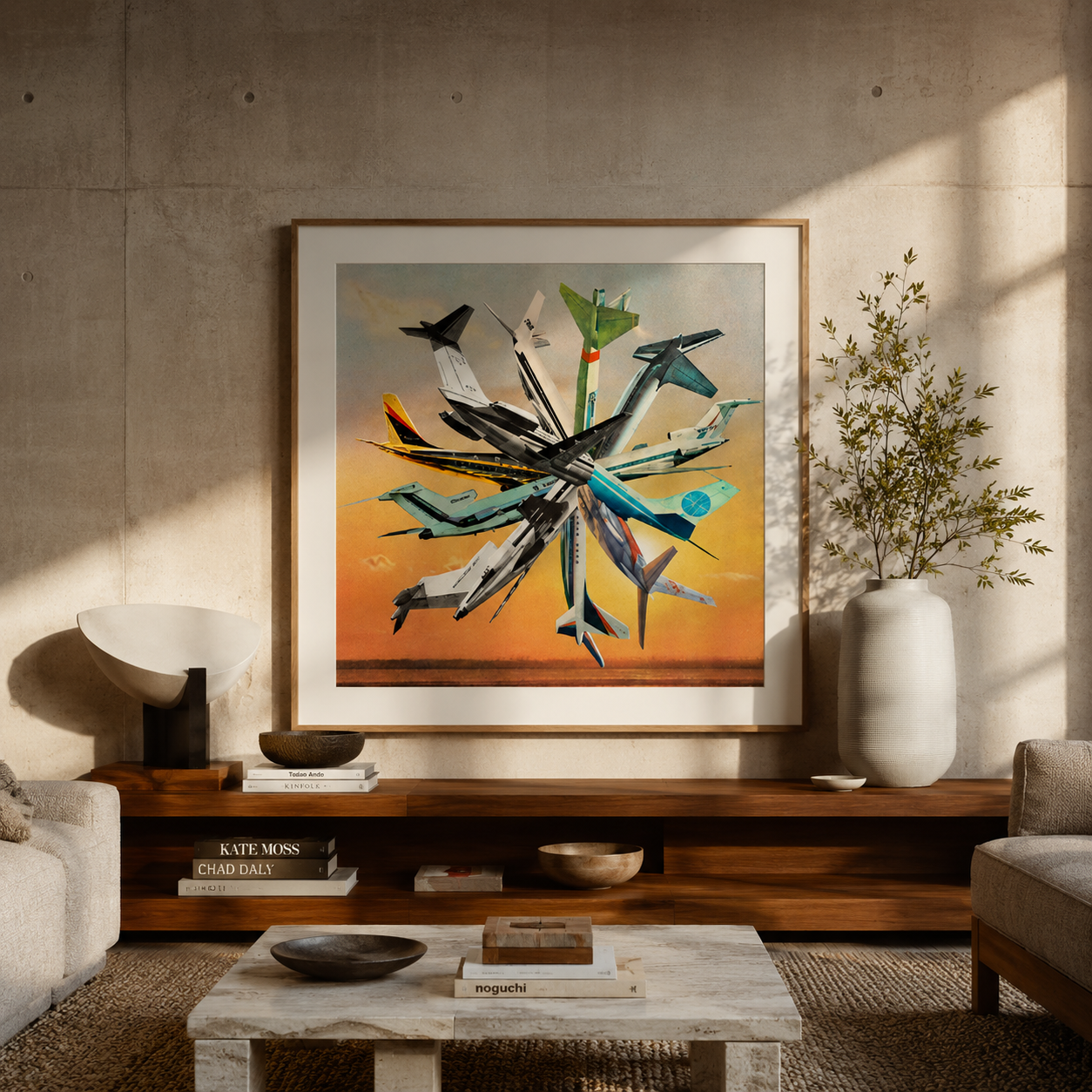
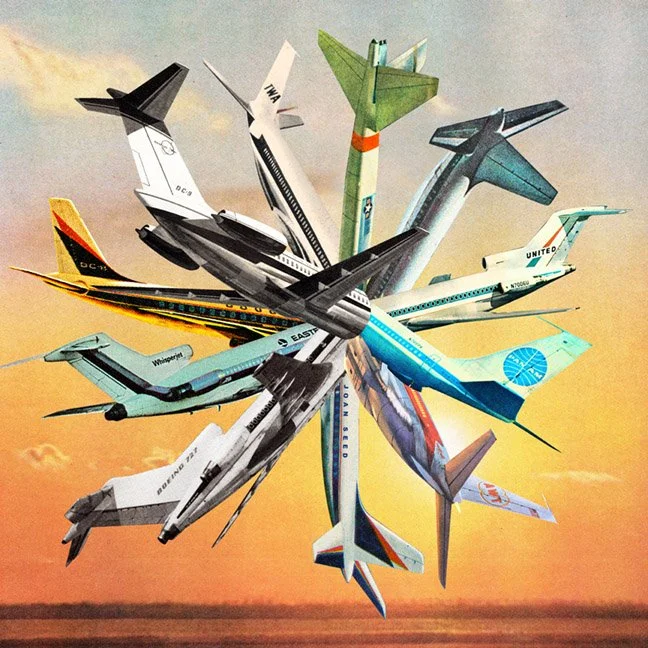
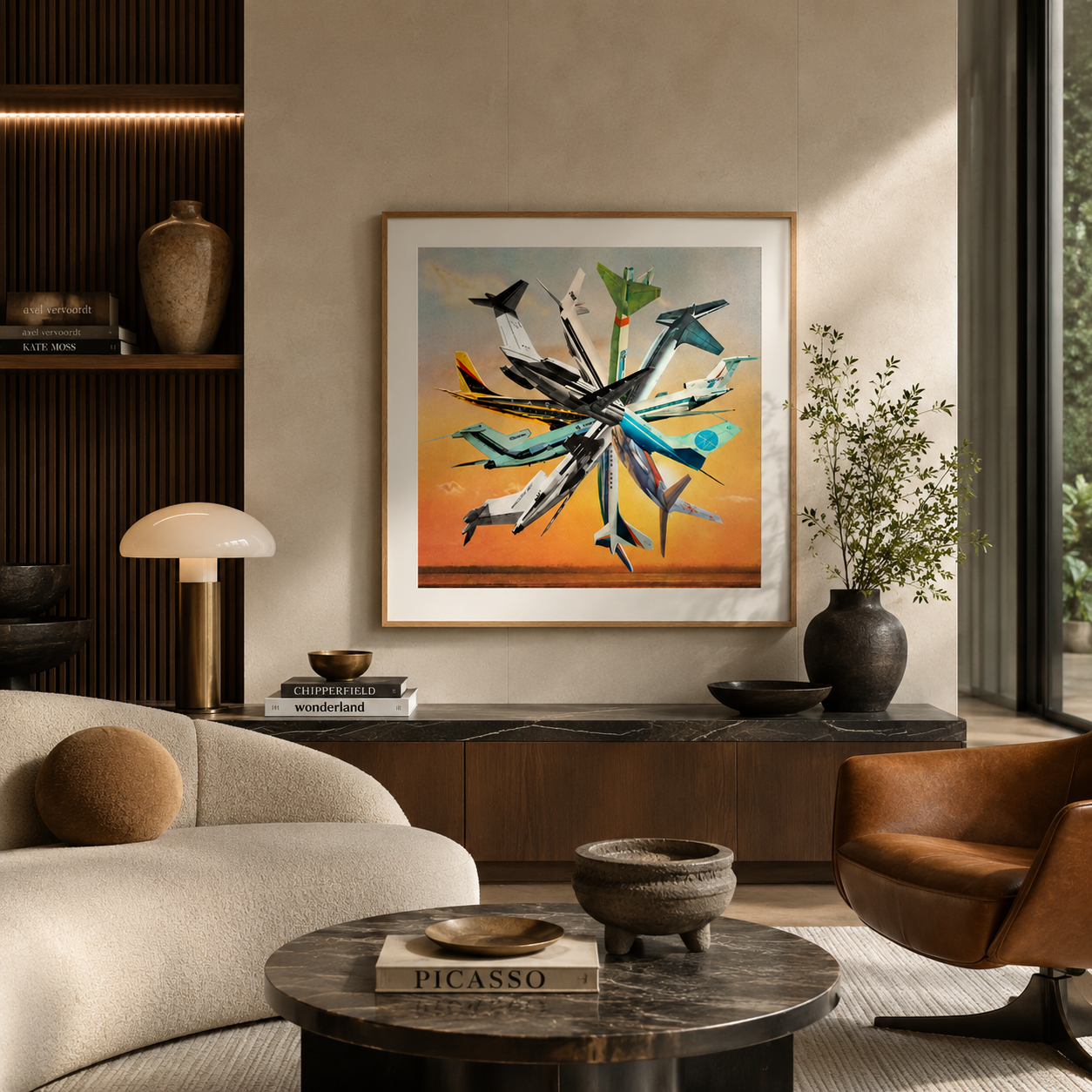
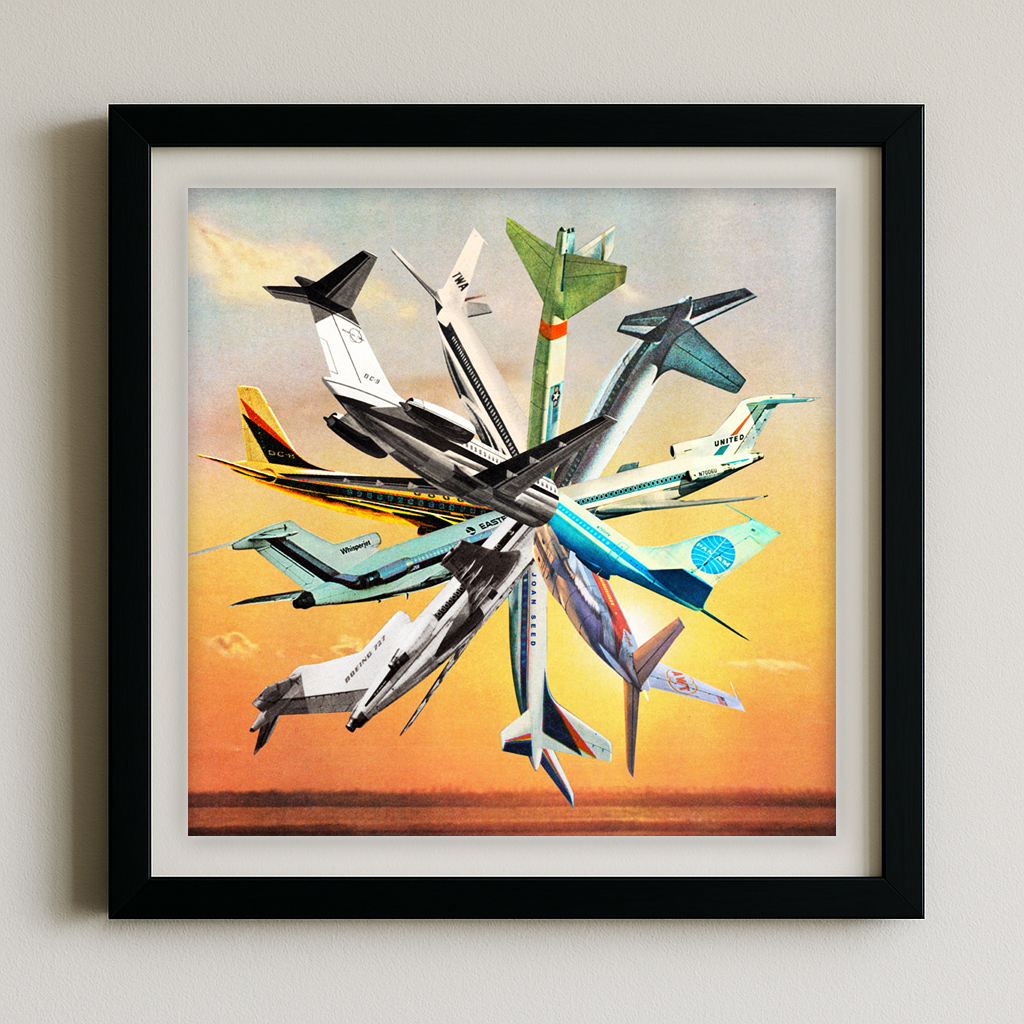
The title announces a collision whose impact the image holds in suspension: against a yellow sky, airliners converge on a single point, their tails fanned out around the edges. Every plane has lost its nose to the collage’s cut edges. From this arrested impact emerges a strangely ordered figure, somewhere between a wheel, a flower, and a mandala. Still recognizable around the perimeter, the planes blur their individual identities at the center.
The warm tones evoke both the sunset of a vintage airline advertisement and skies tinted by the smoke of wildfires whose growing scale and frequency lend these colors a new gravity. Air travel has broadened our access to the world, and every flight may answer a dream or a necessity. Yet the work seems to remind us that the accumulation of air travel belongs to a system whose effects, including climate change and the overcrowding of the most heavily visited places, extend beyond individual intentions.
This shared center evokes a particular way of consuming elsewhere: the same places become must-see destinations because the same images and lists circulate everywhere. It can then be tempting to measure the success of a journey by the expected images it produces, such as selfies taken against backdrops selected in advance. Not every journey needs to transform us. Some are meant for rest, for the pleasure of returning to a beloved place, or for preserving a few images. Others open us to discovery—of a place, another way of being, an aspect of ourselves, or someone we thought we already knew. Even so, one question remains: when an experience is shaped entirely by prepackaged expectations, what room is left for discovery, or for anything that does not already mirror us?
When we ask accumulation alone to feed our desire for elsewhere, we risk returning to where we began with the deceptive fullness of empty calories: sated with images, yet still hungry for elsewhere.
The form of the mandala opens another path. For Carl Gustav Jung, the mandala could represent the Self, an inner wholeness larger than the ego, and the path leading toward it. From this perspective, the planes would no longer converge solely on an experience made uniform everywhere. They would also trace different routes toward an inner center, itself transformed by what was encountered along the way.
We can travel again and again without ever allowing ourselves to be moved. By contrast, encounters with other practices, ways of life, or ways of thinking can shift our perspective and teach us something about ourselves. The collision announced by the title then becomes the possibility of a productive shock, in which differences meet without erasing one another.
This receptiveness runs through a centuries-old tradition of travel writing. In The Way of the World, Swiss writer and traveler Nicolas Bouvier gives it form through a road that acts upon the traveler and tests his certainties.
Reading, too, can become a form of travel. Without moving the body, it exposes us to other lives and other ways of thinking while offering a more modest way of going elsewhere. Whatever language it speaks, a work can in turn open onto a territory of discovery. To approach it in this spirit is not to extract a definitive message from it, but to enter its garden, follow a few of its paths, and accept that some may disorient us.
This willingness to remain open lay at the heart of the approach taken by Sister Wendy Beckett, the art historian known for the programs she presented on the BBC. She invited viewers not to impose their own conditions or labels in advance, and to loosen the defenses of the ego. A work can then unsettle us and shake some of our certainties, opening a space for exploration in which another person’s vision leads us back, by a different route, to our own truth.
At the heart of Airplane Collision, the point of impact becomes a threshold. The work invites us to consider what our journeys produce in the world, as well as what they allow into us. The distance traveled does not always measure the magnitude of the journey. Sometimes an encounter transforms the way we see, leaving us more curious and ready to marvel at what we would never have thought to seek.
-Louis Morency
Context
In Airplane Collision, Joan Seed brings together vintage airliners whose fuselages converge on a central point against a yellow-orange sky. Their noses disappear into the collage’s cut edges while their tails fan out around the perimeter, creating a radial composition that evokes at once a mandala, a suspended ballet, and a midair collision. Through found images, shifts in scale, and improbable juxtapositions, this retrofuturist digital collage enters into dialogue with the traditions of Dada photomontage and Surrealist collage. Its repurposing of twentieth-century advertising and technological imagery also recalls certain strategies of Pop Art.
The aircraft in the work embody the modern promise of rapid mobility and access to the world. Their accumulation also brings the contradictions of commercial aviation and mass tourism into view. Their convergence on a single point evokes standardized itineraries and the overtourism that overwhelms destinations made unmissable by the global circulation of images. Beneath a sky colored as if by smoke, Airplane Collision opens an ecocritical reading of travel, in which the desire for elsewhere meets the environmental impact of air travel, greenhouse gas emissions, and landscapes marked by climate change and wildfires.
Artwork Details
Title: Airplane Collision
Artist: Joan Seed
Medium: Mixed Media Collage
Limited edition prints, hand-signed and numbered
Material: Museum-grade giclée print on archival, textured cotton paper
Size Options:
• 30 × 30 inches (76.2 × 76.2 cm)
• 60 × 60 inches (152.4 × 152.4 cm)
Shipping: Flat rate of $175 CAD per order.
For acquisitions, inquiries, and commissions: joan@joanseed.ca
© 2026 Joan Seed. All rights reserved. This artwork and its images may not be reproduced, copied, distributed, or used in any form without the prior written permission of the artist.
The Convergence of Elsewheres
A Letter from Joan:
My dear,
We can sleep soundly: the world still has excellent hotels, even if their martinis do not always rise to the occasion.
You and I have always had a taste for adventure and the good sense to impose a few conditions on it: coffee capable of making the morning fit for company, a pillow worthy of the name, and a sunset well-bred enough to flatter our complexions. A change of scenery is delightful, provided the scenery doesn’t change too much.
Some people claim to travel in order to find themselves. Personally, I prefer not to lose myself in the first place. It’s less risky.
I sent my itinerary to our dear supporting cast. They were relieved to find exactly what they had expected, and I confess I was too. We certainly wouldn’t want to miss what everyone else has already seen. How else could we pass for pioneers in the eyes of those who follow us?
So we followed the plan to the letter. Of course, our planes all ended up converging on the same destination. They call that a collision. I prefer to see it as remarkable choreography.
Kisses from every direction at once,
Joan
A Closer Look
The title announces a collision whose impact the image holds in suspension: against a yellow sky, airliners converge on a single point, their tails fanned out around the edges. Every plane has lost its nose to the collage’s cut edges. From this arrested impact emerges a strangely ordered figure, somewhere between a wheel, a flower, and a mandala. Still recognizable around the perimeter, the planes blur their individual identities at the center.
The warm tones evoke both the sunset of a vintage airline advertisement and skies tinted by the smoke of wildfires whose growing scale and frequency lend these colors a new gravity. Air travel has broadened our access to the world, and every flight may answer a dream or a necessity. Yet the work seems to remind us that the accumulation of air travel belongs to a system whose effects, including climate change and the overcrowding of the most heavily visited places, extend beyond individual intentions.
This shared center evokes a particular way of consuming elsewhere: the same places become must-see destinations because the same images and lists circulate everywhere. It can then be tempting to measure the success of a journey by the expected images it produces, such as selfies taken against backdrops selected in advance. Not every journey needs to transform us. Some are meant for rest, for the pleasure of returning to a beloved place, or for preserving a few images. Others open us to discovery—of a place, another way of being, an aspect of ourselves, or someone we thought we already knew. Even so, one question remains: when an experience is shaped entirely by prepackaged expectations, what room is left for discovery, or for anything that does not already mirror us?
When we ask accumulation alone to feed our desire for elsewhere, we risk returning to where we began with the deceptive fullness of empty calories: sated with images, yet still hungry for elsewhere.
The form of the mandala opens another path. For Carl Gustav Jung, the mandala could represent the Self, an inner wholeness larger than the ego, and the path leading toward it. From this perspective, the planes would no longer converge solely on an experience made uniform everywhere. They would also trace different routes toward an inner center, itself transformed by what was encountered along the way.
We can travel again and again without ever allowing ourselves to be moved. By contrast, encounters with other practices, ways of life, or ways of thinking can shift our perspective and teach us something about ourselves. The collision announced by the title then becomes the possibility of a productive shock, in which differences meet without erasing one another.
This receptiveness runs through a centuries-old tradition of travel writing. In The Way of the World, Swiss writer and traveler Nicolas Bouvier gives it form through a road that acts upon the traveler and tests his certainties.
Reading, too, can become a form of travel. Without moving the body, it exposes us to other lives and other ways of thinking while offering a more modest way of going elsewhere. Whatever language it speaks, a work can in turn open onto a territory of discovery. To approach it in this spirit is not to extract a definitive message from it, but to enter its garden, follow a few of its paths, and accept that some may disorient us.
This willingness to remain open lay at the heart of the approach taken by Sister Wendy Beckett, the art historian known for the programs she presented on the BBC. She invited viewers not to impose their own conditions or labels in advance, and to loosen the defenses of the ego. A work can then unsettle us and shake some of our certainties, opening a space for exploration in which another person’s vision leads us back, by a different route, to our own truth.
At the heart of Airplane Collision, the point of impact becomes a threshold. The work invites us to consider what our journeys produce in the world, as well as what they allow into us. The distance traveled does not always measure the magnitude of the journey. Sometimes an encounter transforms the way we see, leaving us more curious and ready to marvel at what we would never have thought to seek.
-Louis Morency
Context
In Airplane Collision, Joan Seed brings together vintage airliners whose fuselages converge on a central point against a yellow-orange sky. Their noses disappear into the collage’s cut edges while their tails fan out around the perimeter, creating a radial composition that evokes at once a mandala, a suspended ballet, and a midair collision. Through found images, shifts in scale, and improbable juxtapositions, this retrofuturist digital collage enters into dialogue with the traditions of Dada photomontage and Surrealist collage. Its repurposing of twentieth-century advertising and technological imagery also recalls certain strategies of Pop Art.
The aircraft in the work embody the modern promise of rapid mobility and access to the world. Their accumulation also brings the contradictions of commercial aviation and mass tourism into view. Their convergence on a single point evokes standardized itineraries and the overtourism that overwhelms destinations made unmissable by the global circulation of images. Beneath a sky colored as if by smoke, Airplane Collision opens an ecocritical reading of travel, in which the desire for elsewhere meets the environmental impact of air travel, greenhouse gas emissions, and landscapes marked by climate change and wildfires.
Artwork Details
Title: Airplane Collision
Artist: Joan Seed
Medium: Mixed Media Collage
Limited edition prints, hand-signed and numbered
Material: Museum-grade giclée print on archival, textured cotton paper
Size Options:
• 30 × 30 inches (76.2 × 76.2 cm)
• 60 × 60 inches (152.4 × 152.4 cm)
Shipping: Flat rate of $175 CAD per order.
For acquisitions, inquiries, and commissions: joan@joanseed.ca
© 2026 Joan Seed. All rights reserved. This artwork and its images may not be reproduced, copied, distributed, or used in any form without the prior written permission of the artist.