Limited edition fine art prints.
A letter from joan
My dear,
I’m writing to you from a carnival planted in the middle of the plains, somewhere between Iowa City and the end of the world. The storm has turned the sky into a swamp of sickly green water. And the fortune teller’s cards have blown away... along with the strongman’s dignity, for that matter.
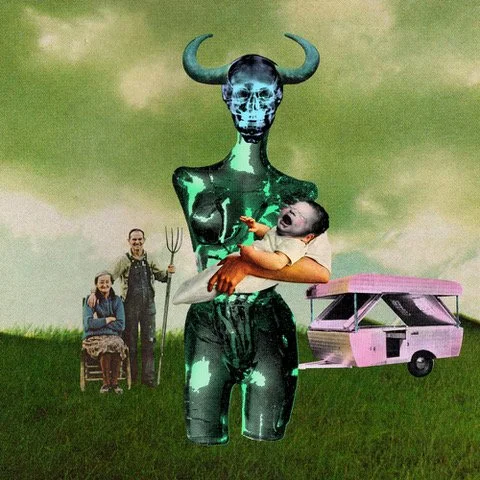
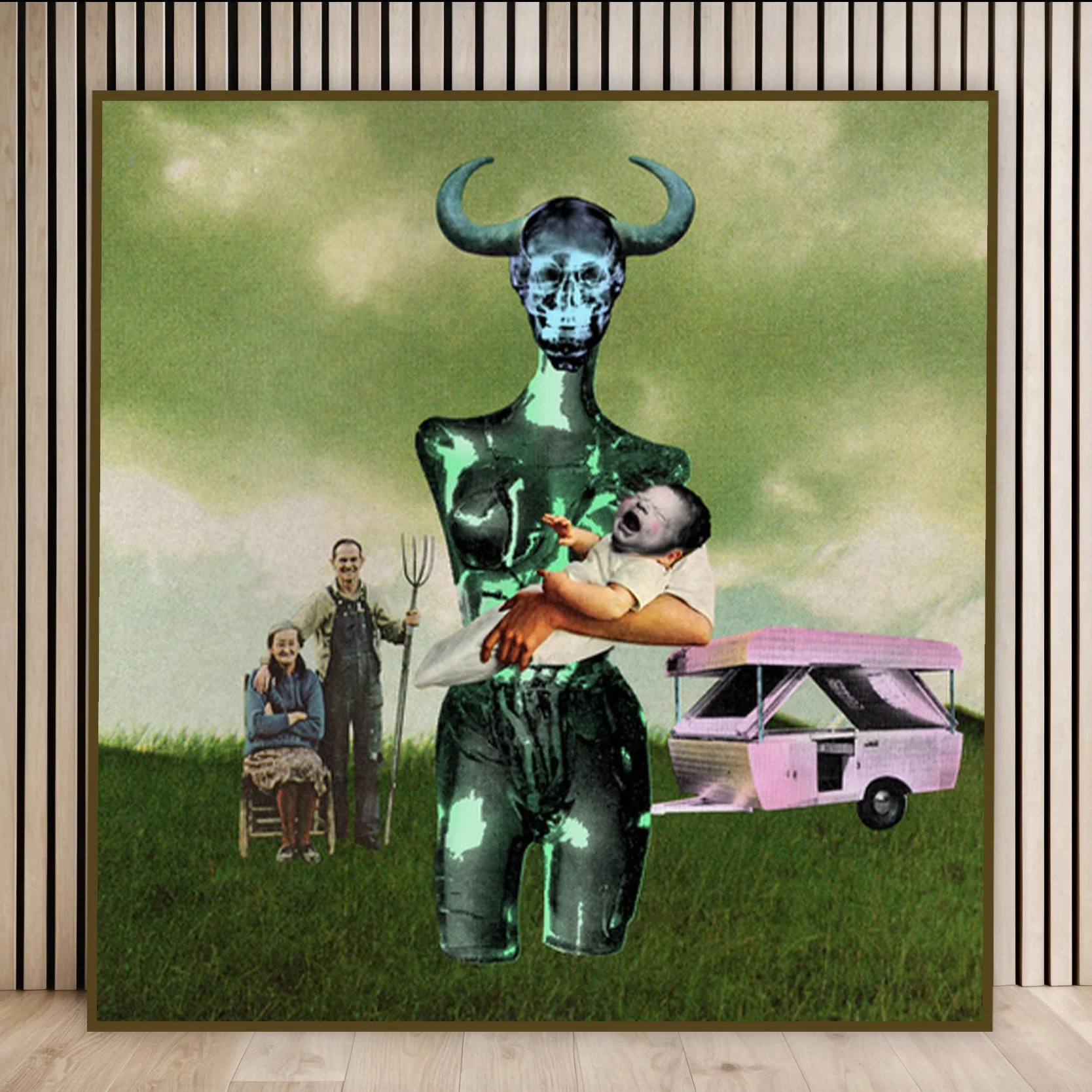
We took shelter in a candy-pink trailer, as fresh as my grandfather’s peppermints. A horned woman was rocking a baby under the disapproving gaze of a very proper couple. The man was holding a pitchfork, no doubt to put the child at ease. The lady advised me to beware of unnatural creatures. I didn’t ask which ones.
While I wait for the rain to stop, I’m going to head over to the bearded lady’s bar. I hear she serves a passable whiskey without measuring it too carefully, asking questions, or offering unsolicited advice. In other words, I love her already.
Joan
A CLOSER LOOK
When Fear Finds Its Target, or The Making of a Monster
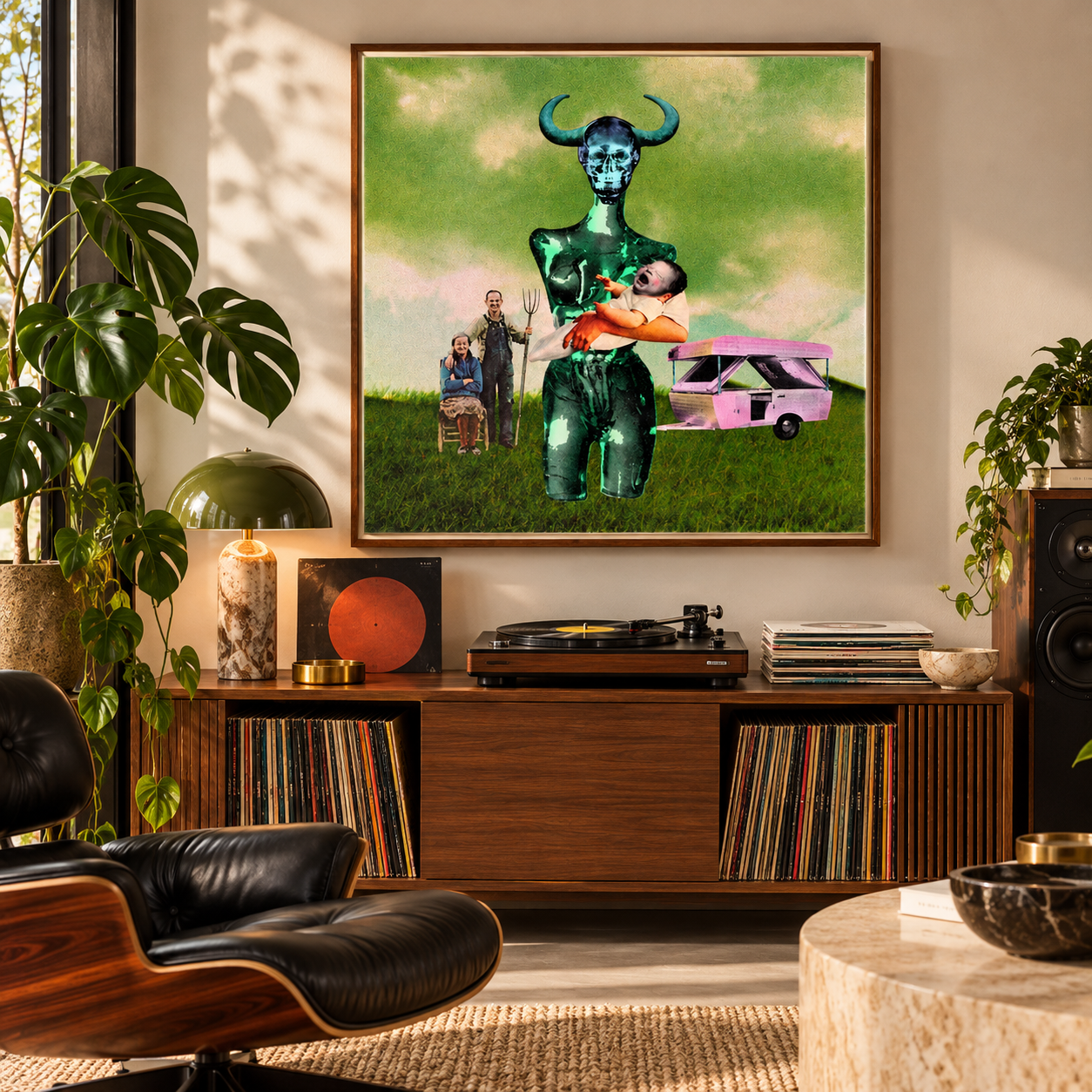
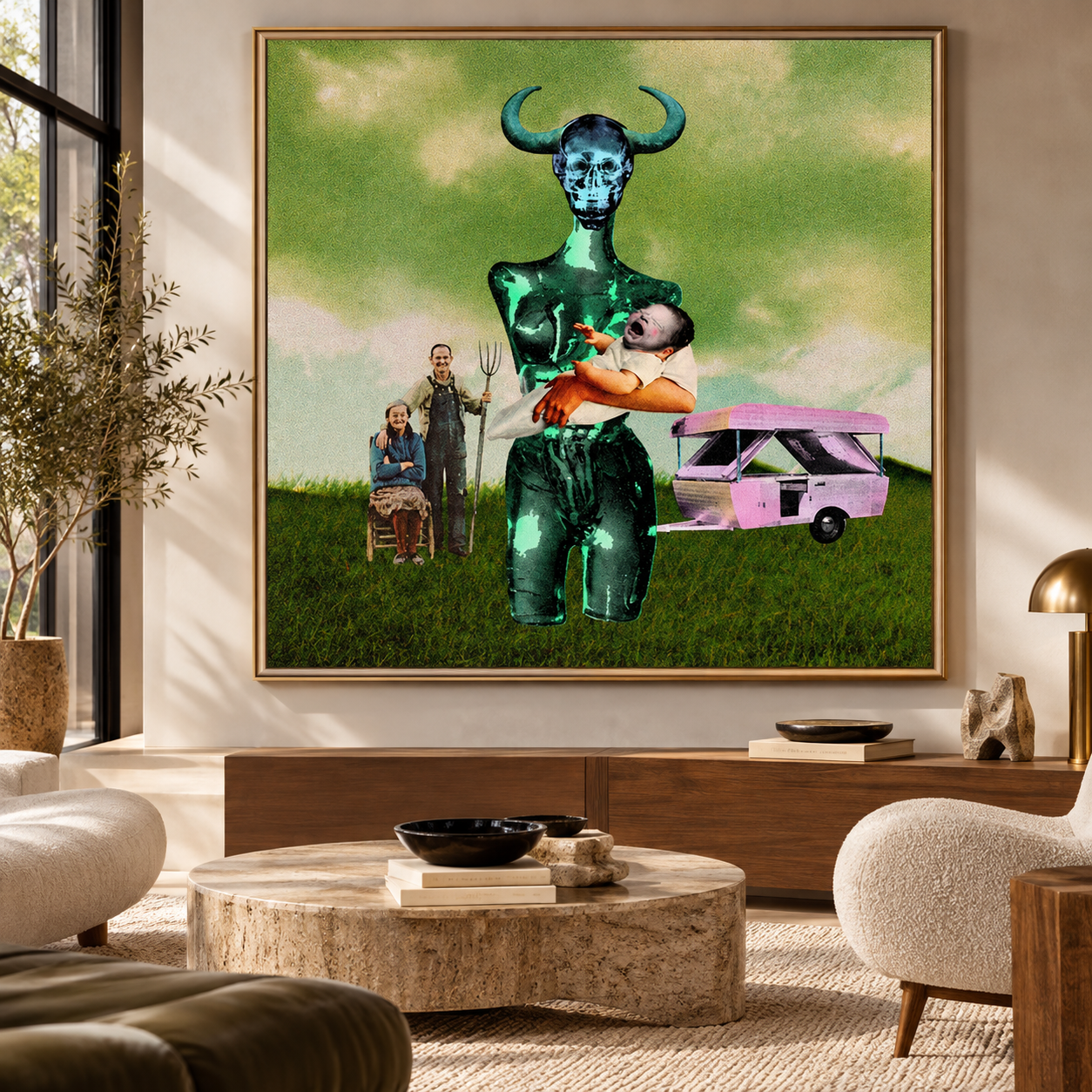
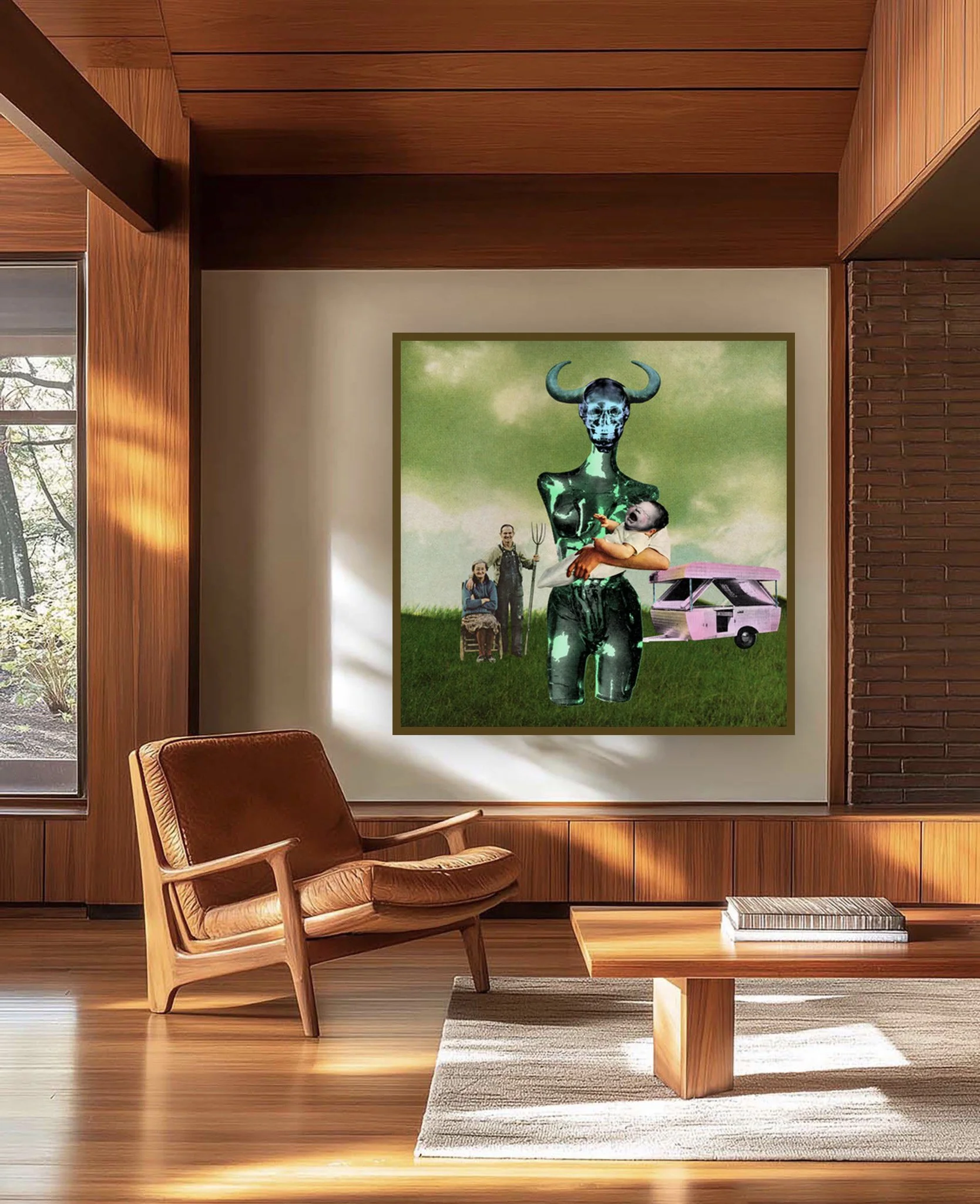
In American Gothic 2, Joan Seed sets a rural scene beneath a sky where greenish clouds suggest a miasma. An elderly couple occupies the left side of the image, isolated amid a vast expanse of grass: the woman is seated, while the man stands behind her holding a pitchfork. On the right, an uninviting pink pop-up camper appears deserted. In the foreground, a strange, outsized figure dominates the landscape. The figure’s legs end above the knees, and one arm is missing as well. The remaining arm, more human in appearance, holds a crying baby. Two inward-curving horns frame an X-ray image of a skull in place of a face. The child’s rosy cheeks strangely echo the camper’s colour. Pink and green create an almost Easter-like palette, though here it takes on an ominous cast. The child’s open mouth disturbs the silence of the scene.
The man with the pitchfork and the seated woman recall American Gothic, created in 1930 by American painter Grant Wood (1891–1942). For the work that would become an American national icon, Wood drew inspiration from a house in Eldon, Iowa, a Midwestern state shaped by its prairies and agriculture. Joan’s grassy expanse naturally extends this horizon. In the original painting, a farmer and his daughter pose in front of a Carpenter Gothic house. After slightly transforming the pair, Joan pushes them to one side and replaces the house with a home on wheels. The Gothic moves out of the architecture and into the atmosphere. The number 2 makes this reworking feel like a cinematic sequel. The setting remains recognisable; the scene itself descends into horror.
The plains and the camper also recall Carnivàle, an HBO series set in the Dust Bowl of the 1930s. Its travelling carnival brought together performers presented as human curiosities in sideshow attractions. They could find a community there while remaining exposed to an audience that came to gauge their difference. The series dramatises a struggle between Light and Darkness. Yet the Creature of Darkness appears in the form of Brother Justin, a charismatic preacher, while the people exhibited as “freaks” are not the ones who embody evil. This reversal shifts the threat towards the seemingly respectable figure. Frontal and outsized, the figure Joan places in the foreground is similarly put on display as an attraction. The image makes us part of the audience before we even begin to question what we are seeing.
The silhouette comes from Bluebeard’s Wife, a 1969 work by Arman (1928–2005), born Armand Fernandez. The French-American artist embedded shaving items in a transparent female torso, following the principle of his “accumulations.” Joan transforms this shell, adds an X-rayed face and horns, then superimposes the image of a cradled child on its body. In Arman’s work, the contents remain visible through the transparent surface; in Joan’s collage, they become harder to discern. That logic of filling continues on another level. The silhouette becomes a vessel in which signs accumulate before our gaze fills it with a narrative.
This is when the figure of Moloch emerges from the distant past. In certain biblical texts of ancient Israel, the name is associated with child offerings condemned as abominable. Later traditions turned Moloch into a monstrous idol, sometimes given bovine features and said to receive newborns as sacrifices It remains unclear what the name “Moloch” denoted in antiquity; its symbolic power, however, lies precisely in the monstrous figure constructed by later traditions. In biblical polemic and its afterlife, Moloch gives a terrifying face to practices attributed to neighbouring peoples and helps draw a boundary between a community and those it casts outside its moral order.
When we look at Joan’s work, we may unwittingly repeat the same gesture. In troubled times, a community may be tempted to stigmatise the Other by treating it as the source of a diffuse threat. The scene’s sinister atmosphere leaves us vulnerable to the same reflex. We connect the horns, the skull and the baby’s cries, then almost immediately cast the central figure as the source of the threat. Yet the human arm holds the child securely, and nothing in the central figure’s demeanour confirms our suspicion. Does its difference alone persuade us that the figure is to be feared? Do the baby’s cries express a particular terror, or simply the ordinary needs of an infant?
In American Gothic 2, Joan may shift the question away from the monster’s identity and towards the process by which it is made. A collective identity sometimes consolidates itself in much the same way, filling whatever it regards as foreign with its own fears. Collage makes this mechanism visible: we assemble the fragments, lend them coherence, then forget that the face taking shape before us bears, above all, our own signature.
-Louis Morency
CONTEXT
Few images in American art have had an afterlife comparable to Grant Wood’s American Gothic (1930). Its frontal composition, pitchfork, and Carpenter Gothic house have formed a recognizable visual formula for decades, repeatedly reworked in caricatures and parodies. The number 2 places Joan Seed’s contemporary collage within this history of reinterpretation while also nodding to horror’s tradition of numbered sequels, familiar from franchises such as Scream and Halloween.
Joan drew in part on the world of Carnivàle, an HBO series about a traveling carnival crossing the Dust Bowl in 1934, and on Bluebeard’s Wife (1969) by Franco-American artist Arman. A leading figure of Nouveau Réalisme, Arman placed manufactured objects at the heart of his practice; his “accumulations” brought together numerous objects of the same kind. Carnivàle evokes the ambivalent history of performances staged on the margins of circuses, often known at the time as sideshows or freak shows. People whose bodies did not conform to dominant norms were presented as “human curiosities.” For some performers, these shows offered a chance to earn a living, even to survive, while allowing them to fashion a stage persona. This measure of autonomy existed within a system that turned their difference into a commodity, sometimes with little regard for their dignity. These historical categories reveal the role of the social gaze in constructing the Other.
ARTWORK DETAILS
Title: American Gothic 2
Artist: Joan Seed
Medium: Mixed Media Collage
Limited edition prints, hand-signed and numbered
Material: Museum-grade giclée print on archival, textured cotton paper
Size Options:
• 30 × 30 inches (76.2 × 76.2 cm)
• 60 × 60 inches (152.4 × 152.4 cm)
Shipping: Flat rate of $175 CAD per order.
For acquisitions, inquiries, and commissions: joan@joanseed.ca
© 2026 Joan Seed. All rights reserved. This artwork and its images may not be reproduced, copied, distributed, or used in any form without the prior written permission of the artist.
Limited edition fine art prints.
A letter from joan
My dear,
I’m writing to you from a carnival planted in the middle of the plains, somewhere between Iowa City and the end of the world. The storm has turned the sky into a swamp of sickly green water. And the fortune teller’s cards have blown away... along with the strongman’s dignity, for that matter.
We took shelter in a candy-pink trailer, as fresh as my grandfather’s peppermints. A horned woman was rocking a baby under the disapproving gaze of a very proper couple. The man was holding a pitchfork, no doubt to put the child at ease. The lady advised me to beware of unnatural creatures. I didn’t ask which ones.
While I wait for the rain to stop, I’m going to head over to the bearded lady’s bar. I hear she serves a passable whiskey without measuring it too carefully, asking questions, or offering unsolicited advice. In other words, I love her already.
Joan
A CLOSER LOOK
When Fear Finds Its Target, or The Making of a Monster
In American Gothic 2, Joan Seed sets a rural scene beneath a sky where greenish clouds suggest a miasma. An elderly couple occupies the left side of the image, isolated amid a vast expanse of grass: the woman is seated, while the man stands behind her holding a pitchfork. On the right, an uninviting pink pop-up camper appears deserted. In the foreground, a strange, outsized figure dominates the landscape. The figure’s legs end above the knees, and one arm is missing as well. The remaining arm, more human in appearance, holds a crying baby. Two inward-curving horns frame an X-ray image of a skull in place of a face. The child’s rosy cheeks strangely echo the camper’s colour. Pink and green create an almost Easter-like palette, though here it takes on an ominous cast. The child’s open mouth disturbs the silence of the scene.
The man with the pitchfork and the seated woman recall American Gothic, created in 1930 by American painter Grant Wood (1891–1942). For the work that would become an American national icon, Wood drew inspiration from a house in Eldon, Iowa, a Midwestern state shaped by its prairies and agriculture. Joan’s grassy expanse naturally extends this horizon. In the original painting, a farmer and his daughter pose in front of a Carpenter Gothic house. After slightly transforming the pair, Joan pushes them to one side and replaces the house with a home on wheels. The Gothic moves out of the architecture and into the atmosphere. The number 2 makes this reworking feel like a cinematic sequel. The setting remains recognisable; the scene itself descends into horror.
The plains and the camper also recall Carnivàle, an HBO series set in the Dust Bowl of the 1930s. Its travelling carnival brought together performers presented as human curiosities in sideshow attractions. They could find a community there while remaining exposed to an audience that came to gauge their difference. The series dramatises a struggle between Light and Darkness. Yet the Creature of Darkness appears in the form of Brother Justin, a charismatic preacher, while the people exhibited as “freaks” are not the ones who embody evil. This reversal shifts the threat towards the seemingly respectable figure. Frontal and outsized, the figure Joan places in the foreground is similarly put on display as an attraction. The image makes us part of the audience before we even begin to question what we are seeing.
The silhouette comes from Bluebeard’s Wife, a 1969 work by Arman (1928–2005), born Armand Fernandez. The French-American artist embedded shaving items in a transparent female torso, following the principle of his “accumulations.” Joan transforms this shell, adds an X-rayed face and horns, then superimposes the image of a cradled child on its body. In Arman’s work, the contents remain visible through the transparent surface; in Joan’s collage, they become harder to discern. That logic of filling continues on another level. The silhouette becomes a vessel in which signs accumulate before our gaze fills it with a narrative.
This is when the figure of Moloch emerges from the distant past. In certain biblical texts of ancient Israel, the name is associated with child offerings condemned as abominable. Later traditions turned Moloch into a monstrous idol, sometimes given bovine features and said to receive newborns as sacrifices It remains unclear what the name “Moloch” denoted in antiquity; its symbolic power, however, lies precisely in the monstrous figure constructed by later traditions. In biblical polemic and its afterlife, Moloch gives a terrifying face to practices attributed to neighbouring peoples and helps draw a boundary between a community and those it casts outside its moral order.
When we look at Joan’s work, we may unwittingly repeat the same gesture. In troubled times, a community may be tempted to stigmatise the Other by treating it as the source of a diffuse threat. The scene’s sinister atmosphere leaves us vulnerable to the same reflex. We connect the horns, the skull and the baby’s cries, then almost immediately cast the central figure as the source of the threat. Yet the human arm holds the child securely, and nothing in the central figure’s demeanour confirms our suspicion. Does its difference alone persuade us that the figure is to be feared? Do the baby’s cries express a particular terror, or simply the ordinary needs of an infant?
In American Gothic 2, Joan may shift the question away from the monster’s identity and towards the process by which it is made. A collective identity sometimes consolidates itself in much the same way, filling whatever it regards as foreign with its own fears. Collage makes this mechanism visible: we assemble the fragments, lend them coherence, then forget that the face taking shape before us bears, above all, our own signature.
-Louis Morency
CONTEXT
Few images in American art have had an afterlife comparable to Grant Wood’s American Gothic (1930). Its frontal composition, pitchfork, and Carpenter Gothic house have formed a recognizable visual formula for decades, repeatedly reworked in caricatures and parodies. The number 2 places Joan Seed’s contemporary collage within this history of reinterpretation while also nodding to horror’s tradition of numbered sequels, familiar from franchises such as Scream and Halloween.
Joan drew in part on the world of Carnivàle, an HBO series about a traveling carnival crossing the Dust Bowl in 1934, and on Bluebeard’s Wife (1969) by Franco-American artist Arman. A leading figure of Nouveau Réalisme, Arman placed manufactured objects at the heart of his practice; his “accumulations” brought together numerous objects of the same kind. Carnivàle evokes the ambivalent history of performances staged on the margins of circuses, often known at the time as sideshows or freak shows. People whose bodies did not conform to dominant norms were presented as “human curiosities.” For some performers, these shows offered a chance to earn a living, even to survive, while allowing them to fashion a stage persona. This measure of autonomy existed within a system that turned their difference into a commodity, sometimes with little regard for their dignity. These historical categories reveal the role of the social gaze in constructing the Other.
ARTWORK DETAILS
Title: American Gothic 2
Artist: Joan Seed
Medium: Mixed Media Collage
Limited edition prints, hand-signed and numbered
Material: Museum-grade giclée print on archival, textured cotton paper
Size Options:
• 30 × 30 inches (76.2 × 76.2 cm)
• 60 × 60 inches (152.4 × 152.4 cm)
Shipping: Flat rate of $175 CAD per order.
For acquisitions, inquiries, and commissions: joan@joanseed.ca
© 2026 Joan Seed. All rights reserved. This artwork and its images may not be reproduced, copied, distributed, or used in any form without the prior written permission of the artist.