A LETTER FROM JOAN
Darling,
Golden Teachers really do live up to their name. These mushrooms have taught me that everything breathes together in a universe that abhors fences. It sometimes takes a while to understand: our breath mingles with that of plants, and even thoughts have roots.
Once you feel deep down that everything is connected, compassion grows more easily. So does self-love, even in the corners you thought were only fit for compost.
Love from every strand of my inner mycelium,
Joan
A CLOSER LOOK
Everything Breathes
An Anatomy of the Greater Whole
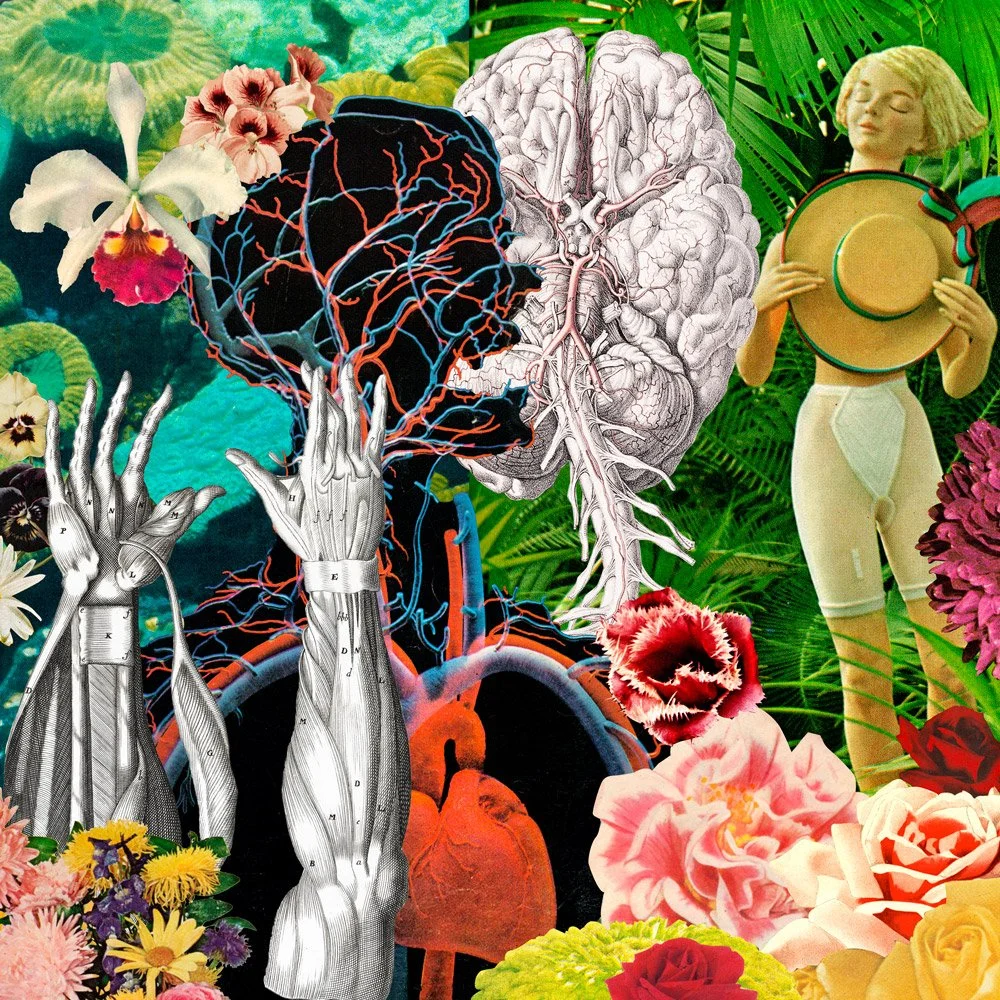
In Anatomical Garden, Joan Seed depicts a natural world that seems conscious of itself. Flesh takes root and thought blossoms. Vintage anatomical plates intertwine with lush plant life. A heart comes to the surface among the flowers. Veins branch like stems, while anatomical hands rise from the bouquet. Opened and scattered, the body seems to have shed its boundaries and spread into the garden.
Joan’s letter offers a key to interpreting this vision: she connects the Golden Teachers with the realization that everything is interconnected. These psychedelic mushrooms do not appear in the collage. Read alongside the letter, however, the work could evoke a perception of the world in which the boundaries between the self and the living world become more porous. Bodies, plants, thought and matter might all participate in the same movement. Compassion and self-love could then grow from a simple recognition: caring for any living being, oneself included, means caring for one small part of the greater whole.
The cut-out images also bring together two traditions devoted to the close observation of life. It is as though Leonardo da Vinci were reaching out to Mary Delany, the eighteenth-century English artist who created nearly a thousand flowers from cut paper. Leonardo opens the body to reveal its architecture; Delany reassembles each specimen, petal by petal, to bring its singularity into view. In Joan’s garden, dissection and reassembly become complementary responses to the mystery of life. The precision of the anatomical plates extends into the collage’s profusion of blooms, as scientific rigor and botanical imagination illuminate the same reality by different paths.
To the right, a woman with the air of a 1950s model stands nearly nude, poised and serene. Her eyes closed, she presses a large hat against her chest. Beside plates that lay the body open to inspection, her closed eyes suggest another kind of knowledge: the body experienced from within. Anatomy reveals what lies beneath the skin; she listens to what is happening inside. The garden makes room for both ways of knowing.
She seems to breathe without moving, fully attuned to the garden around her. In this remade paradise, she recalls Eve, returning to the garden with the knowledge for which she had been cast out. The word paradise carries a wall in its very roots: in ancient Persia, the term from which it derives referred to an enclosure or walled garden. Joan’s paradise has lost its walls. Anatomy spills beyond the body and flowers overrun the plates. Life moves freely through it.
This figure may also be read as a tribute to women whose knowledge of plants, remedies and the body has sometimes inspired as much suspicion as gratitude. Some healers and herbalists saw their practices associated with witchcraft. The collage symbolically restores them to the heart of a history of knowledge about the living world that has often obscured their contributions.
In this new kind of garden, duality begins to fade. The human becomes nature once more, and nature takes human form. The heart, brain, hands and flowers belong to the same cosmic organism. Everything breathes. Everything is one.
CONTEXT
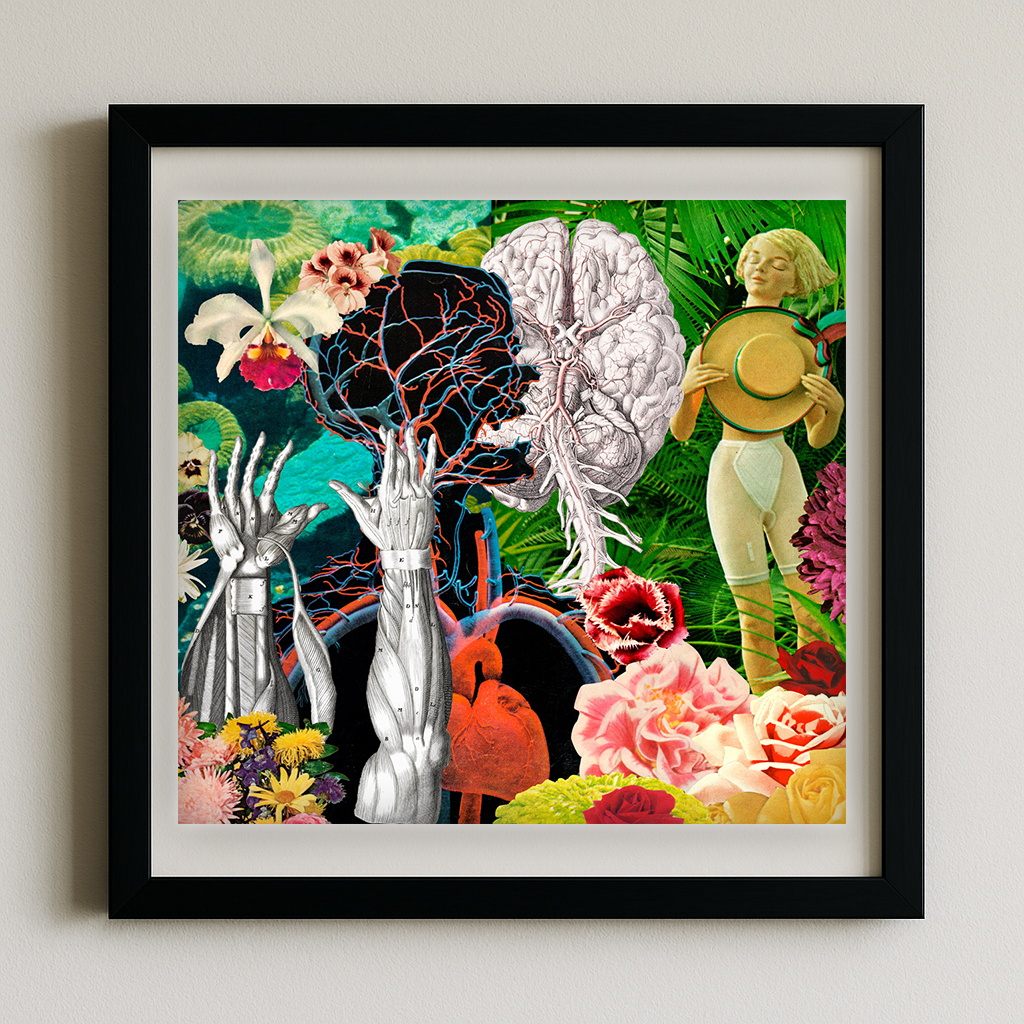
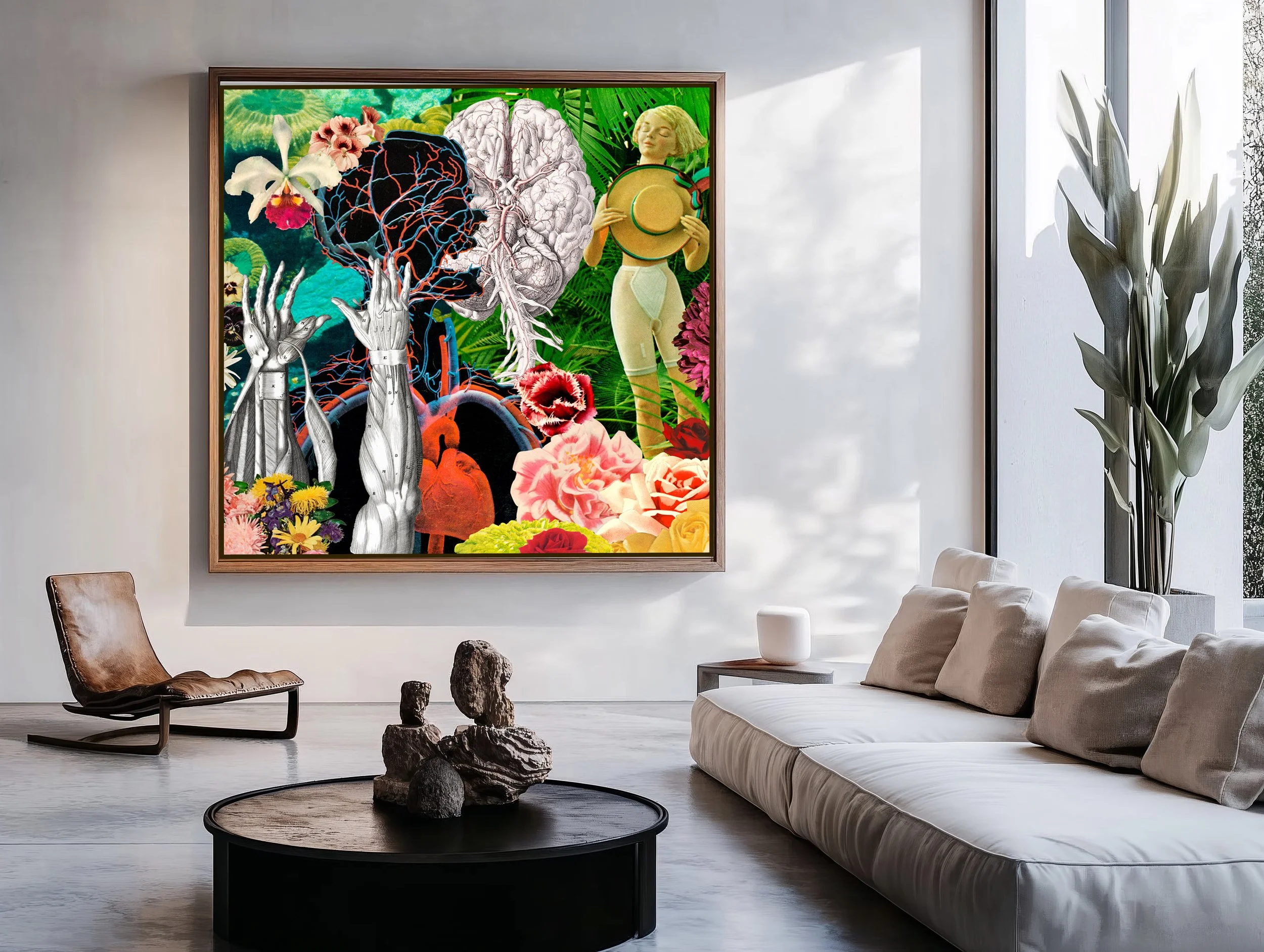
Anatomical Garden is a surreal digital collage in which vintage anatomical illustrations mingle with lush plant life. A heart, a brain and branching blood vessels appear among the flowers, while dissected hands rise like stems. To the right, a woman with a retro look stands with her eyes closed, absorbed in an organic landscape where the human body seems to extend into nature.
At the intersection of anatomical art and botanical collage, the work embraces the visual abundance of maximalism. It recalls Leonardo da Vinci’s studies of the human body as well as the paper mosaics of Mary Delany, the eighteenth-century English artist known for her remarkably precise floral compositions. By transforming the body into a landscape, Joan Seed draws on a surrealist tradition that brings ordinarily separate images together. The collage also resonates with contemporary approaches to human health that emphasize its connections with the natural world.
EXPLORE FURTHER
Explore the botanical world of artist Giovanna Nicolo, a collaborator on the Joan Seed project, on her website and Instagram account.
ARTWORK DETAILS
Title: Anatomical Garden
French Title: Jardin anatomique
Artist: Joan Seed
Medium: Mixed Media CollageLimited edition prints, hand-signed and numbered
Material: Museum-grade giclée print on archival, textured cotton paper
Size Options:
• 30 × 30 inches (76.2 × 76.2 cm)
• 60 × 60 inches (152.4 × 152.4 cm)
Shipping: Flat rate of $175 CAD per order.
For acquisitions, inquiries, and commissions: joan@joanseed.ca
© 2026 Joan Seed. All rights reserved. This artwork and its images may not be reproduced, copied, distributed, or used in any form without the prior written permission of the artist.
A LETTER FROM JOAN
Darling,
Golden Teachers really do live up to their name. These mushrooms have taught me that everything breathes together in a universe that abhors fences. It sometimes takes a while to understand: our breath mingles with that of plants, and even thoughts have roots.
Once you feel deep down that everything is connected, compassion grows more easily. So does self-love, even in the corners you thought were only fit for compost.
Love from every strand of my inner mycelium,
Joan
A CLOSER LOOK
Everything Breathes
An Anatomy of the Greater Whole
In Anatomical Garden, Joan Seed depicts a natural world that seems conscious of itself. Flesh takes root and thought blossoms. Vintage anatomical plates intertwine with lush plant life. A heart comes to the surface among the flowers. Veins branch like stems, while anatomical hands rise from the bouquet. Opened and scattered, the body seems to have shed its boundaries and spread into the garden.
Joan’s letter offers a key to interpreting this vision: she connects the Golden Teachers with the realization that everything is interconnected. These psychedelic mushrooms do not appear in the collage. Read alongside the letter, however, the work could evoke a perception of the world in which the boundaries between the self and the living world become more porous. Bodies, plants, thought and matter might all participate in the same movement. Compassion and self-love could then grow from a simple recognition: caring for any living being, oneself included, means caring for one small part of the greater whole.
The cut-out images also bring together two traditions devoted to the close observation of life. It is as though Leonardo da Vinci were reaching out to Mary Delany, the eighteenth-century English artist who created nearly a thousand flowers from cut paper. Leonardo opens the body to reveal its architecture; Delany reassembles each specimen, petal by petal, to bring its singularity into view. In Joan’s garden, dissection and reassembly become complementary responses to the mystery of life. The precision of the anatomical plates extends into the collage’s profusion of blooms, as scientific rigor and botanical imagination illuminate the same reality by different paths.
To the right, a woman with the air of a 1950s model stands nearly nude, poised and serene. Her eyes closed, she presses a large hat against her chest. Beside plates that lay the body open to inspection, her closed eyes suggest another kind of knowledge: the body experienced from within. Anatomy reveals what lies beneath the skin; she listens to what is happening inside. The garden makes room for both ways of knowing.
She seems to breathe without moving, fully attuned to the garden around her. In this remade paradise, she recalls Eve, returning to the garden with the knowledge for which she had been cast out. The word paradise carries a wall in its very roots: in ancient Persia, the term from which it derives referred to an enclosure or walled garden. Joan’s paradise has lost its walls. Anatomy spills beyond the body and flowers overrun the plates. Life moves freely through it.
This figure may also be read as a tribute to women whose knowledge of plants, remedies and the body has sometimes inspired as much suspicion as gratitude. Some healers and herbalists saw their practices associated with witchcraft. The collage symbolically restores them to the heart of a history of knowledge about the living world that has often obscured their contributions.
In this new kind of garden, duality begins to fade. The human becomes nature once more, and nature takes human form. The heart, brain, hands and flowers belong to the same cosmic organism. Everything breathes. Everything is one.
CONTEXT
Anatomical Garden is a surreal digital collage in which vintage anatomical illustrations mingle with lush plant life. A heart, a brain and branching blood vessels appear among the flowers, while dissected hands rise like stems. To the right, a woman with a retro look stands with her eyes closed, absorbed in an organic landscape where the human body seems to extend into nature.
At the intersection of anatomical art and botanical collage, the work embraces the visual abundance of maximalism. It recalls Leonardo da Vinci’s studies of the human body as well as the paper mosaics of Mary Delany, the eighteenth-century English artist known for her remarkably precise floral compositions. By transforming the body into a landscape, Joan Seed draws on a surrealist tradition that brings ordinarily separate images together. The collage also resonates with contemporary approaches to human health that emphasize its connections with the natural world.
EXPLORE FURTHER
Explore the botanical world of artist Giovanna Nicolo, a collaborator on the Joan Seed project, on her website and Instagram account.
ARTWORK DETAILS
Title: Anatomical Garden
French Title: Jardin anatomique
Artist: Joan Seed
Medium: Mixed Media CollageLimited edition prints, hand-signed and numbered
Material: Museum-grade giclée print on archival, textured cotton paper
Size Options:
• 30 × 30 inches (76.2 × 76.2 cm)
• 60 × 60 inches (152.4 × 152.4 cm)
Shipping: Flat rate of $175 CAD per order.
For acquisitions, inquiries, and commissions: joan@joanseed.ca
© 2026 Joan Seed. All rights reserved. This artwork and its images may not be reproduced, copied, distributed, or used in any form without the prior written permission of the artist.