A Love Letter from Joan
Darling,
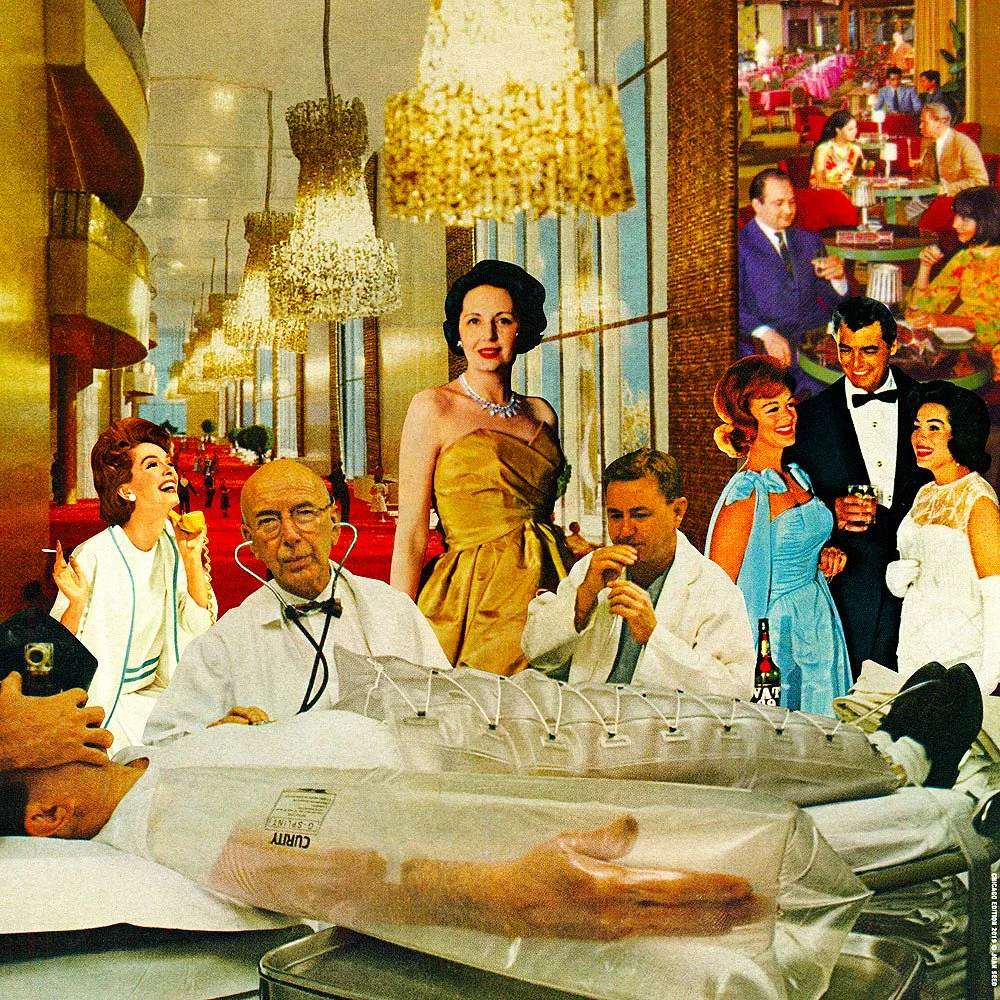
The chandeliers glow, the champagne keeps flowing, and everyone seems determined to survive the evening while looking perfectly happy. People laugh loudly to drown out the silence. They keep themselves moving to convince themselves they are still alive.
Then someone collapses.
What fascinates me most, honestly, is how little it changes. The servers continue their rounds. Conversations resume after a few seconds of hesitation. Already, some guests are watching the scene with that peculiar expression reserved for minor social scandals — a mixture of pity, curiosity, and poorly concealed relief that they are not the one lying on the floor.
And that doctor… is he there to repair the damage, or to erase the traces of certain complacencies?
I suppose that in this kind of world, catastrophes should have the good taste to remain discreet.
Hoping everything continues to go very well, I’m buying you a drink.
Joan
A Closer Look
With Cocktail Casualty, Joan Seed reimagines the glamorous world of 1950s and 1960s high-society receptions through the lens of a much older visual tradition: vanitas painting and memento mori. Like the skulls discreetly embedded in European still lifes or ancient mosaics reminding viewers of life’s fragility, the body stretched across the foreground becomes a rupture at the center of the social spectacle.
At first, the scene feels familiar: glittering chandeliers, elegant gowns, cocktail chatter, and modernist architecture compose a carefully staged world of privilege. But for a few seconds, the illusion falters. Amid the glasses, smiles, and social rituals, a vulnerable body suddenly appears, no longer capable of keeping pace with the choreography surrounding it. And yet, the reception never truly stops. Instead, it absorbs the incident with unsettling ease, as though this kind of collapse already belongs to the décor.
This tension recalls the vanitas traditions of the sixteenth and seventeenth centuries, where jewels, flowers, instruments, and luxurious objects coexisted beside symbols of death meant to remind viewers of the fleeting nature of earthly pleasures.But Cocktail Casualty also evokes the memento mori traditions of ancient Rome, where awareness of death functioned not only as moral warning, but as an invitation toward lucidity. I
In Joan Seed’s world, however, everything seems organized to anesthetize that reminder. The high society depicted here does not entirely deny catastrophe; rather, it absorbs it into its own systems of representation. Discomfort becomes a social inconvenience. For a few moments, eyes turn toward the collapsed body with embarrassment, curiosity, and fleeting compassion. But suffering remains tolerable only as long as it does not visibly disrupt the illusion of control the evening is attempting to preserve.
This atmosphere recalls both Pierre Falardeau’s savage satire in Le temps des bouffons and the decadent emotional emptiness of Paolo Sorrentino’s La grande bellezza. In both worlds, elites drift through environments designed to dazzle while appearing increasingly disconnected from authentic human experience. In Seed’s work, excess functions primarily as a strategy against boredom and mortality. The doctor’s presence introduces another unsettling ambiguity. Though he appears to be a figure of rescue, he never seems entirely separate from the world he has come to save.
The work quietly raises a disturbing question: in environments shaped by excess, where does care truly end, and where does participation in the very systems producing collapse begin? Behind the glittering glasses and chandeliers, a much older truth slowly emerges. Despite every performance of prestige, power, and elegance, the body remains fragile, mortal, and impossible to permanently keep out of frame.
— Louis M.
Context
Through her retro-futurist collages, Joan Seed explores mechanisms of power, desire, and social performance by reworking the advertising and high-society aesthetics of the mid-twentieth century. Her work blends glamour with a diffuse atmosphere of unease, revealing tensions hidden inside fantasies of comfort and success. With Cocktail Casualty, the artist revisits vanitas imagery and memento mori through a social scene where luxury suddenly collides with human fragility.
Balancing social satire with existential unease, the work examines how certain societies transform vulnerability into discreet spectacle, quickly absorbed into the codes of prestige and performance.
Related Work:
https://www.joanseed.com/english/p/my-body-is-your-communion-eat-from-me-postwar-feminine-identity-art-by-joan-seed
Artwork Details
Title: Cocktail Casualty
Artist: Joan Seed
Medium: Mixed Media Collage
Edition: Limited edition prints, hand-signed and numbered
Material: Museum-grade giclée print on archival textured cotton paper
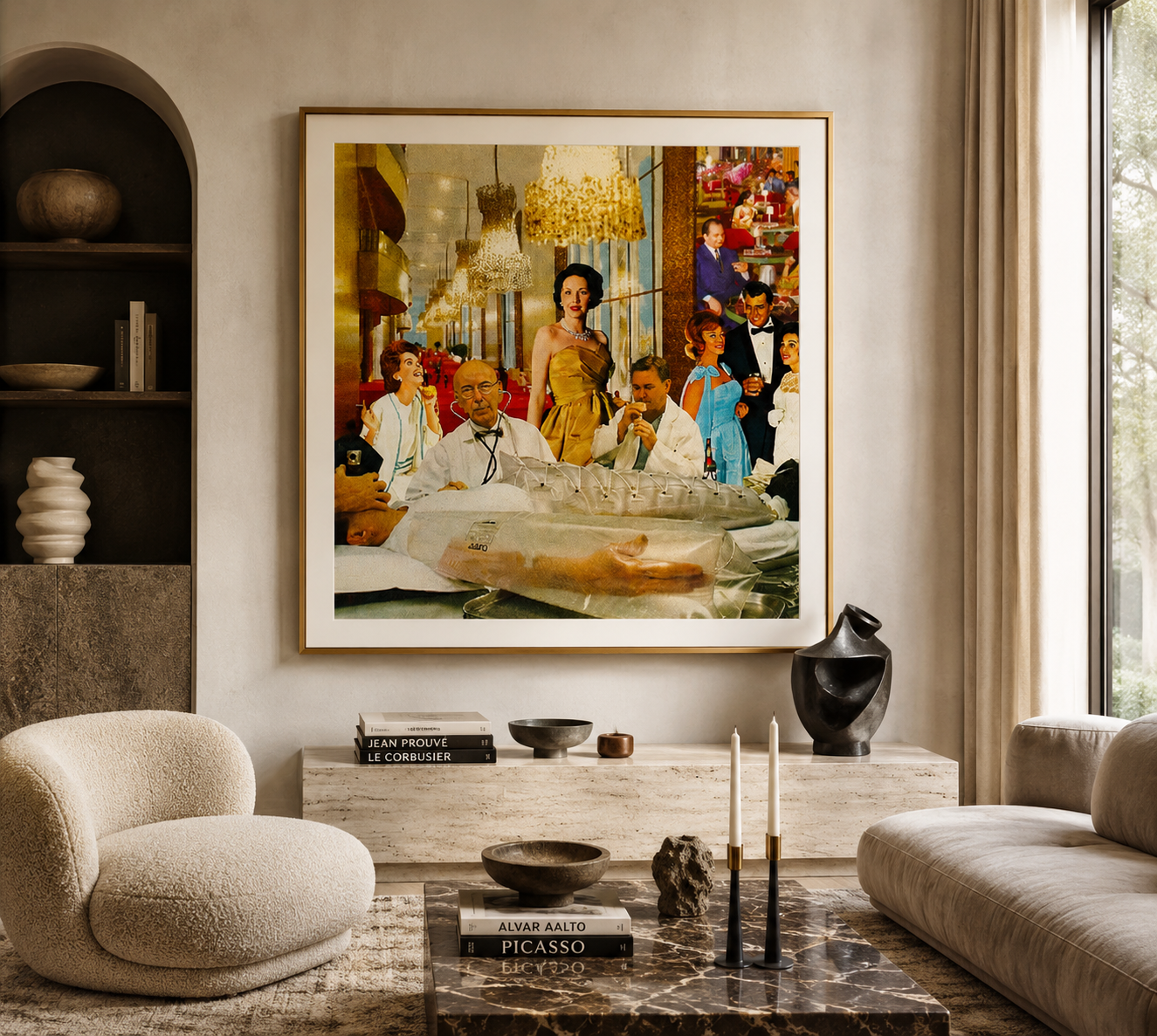
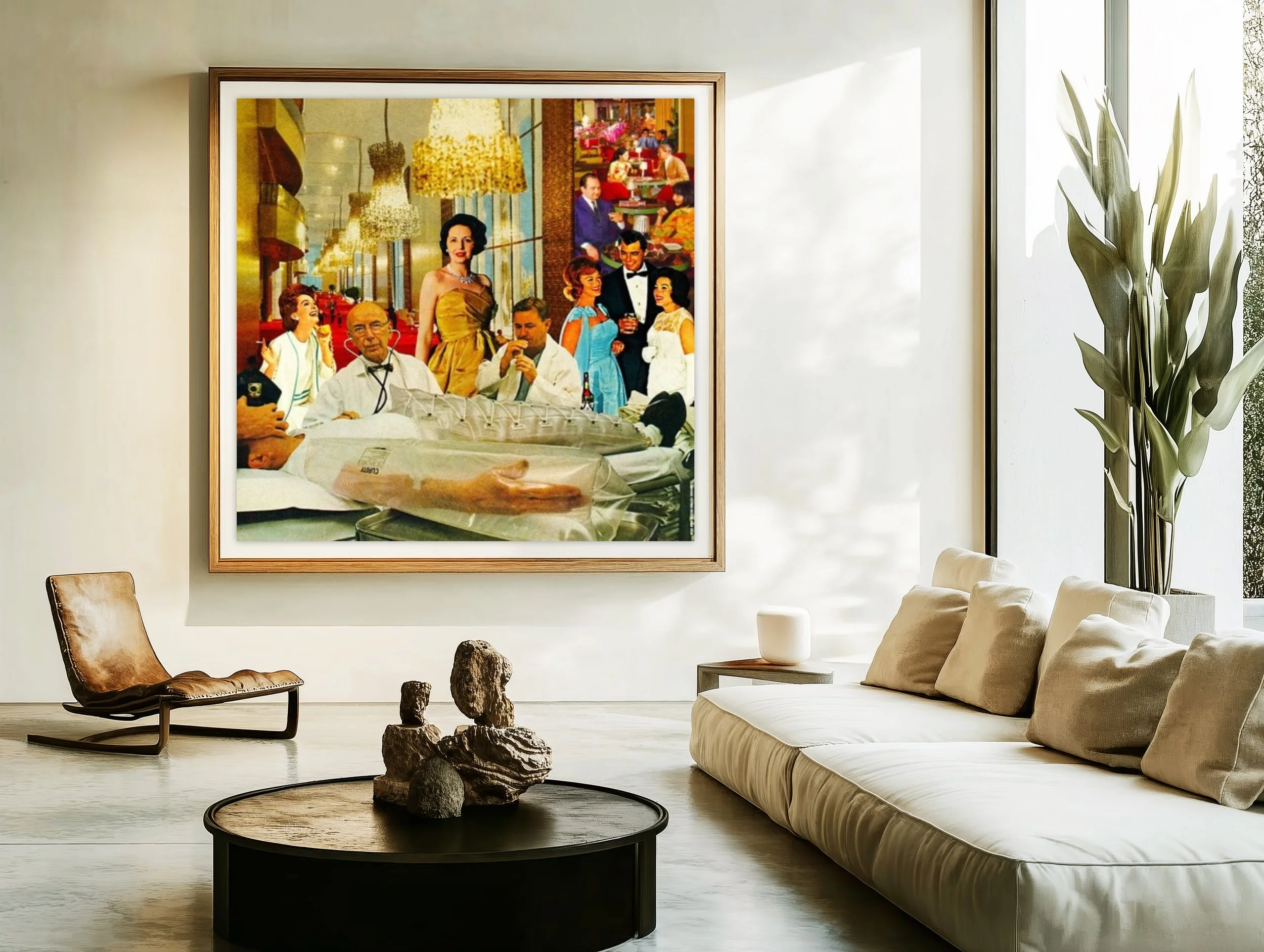
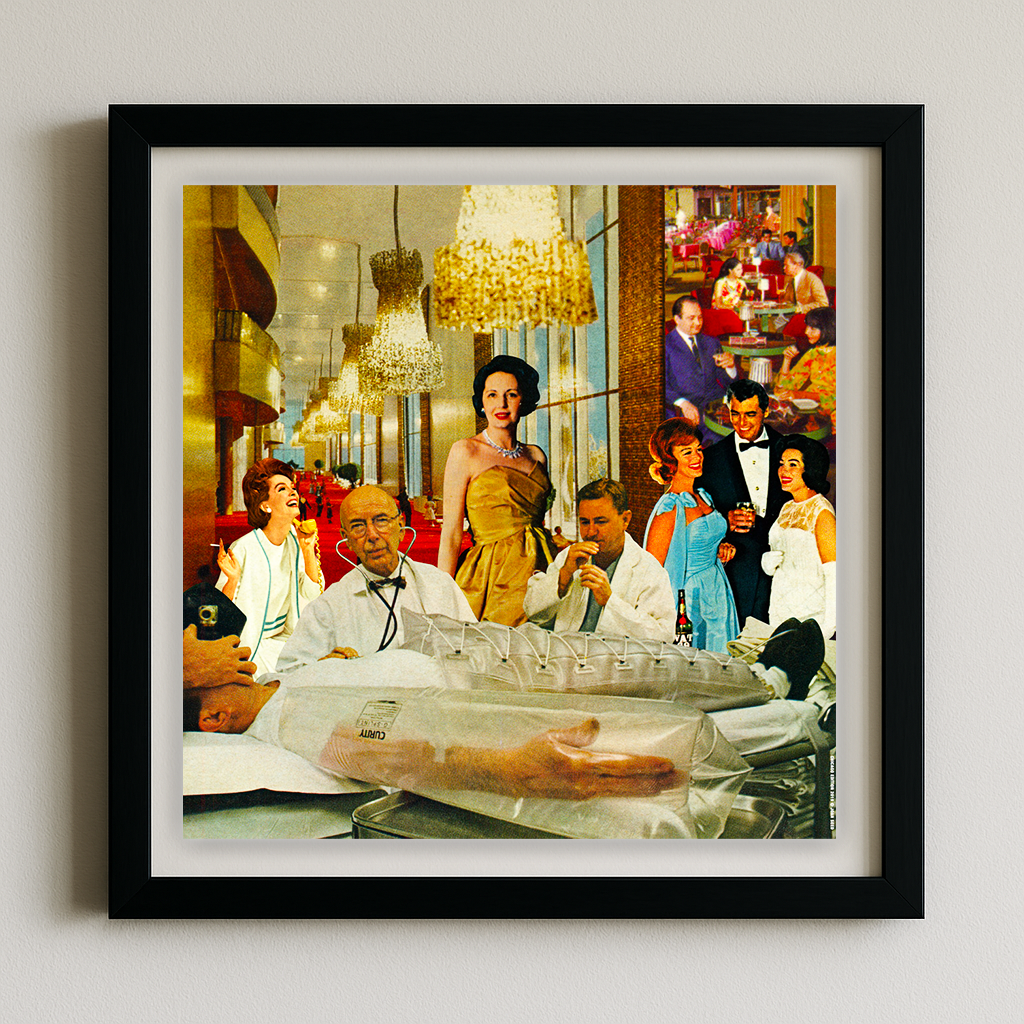
Size Options: 30 × 30 inches (76.2 × 76.2 cm) | 60 × 60 inches (152.4 × 152.4 cm)
Shipping: Flat rate of $175 CAD per order
Contact: joan@joanseed.ca
© 2026 Joan Seed. All rights reserved. This artwork and its images may not be reproduced, copied, distributed, or used in any form without prior written permission from the artist.
A Love Letter from Joan
Darling,
The chandeliers glow, the champagne keeps flowing, and everyone seems determined to survive the evening while looking perfectly happy. People laugh loudly to drown out the silence. They keep themselves moving to convince themselves they are still alive.
Then someone collapses.
What fascinates me most, honestly, is how little it changes. The servers continue their rounds. Conversations resume after a few seconds of hesitation. Already, some guests are watching the scene with that peculiar expression reserved for minor social scandals — a mixture of pity, curiosity, and poorly concealed relief that they are not the one lying on the floor.
And that doctor… is he there to repair the damage, or to erase the traces of certain complacencies?
I suppose that in this kind of world, catastrophes should have the good taste to remain discreet.
Hoping everything continues to go very well, I’m buying you a drink.
Joan
A Closer Look
With Cocktail Casualty, Joan Seed reimagines the glamorous world of 1950s and 1960s high-society receptions through the lens of a much older visual tradition: vanitas painting and memento mori. Like the skulls discreetly embedded in European still lifes or ancient mosaics reminding viewers of life’s fragility, the body stretched across the foreground becomes a rupture at the center of the social spectacle.
At first, the scene feels familiar: glittering chandeliers, elegant gowns, cocktail chatter, and modernist architecture compose a carefully staged world of privilege. But for a few seconds, the illusion falters. Amid the glasses, smiles, and social rituals, a vulnerable body suddenly appears, no longer capable of keeping pace with the choreography surrounding it. And yet, the reception never truly stops. Instead, it absorbs the incident with unsettling ease, as though this kind of collapse already belongs to the décor.
This tension recalls the vanitas traditions of the sixteenth and seventeenth centuries, where jewels, flowers, instruments, and luxurious objects coexisted beside symbols of death meant to remind viewers of the fleeting nature of earthly pleasures.But Cocktail Casualty also evokes the memento mori traditions of ancient Rome, where awareness of death functioned not only as moral warning, but as an invitation toward lucidity. I
In Joan Seed’s world, however, everything seems organized to anesthetize that reminder. The high society depicted here does not entirely deny catastrophe; rather, it absorbs it into its own systems of representation. Discomfort becomes a social inconvenience. For a few moments, eyes turn toward the collapsed body with embarrassment, curiosity, and fleeting compassion. But suffering remains tolerable only as long as it does not visibly disrupt the illusion of control the evening is attempting to preserve.
This atmosphere recalls both Pierre Falardeau’s savage satire in Le temps des bouffons and the decadent emotional emptiness of Paolo Sorrentino’s La grande bellezza. In both worlds, elites drift through environments designed to dazzle while appearing increasingly disconnected from authentic human experience. In Seed’s work, excess functions primarily as a strategy against boredom and mortality. The doctor’s presence introduces another unsettling ambiguity. Though he appears to be a figure of rescue, he never seems entirely separate from the world he has come to save.
The work quietly raises a disturbing question: in environments shaped by excess, where does care truly end, and where does participation in the very systems producing collapse begin? Behind the glittering glasses and chandeliers, a much older truth slowly emerges. Despite every performance of prestige, power, and elegance, the body remains fragile, mortal, and impossible to permanently keep out of frame.
— Louis M.
Context
Through her retro-futurist collages, Joan Seed explores mechanisms of power, desire, and social performance by reworking the advertising and high-society aesthetics of the mid-twentieth century. Her work blends glamour with a diffuse atmosphere of unease, revealing tensions hidden inside fantasies of comfort and success. With Cocktail Casualty, the artist revisits vanitas imagery and memento mori through a social scene where luxury suddenly collides with human fragility.
Balancing social satire with existential unease, the work examines how certain societies transform vulnerability into discreet spectacle, quickly absorbed into the codes of prestige and performance.
Related Work:
https://www.joanseed.com/english/p/my-body-is-your-communion-eat-from-me-postwar-feminine-identity-art-by-joan-seed
Artwork Details
Title: Cocktail Casualty
Artist: Joan Seed
Medium: Mixed Media Collage
Edition: Limited edition prints, hand-signed and numbered
Material: Museum-grade giclée print on archival textured cotton paper
Size Options: 30 × 30 inches (76.2 × 76.2 cm) | 60 × 60 inches (152.4 × 152.4 cm)
Shipping: Flat rate of $175 CAD per order
Contact: joan@joanseed.ca
© 2026 Joan Seed. All rights reserved. This artwork and its images may not be reproduced, copied, distributed, or used in any form without prior written permission from the artist.