A Letter from Joan
Darling,
They promised motherhood would make me feel fulfilled. Mostly, it has made me watertight.
The baby is breathing perfectly well, thank you. I’m the one they forgot to check. So I kept the lace, screwed on the diving helmet, and brought out the cigarette holder. A woman must know how to adapt when domestic bliss reaches deep-sea pressure levels.
I love my little angel. On the logistical front, my breasts take their feeding duties very seriously. I’d simply like everyone to remember that they have a social life too. In fact, I’d be perfectly willing to lean over the cradle like a mother hen, even if it meant leaving a few feathers behind. But I doubt that can be arranged. After all, who would appreciate the quality of my bra then? And anyway, feathers fare terribly in the abyss.
As for the cigarette holder, it serves no purpose whatsoever. That is precisely why I cannot do without it. Lace, on the other hand, is a matter of self-preservation.
Tenderly,
Joan
A Closer Look
The Nemeids
Twenty Thousand Leagues Under the Mothers
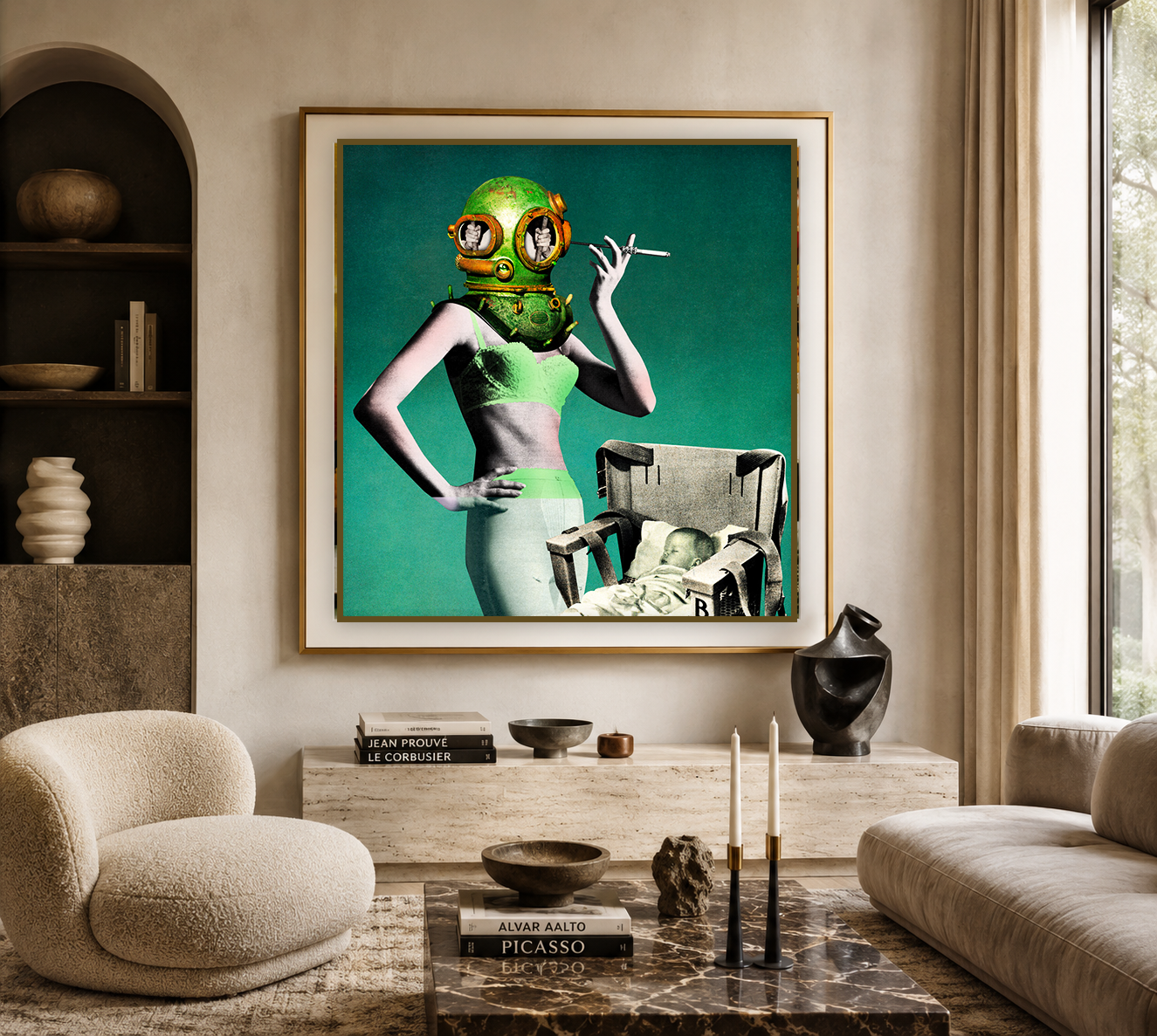
In Doting Mother, Joan Seed seems to delight in disrupting traditional images of motherhood. This is a far cry from the mother hen tenderly watching over her chick. Standing beside her infant, a woman instead displays the glamorous self-assurance of a pin-up. Wearing only high-waisted tights and a lace bra, she brandishes her cigarette holder with ostentatious elegance. Her love for the child mingles with the desire to remain someone in her own right.
Even before the chores and sacrifices begin, pregnancy can be a first plunge into the abyss. The body harbours another life, blurring the usually clear boundary between self and other. In Civilization and Its Discontents, Freud takes up French writer Romain Rolland’s expression “oceanic feeling.” He connects it to the state of an infant who has yet to distinguish the ego from the outside world. Motherhood may recreate that closeness from the opposite shore. In the artwork, the diving helmet draws a boundary around the mother, protecting her from dissolution even as it isolates her.
The dive continues after birth. Promised joy can coexist with postpartum depression, a sense of losing one’s freedom, or the fear of no longer being desirable. The helmet allows the mother to withstand the pressure. By cultivating an alluring poise, she may preserve something of who she was before. Yet the cigarette holder reaches no mouth. Freedom survives as a gesture; pleasure itself remains out of reach.
Two small hands grip bars behind the portholes. Whose might they be? Perhaps they belong to the little girl she once was, banished to some inner oubliette. Freud wrote that the ego is not master in its own house. The diving helmet makes this observation almost literal: a part of that girl may still be at work within her through channels hidden even from her.
Nearby, the baby rests in a sturdy seat. The seat has straps, but the child is not strapped in. That freedom sets the cycle in motion: free to leave the point of origin, the child can embark on a journey of their own. They will nevertheless carry what they have received. A child’s psyche is also shaped by the ways in which their parents relate to themselves. Joan’s choice of glamour offers one example among many. What helps the mother keep from losing herself may become a wall for her child. A child can be deeply loved by someone who remains inaccessible in places. Small wounds are inscribed this way before there are even words to tell them.
What if this baby one day became the woman in the diving helmet? Becoming a mother could bring her back to her own childhood, like a diver descending into the waters of her unconscious. The mother carries the child she once was; the child may one day carry traces of her own mother. The cycle need not repeat itself exactly. Each generation resumes the voyage from a different shore, with the possibility of transforming what it encounters in the depths.
Jules Verne provides another vessel for this descent. The French title Vingt mille lieues sous les mers becomes Vingt mille lieues sous les mères. The two phrases sound identical, but the word mers (“seas”) has become mères (“mothers”). In Verne’s novel, the twenty thousand leagues measure the distance travelled beneath the seas. Here, the route also descends into the depths of the unconscious and crosses several generations of mothers. The Nautilus, Captain Nemo’s submarine, opens the vastness of the oceans to its passengers while confining them to an enclosed world. In Latin, nemo means “no one.” Beneath the diving helmet, the mother no longer has a face. Could the woman who is trying to remain someone fear becoming no one at all?
The Greek-derived suffix -id can denote descent. Let us therefore call Nemo’s imaginary descendants the Nemeids. Their name makes them kin to the Nereids, sea nymphs born of Nereus, an ancient sea god, and the Oceanid Doris. The association extends into popular culture: in the French Canadian versions of Pixar’s films, Nemo appears alongside Doris, the name given to Dory. Living with memory loss, she too dives into the past in search of her memories and origins. Culture, too, has a subterranean memory.
Actions leave traces, but traces do not dictate a destiny. Doting Mother brings us to the point where what mothers unwittingly pass on meets what their children may one day transform. Beneath the helmet, behind the bars, something may be waiting to be recognized. Nearby, the open straps already announce the next departure.
-Louis Morency
Context
Doting Mother (Tendresse maternelle) is a retrofuturist surrealist collage in which Joan Seed juxtaposes the glamorous imagery of the mid-twentieth century with the complex realities of motherhood. Wearing high-waisted tights and a lace bra, a woman stands beside an infant, her head encased in a diving helmet. Her cigarette holder, pin-up pose, and the small hands gripping bars behind the helmet’s portholes create a scene as elegant as it is enigmatic.
The artwork belongs to a tradition of feminist and surrealist collage that subverts idealized images of domestic life to reveal the tensions beneath them. The diving helmet may evoke social pressure, isolation, the mental load, or postpartum depression, while the lingerie reminds us that a woman’s identity and sensuality do not disappear with motherhood. These themes resonate today in discussions about the work of parenting, maternal mental health, and the possibility of caring for a child without surrendering.
Related artworks:
bit.ly/4wCv1x4
bit.ly/4fXhQ2A
Artwork Details
English Haut du formulaireTitle: Doting Mother
French Title: Tendresse maternelle
Artist: Joan Seed
Medium: Mixed Media Collage
Limited edition prints, hand-signed and numbered
Material: Museum-grade giclée print on archival, textured cotton paper
Size Options:
• 30 × 30 inches (76.2 × 76.2 cm)
• 60 × 60 inches (152.4 × 152.4 cm)
Shipping: Flat rate of $175 CAD per order.
For acquisitions, inquiries, and commissions: joan@joanseed.ca
© 2026 Joan Seed. All rights reserved. This artwork and its images may not be reproduced, copied, distributed, or used in any form without the prior written permission of the artist.
A Letter from Joan
Darling,
They promised motherhood would make me feel fulfilled. Mostly, it has made me watertight.
The baby is breathing perfectly well, thank you. I’m the one they forgot to check. So I kept the lace, screwed on the diving helmet, and brought out the cigarette holder. A woman must know how to adapt when domestic bliss reaches deep-sea pressure levels.
I love my little angel. On the logistical front, my breasts take their feeding duties very seriously. I’d simply like everyone to remember that they have a social life too. In fact, I’d be perfectly willing to lean over the cradle like a mother hen, even if it meant leaving a few feathers behind. But I doubt that can be arranged. After all, who would appreciate the quality of my bra then? And anyway, feathers fare terribly in the abyss.
As for the cigarette holder, it serves no purpose whatsoever. That is precisely why I cannot do without it. Lace, on the other hand, is a matter of self-preservation.
Tenderly,
Joan
A Closer Look
The Nemeids
Twenty Thousand Leagues Under the Mothers
In Doting Mother, Joan Seed seems to delight in disrupting traditional images of motherhood. This is a far cry from the mother hen tenderly watching over her chick. Standing beside her infant, a woman instead displays the glamorous self-assurance of a pin-up. Wearing only high-waisted tights and a lace bra, she brandishes her cigarette holder with ostentatious elegance. Her love for the child mingles with the desire to remain someone in her own right.
Even before the chores and sacrifices begin, pregnancy can be a first plunge into the abyss. The body harbours another life, blurring the usually clear boundary between self and other. In Civilization and Its Discontents, Freud takes up French writer Romain Rolland’s expression “oceanic feeling.” He connects it to the state of an infant who has yet to distinguish the ego from the outside world. Motherhood may recreate that closeness from the opposite shore. In the artwork, the diving helmet draws a boundary around the mother, protecting her from dissolution even as it isolates her.
The dive continues after birth. Promised joy can coexist with postpartum depression, a sense of losing one’s freedom, or the fear of no longer being desirable. The helmet allows the mother to withstand the pressure. By cultivating an alluring poise, she may preserve something of who she was before. Yet the cigarette holder reaches no mouth. Freedom survives as a gesture; pleasure itself remains out of reach.
Two small hands grip bars behind the portholes. Whose might they be? Perhaps they belong to the little girl she once was, banished to some inner oubliette. Freud wrote that the ego is not master in its own house. The diving helmet makes this observation almost literal: a part of that girl may still be at work within her through channels hidden even from her.
Nearby, the baby rests in a sturdy seat. The seat has straps, but the child is not strapped in. That freedom sets the cycle in motion: free to leave the point of origin, the child can embark on a journey of their own. They will nevertheless carry what they have received. A child’s psyche is also shaped by the ways in which their parents relate to themselves. Joan’s choice of glamour offers one example among many. What helps the mother keep from losing herself may become a wall for her child. A child can be deeply loved by someone who remains inaccessible in places. Small wounds are inscribed this way before there are even words to tell them.
What if this baby one day became the woman in the diving helmet? Becoming a mother could bring her back to her own childhood, like a diver descending into the waters of her unconscious. The mother carries the child she once was; the child may one day carry traces of her own mother. The cycle need not repeat itself exactly. Each generation resumes the voyage from a different shore, with the possibility of transforming what it encounters in the depths.
Jules Verne provides another vessel for this descent. The French title Vingt mille lieues sous les mers becomes Vingt mille lieues sous les mères. The two phrases sound identical, but the word mers (“seas”) has become mères (“mothers”). In Verne’s novel, the twenty thousand leagues measure the distance travelled beneath the seas. Here, the route also descends into the depths of the unconscious and crosses several generations of mothers. The Nautilus, Captain Nemo’s submarine, opens the vastness of the oceans to its passengers while confining them to an enclosed world. In Latin, nemo means “no one.” Beneath the diving helmet, the mother no longer has a face. Could the woman who is trying to remain someone fear becoming no one at all?
The Greek-derived suffix -id can denote descent. Let us therefore call Nemo’s imaginary descendants the Nemeids. Their name makes them kin to the Nereids, sea nymphs born of Nereus, an ancient sea god, and the Oceanid Doris. The association extends into popular culture: in the French Canadian versions of Pixar’s films, Nemo appears alongside Doris, the name given to Dory. Living with memory loss, she too dives into the past in search of her memories and origins. Culture, too, has a subterranean memory.
Actions leave traces, but traces do not dictate a destiny. Doting Mother brings us to the point where what mothers unwittingly pass on meets what their children may one day transform. Beneath the helmet, behind the bars, something may be waiting to be recognized. Nearby, the open straps already announce the next departure.
-Louis Morency
Context
Doting Mother (Tendresse maternelle) is a retrofuturist surrealist collage in which Joan Seed juxtaposes the glamorous imagery of the mid-twentieth century with the complex realities of motherhood. Wearing high-waisted tights and a lace bra, a woman stands beside an infant, her head encased in a diving helmet. Her cigarette holder, pin-up pose, and the small hands gripping bars behind the helmet’s portholes create a scene as elegant as it is enigmatic.
The artwork belongs to a tradition of feminist and surrealist collage that subverts idealized images of domestic life to reveal the tensions beneath them. The diving helmet may evoke social pressure, isolation, the mental load, or postpartum depression, while the lingerie reminds us that a woman’s identity and sensuality do not disappear with motherhood. These themes resonate today in discussions about the work of parenting, maternal mental health, and the possibility of caring for a child without surrendering.
Related artworks:
bit.ly/4wCv1x4
bit.ly/4fXhQ2A
Artwork Details
English Haut du formulaireTitle: Doting Mother
French Title: Tendresse maternelle
Artist: Joan Seed
Medium: Mixed Media Collage
Limited edition prints, hand-signed and numbered
Material: Museum-grade giclée print on archival, textured cotton paper
Size Options:
• 30 × 30 inches (76.2 × 76.2 cm)
• 60 × 60 inches (152.4 × 152.4 cm)
Shipping: Flat rate of $175 CAD per order.
For acquisitions, inquiries, and commissions: joan@joanseed.ca
© 2026 Joan Seed. All rights reserved. This artwork and its images may not be reproduced, copied, distributed, or used in any form without the prior written permission of the artist.