A LETTER FROM JOAN
My dear,
Once upon a time, people said the head was sacred. A temple, no less. Then centuries passed, and the temple became a drive-thru.
And here comes our heroine. No jewels, no laurels: she’s been crowned with a double hamburger dripping with grease and ambition. I think she’d be the perfect American Mona Lisa: an icon served up for here or to go.
Do I laugh or cry? A bit of both, I suppose. In old fairy tales, the curse was eventually broken. In this one, you order it as a combo.
With all my greasy love,
Joan
A CLOSER LOOK
What We’re Made Of
Portrait of a Saturated Mind
Hamburger Head pushes its visual joke to the point of absurdity. Against a vivid blue background, a young woman with retro charm wears an oversized stack of buns and meat. Orange cheese oozes down in thick streams, and the patties glisten beneath a film of grease. The hamburger hides her eyes and the top of her head. It appears superimposed on her skull, gradually replacing it.
This partial disappearance recalls René Magritte’s Surrealist painting The Son of Man (1964). A green apple creates a kind of eclipse: placed in front of a face we imagine intact, it preserves its mystery and the possibility of revelation. In Joan’s work, what may have begun as an eclipse gradually becomes something else. The hamburger swells to such proportions that it seems poised to replace the head it covers. Mystery itself is under threat: the young woman’s identity could eventually merge with this prepackaged image.
Giuseppe Arcimboldo’s composite portraits open another path. Summer (1563) offers one example: fruits and other plant forms retain their own shapes while bringing a face into view. Without depicting the everyday diet of their period, these works invite comparison. Arcimboldo builds a complex figure from a multitude of recognizable elements; in Joan’s work, one enormous ultra-processed product tends to take over the entire composition.
During the twentieth century, the rise of fast food and mass consumption made the hamburger an icon of the Americanization of everyday life—an image several artists helped lodge in the collective imagination. Andy Warhol distills its advertising power in Hamburger (1985–1986), where a generic burger silhouette appears alongside the words “HAMBURGER,” “Wholesome,” and “Delicious.” In Floor Burger (1962), Claes Oldenburg turns the motif into an imposing sculpture made of stuffed canvas, both soft and swollen. David LaChapelle later makes the burger a mass that crushes a woman in Death by Hamburger (2001). In Joan’s work, the relationship becomes more intimate and oppressive: the burger has conquered the very territory of the head.
The white device in her hand extends this relationship. Its cord runs up the left side, away from her head, before entering the top bun. The device could be a pump: if so, the woman would be feeding the very thing that is overtaking her. Her gesture hints at conditioning, while the mechanism tightens its hold on her in return.
Food takes on a figurative dimension here. Omnipresent and engineered for immediate appeal, some ultra-processed products can encourage patterns of consumption that resemble addiction. Their intensity can also make simpler foods less appealing, even though those foods take longer to prepare and have flavors we learn to appreciate more over time. A similar logic can take hold of of our attention. Fast-moving or repetitive content, in which facts are presented without nuance, is offered almost without end. What nourishes thought takes more patience, whether it is a work we spend time with or a conversation we allow to ripen. In both cases, our choices depend on the resources and opportunities available to each of us. When a society works to broaden that access, it creates the conditions for freer thought and debate.
The cord attached to the device evokes the feed we scroll through. Our clicks, likes, shares, and even the time spent on a post can feed whatever ends up saturating our attention. The head fills with images, but this abundance can mask an underlying impoverishment. The eyes disappear while the mouth remains: the organ that consumes and proclaims stays visible; the gaze needed for perspective and discernment is blocked. When that happens, certainty can swell faster than understanding.
The white makeup applied to the visible portion of her face recalls the performing arts. It, too, conceals, but still presupposes a distinct person capable of expressing herself through artifice. The woman can thus play with her appearance and reinvent herself. The burger, by contrast, threatens to erase the distance between her and what covers her.
As is often the case in Joan’s work, comic excess ultimately brings us back to ourselves. The substitution remains incomplete: the lower part of the face survives beneath the mass, while the woman still has the device in hand. These signs preserve a space from which she can still act and choose what she feeds—and, in turn, what feeds her. She might then rediscover the joy of freer thought and once again become the author of her own composition.
CONTEXT
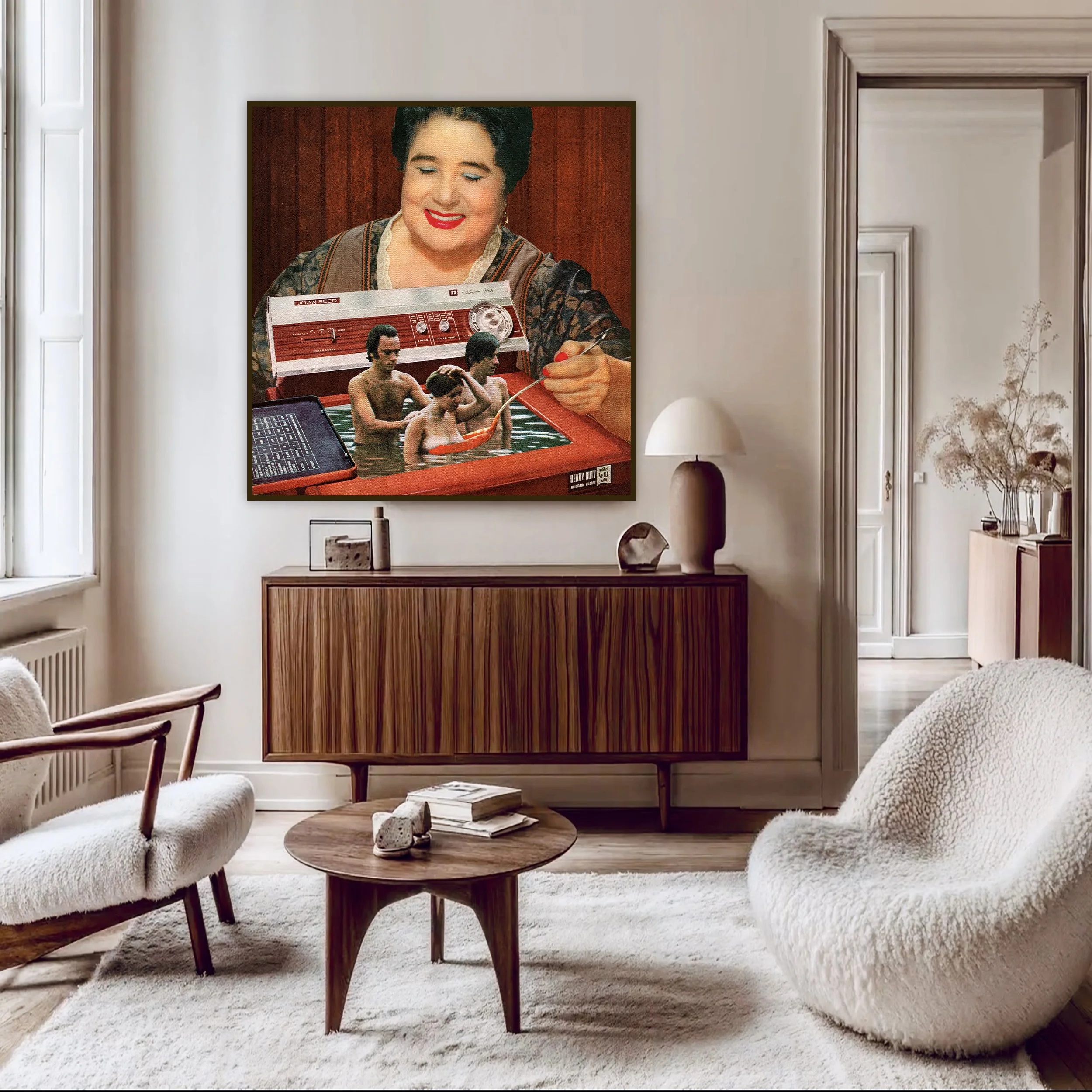
In Hamburger Head, Joan Seed subverts the conventions of retro portraiture and food advertising. Against a saturated blue background, a young woman holds a device connected by a cord to the enormous burger covering her eyes and the top of her head. Vivid colors and the deliberately absurd montage place the work within pop surrealism and the tradition of satirical collage.
The burger, an icon of fast food and an emblem of mass consumption, condenses the promises of abundance and the excesses associated with the Americanization of everyday life. By allowing it to encroach on the face itself, Joan Seed turns a familiar food into an invasive image. Hamburger Head thus offers a biting look at how what we consume can eventually shape our identity.
ARTWORK DETAILS
Title: Hamburger Head
Artist: Joan Seed
Medium: Mixed Media Collage
Limited edition prints, hand-signed and numbered
Material: Museum-grade giclée print on archival, textured cotton paper
Size Options:
• 30 × 30 inches (76.2 × 76.2 cm)
• 60 × 60 inches (152.4 × 152.4 cm)
Shipping: Flat rate of $175 CAD per order.
A LETTER FROM JOAN
My dear,
Once upon a time, people said the head was sacred. A temple, no less. Then centuries passed, and the temple became a drive-thru.
And here comes our heroine. No jewels, no laurels: she’s been crowned with a double hamburger dripping with grease and ambition. I think she’d be the perfect American Mona Lisa: an icon served up for here or to go.
Do I laugh or cry? A bit of both, I suppose. In old fairy tales, the curse was eventually broken. In this one, you order it as a combo.
With all my greasy love,
Joan
A CLOSER LOOK
What We’re Made Of
Portrait of a Saturated Mind
Hamburger Head pushes its visual joke to the point of absurdity. Against a vivid blue background, a young woman with retro charm wears an oversized stack of buns and meat. Orange cheese oozes down in thick streams, and the patties glisten beneath a film of grease. The hamburger hides her eyes and the top of her head. It appears superimposed on her skull, gradually replacing it.
This partial disappearance recalls René Magritte’s Surrealist painting The Son of Man (1964). A green apple creates a kind of eclipse: placed in front of a face we imagine intact, it preserves its mystery and the possibility of revelation. In Joan’s work, what may have begun as an eclipse gradually becomes something else. The hamburger swells to such proportions that it seems poised to replace the head it covers. Mystery itself is under threat: the young woman’s identity could eventually merge with this prepackaged image.
Giuseppe Arcimboldo’s composite portraits open another path. Summer (1563) offers one example: fruits and other plant forms retain their own shapes while bringing a face into view. Without depicting the everyday diet of their period, these works invite comparison. Arcimboldo builds a complex figure from a multitude of recognizable elements; in Joan’s work, one enormous ultra-processed product tends to take over the entire composition.
During the twentieth century, the rise of fast food and mass consumption made the hamburger an icon of the Americanization of everyday life—an image several artists helped lodge in the collective imagination. Andy Warhol distills its advertising power in Hamburger (1985–1986), where a generic burger silhouette appears alongside the words “HAMBURGER,” “Wholesome,” and “Delicious.” In Floor Burger (1962), Claes Oldenburg turns the motif into an imposing sculpture made of stuffed canvas, both soft and swollen. David LaChapelle later makes the burger a mass that crushes a woman in Death by Hamburger (2001). In Joan’s work, the relationship becomes more intimate and oppressive: the burger has conquered the very territory of the head.
The white device in her hand extends this relationship. Its cord runs up the left side, away from her head, before entering the top bun. The device could be a pump: if so, the woman would be feeding the very thing that is overtaking her. Her gesture hints at conditioning, while the mechanism tightens its hold on her in return.
Food takes on a figurative dimension here. Omnipresent and engineered for immediate appeal, some ultra-processed products can encourage patterns of consumption that resemble addiction. Their intensity can also make simpler foods less appealing, even though those foods take longer to prepare and have flavors we learn to appreciate more over time. A similar logic can take hold of of our attention. Fast-moving or repetitive content, in which facts are presented without nuance, is offered almost without end. What nourishes thought takes more patience, whether it is a work we spend time with or a conversation we allow to ripen. In both cases, our choices depend on the resources and opportunities available to each of us. When a society works to broaden that access, it creates the conditions for freer thought and debate.
The cord attached to the device evokes the feed we scroll through. Our clicks, likes, shares, and even the time spent on a post can feed whatever ends up saturating our attention. The head fills with images, but this abundance can mask an underlying impoverishment. The eyes disappear while the mouth remains: the organ that consumes and proclaims stays visible; the gaze needed for perspective and discernment is blocked. When that happens, certainty can swell faster than understanding.
The white makeup applied to the visible portion of her face recalls the performing arts. It, too, conceals, but still presupposes a distinct person capable of expressing herself through artifice. The woman can thus play with her appearance and reinvent herself. The burger, by contrast, threatens to erase the distance between her and what covers her.
As is often the case in Joan’s work, comic excess ultimately brings us back to ourselves. The substitution remains incomplete: the lower part of the face survives beneath the mass, while the woman still has the device in hand. These signs preserve a space from which she can still act and choose what she feeds—and, in turn, what feeds her. She might then rediscover the joy of freer thought and once again become the author of her own composition.
CONTEXT
In Hamburger Head, Joan Seed subverts the conventions of retro portraiture and food advertising. Against a saturated blue background, a young woman holds a device connected by a cord to the enormous burger covering her eyes and the top of her head. Vivid colors and the deliberately absurd montage place the work within pop surrealism and the tradition of satirical collage.
The burger, an icon of fast food and an emblem of mass consumption, condenses the promises of abundance and the excesses associated with the Americanization of everyday life. By allowing it to encroach on the face itself, Joan Seed turns a familiar food into an invasive image. Hamburger Head thus offers a biting look at how what we consume can eventually shape our identity.
ARTWORK DETAILS
Title: Hamburger Head
Artist: Joan Seed
Medium: Mixed Media Collage
Limited edition prints, hand-signed and numbered
Material: Museum-grade giclée print on archival, textured cotton paper
Size Options:
• 30 × 30 inches (76.2 × 76.2 cm)
• 60 × 60 inches (152.4 × 152.4 cm)
Shipping: Flat rate of $175 CAD per order.