

A Letter from Joan:
My dear friend,
People often ask me how I behave in an emergency.
I lie down, naturally.
The flames cast a remarkably flattering light. It would be a shame not to make the most of it. That seems perfectly reasonable to me.
I’ve been accused of lacking decency. I confess I don’t entirely understand why. The flames, for their part, have never judged me. They’ve simply done a wonderful job of illuminating my profile.
If civilization insists on collapsing, I’d rather it did so without leaving me in the shade.
With my warmest, most ardent affection,
Joan
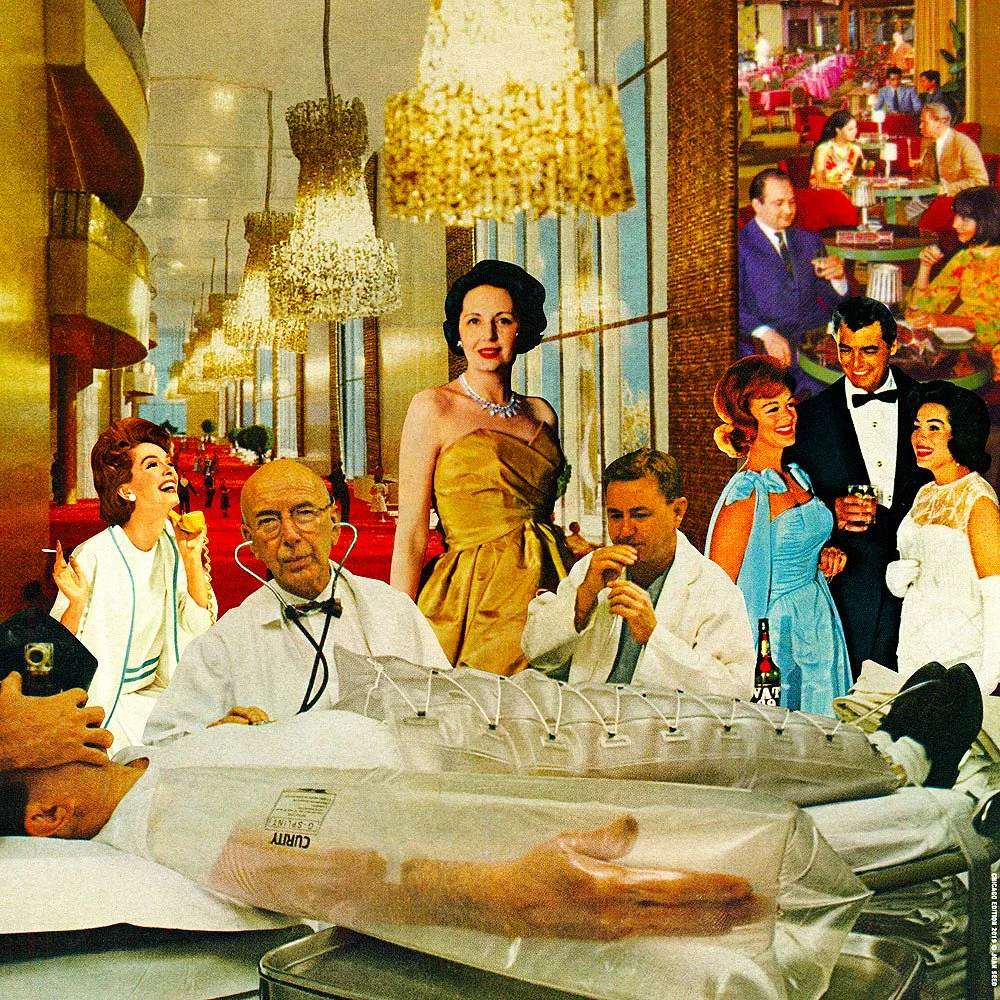
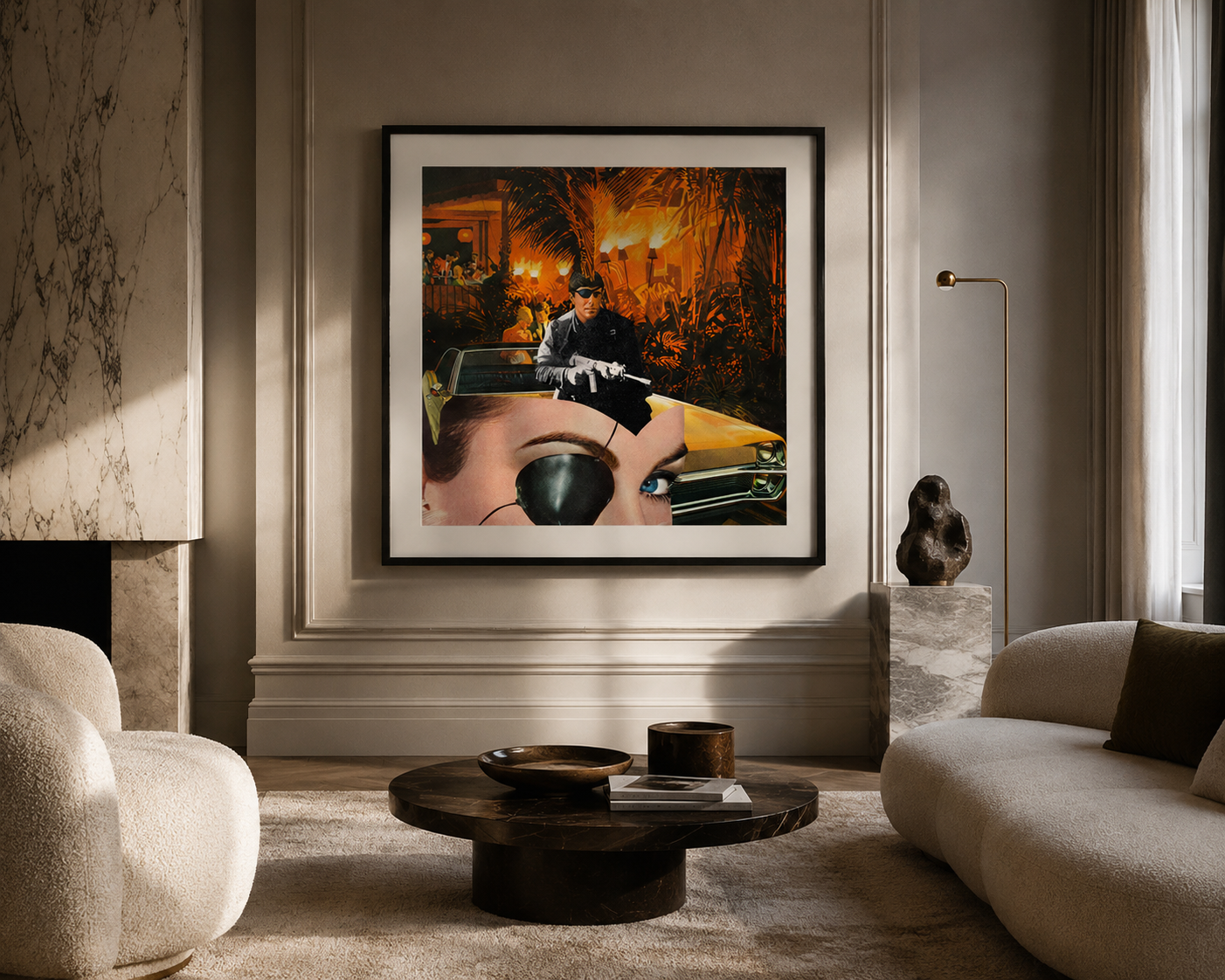
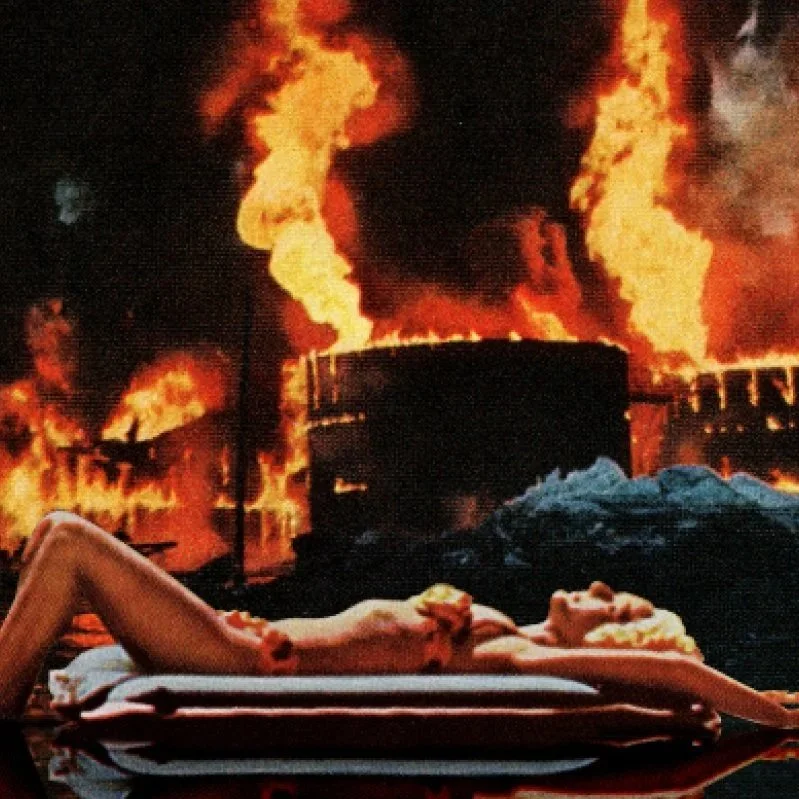
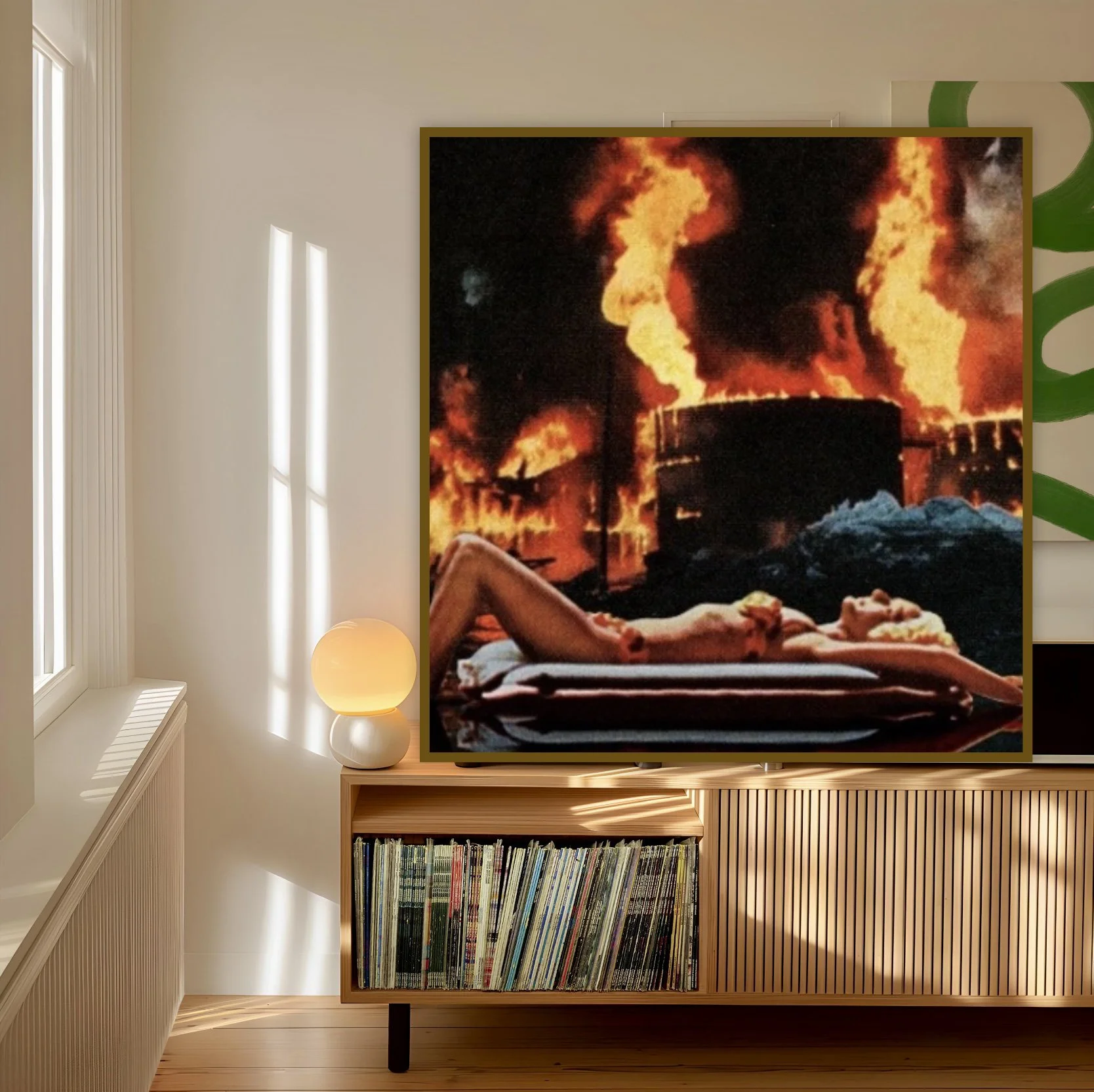
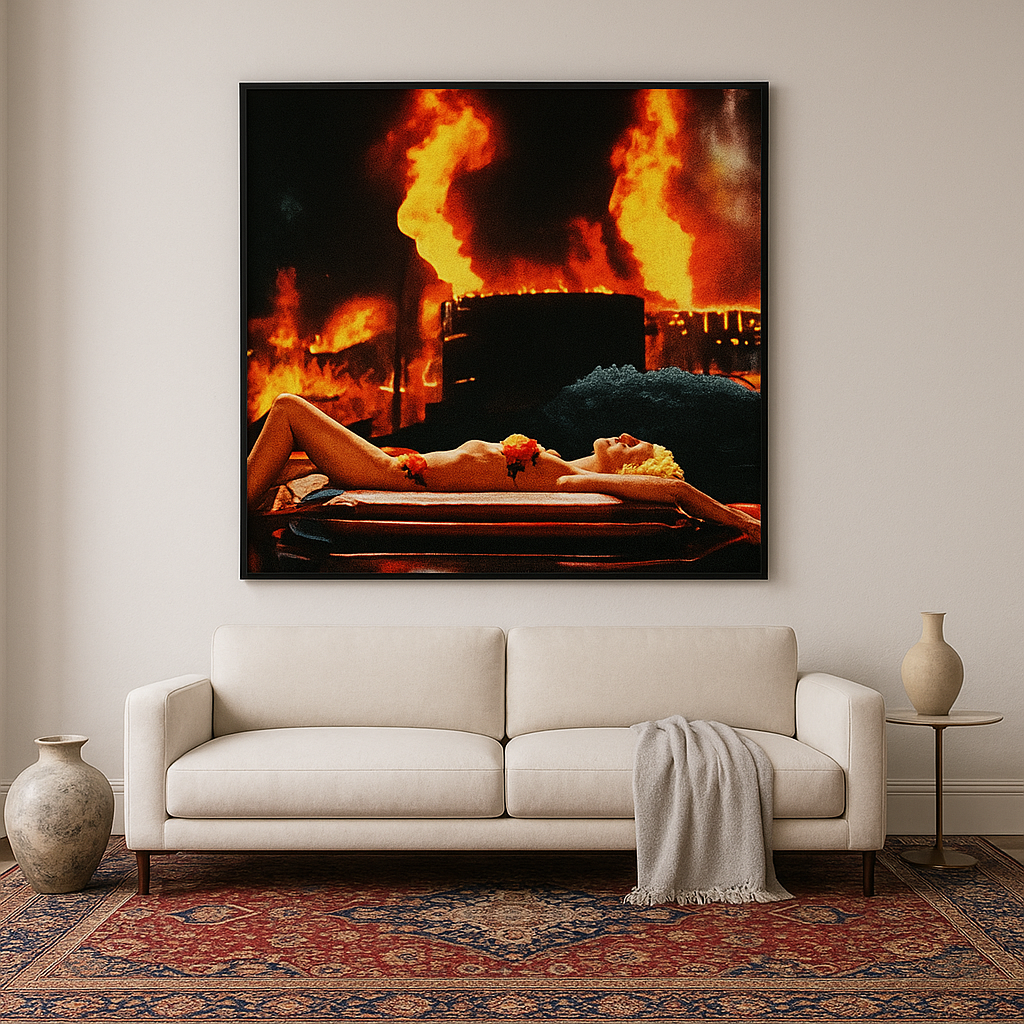
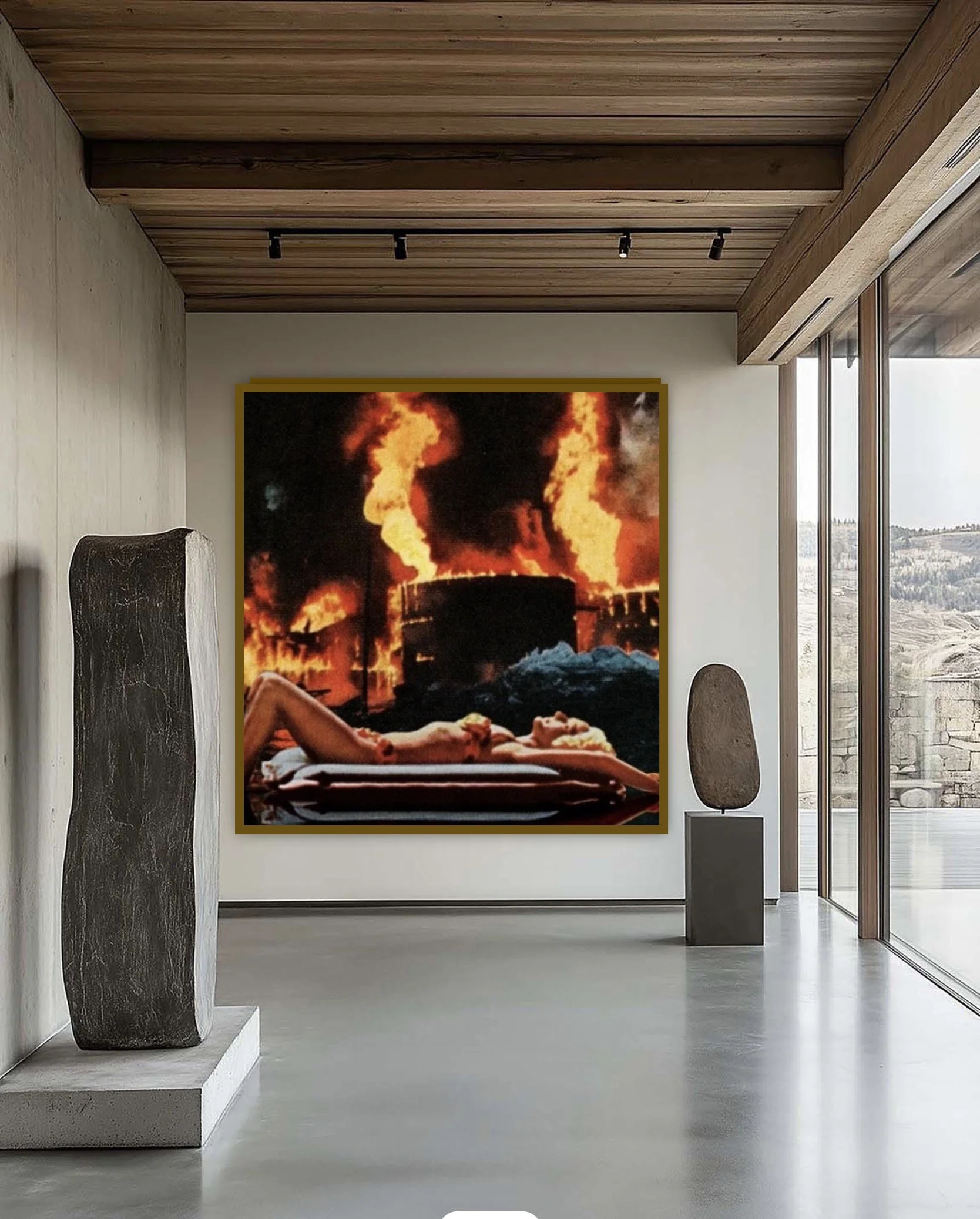
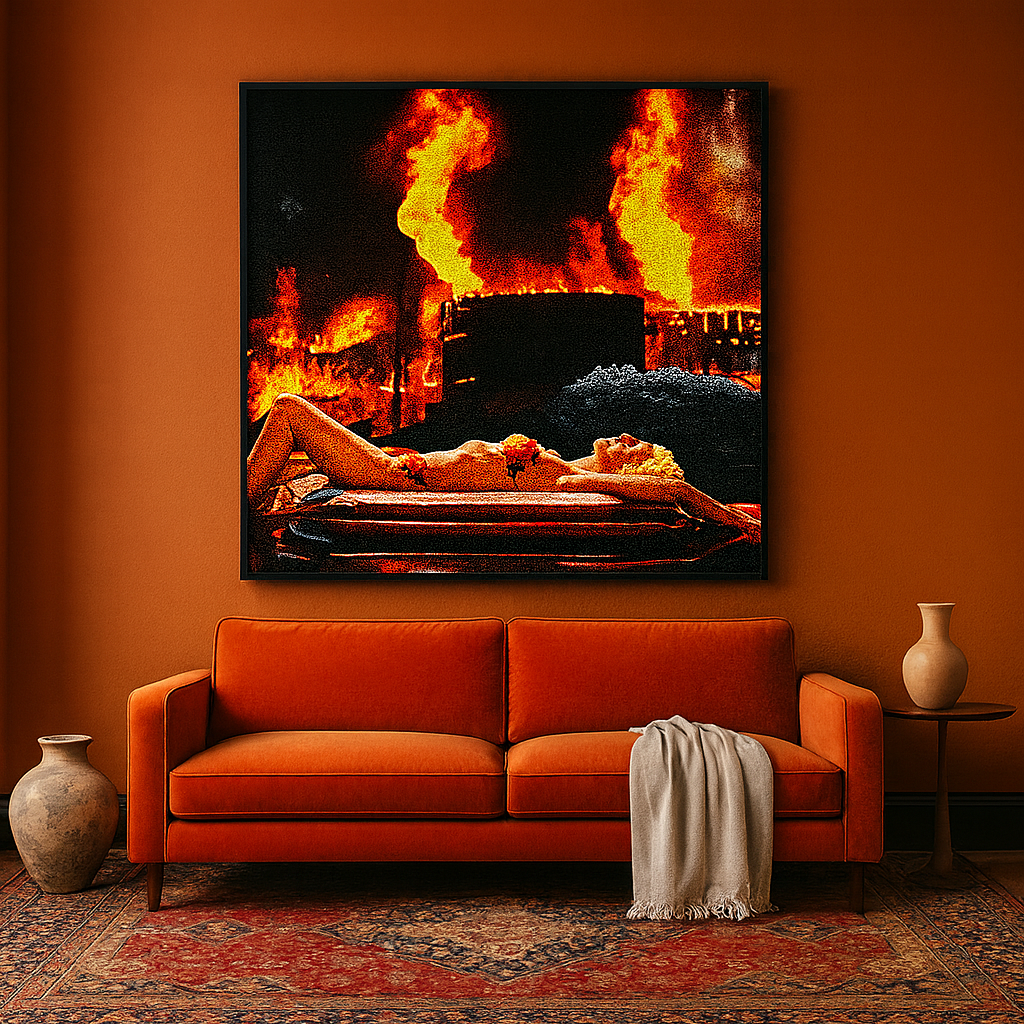
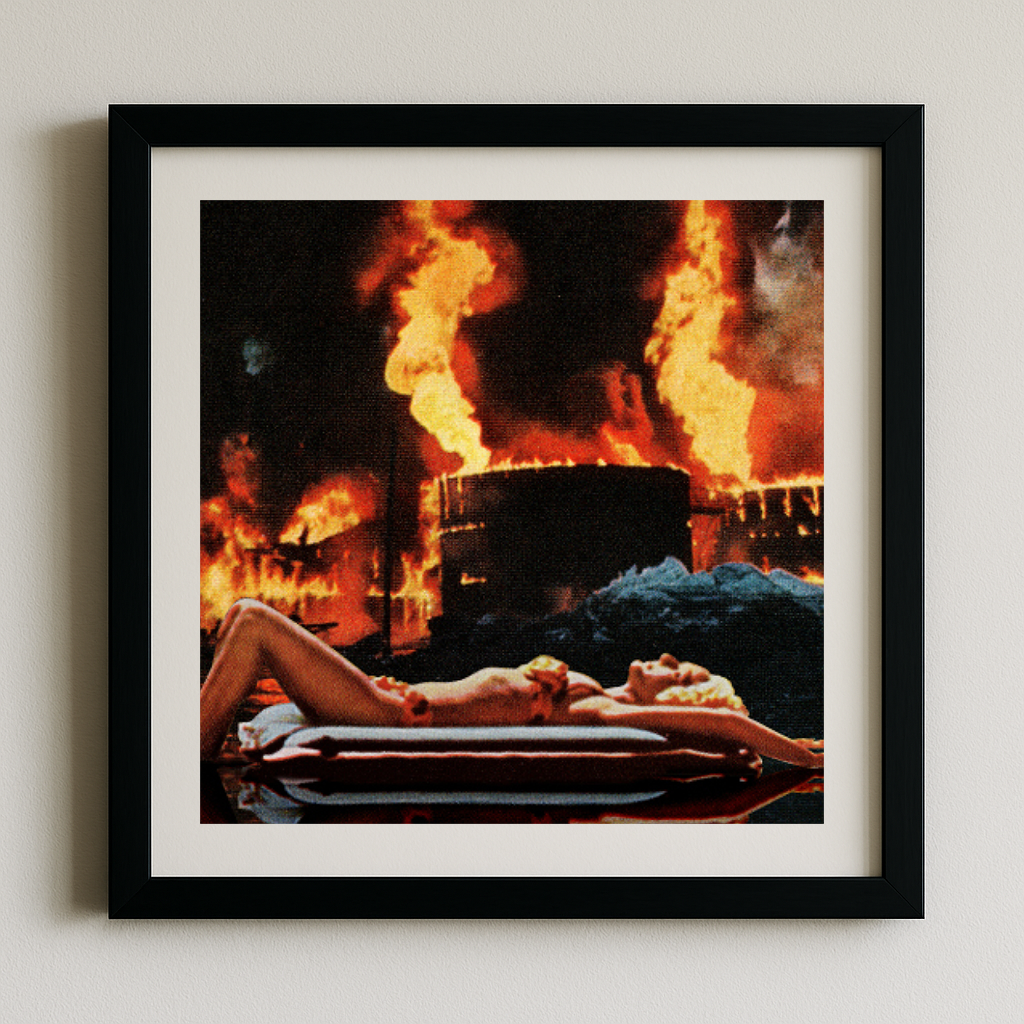
Stretched out on an inflatable mattress, a woman in a bikini lounges before a towering blaze with almost insolent ease. Nothing in her posture suggests that the fire troubles her. Quite the opposite. She seems to welcome the heat with unmistakable pleasure, as though catastrophe itself had opened a space where anything might be permitted.
At first glance, the scene may seem absurd. Joan Seed moves away from realism to reveal an inner disposition. The blaze gradually becomes something else: the setting in which a certain way of responding to catastrophe comes into view.
The title, How I Behave in an Emergency, immediately directs our attention to the woman herself. The subtitle, Notes on Emergency Conduct, shifts our focus toward the way she chooses to inhabit catastrophe. The longer we look, the more one question insists: what exactly is unfolding before our eyes?
The scene almost naturally evokes an imagined Rome. The monumental structure in the background recalls the Colosseum without ever truly depicting it. We are reminded of the emperor Nero watching the city consumed by flames, as portrayed by the Roman historians Suetonius and Cassius Dio. Whether this image faithfully reflects historical reality is of little importance here. What remains with us is the enduring figure it has become: one that embodies the unsettling proximity between power, spectacle, and catastrophe.
This proximity opens onto a broader reflection on the notion of decency. For centuries, decency was often expressed through conventions of dress, propriety, and social conduct. Joan Seed gently shifts the question. When the world is burning, does indecency reside in the exposure of the body—or in the exhibition of carefree detachment?
Other works and other periods of history have offered very different responses to the experience of catastrophe. In The End of the World Through a Soft Filter, Joan Seed explored climate peril through the comforting rhythms of everyday life, where gentleness itself encouraged denial. In an entirely different context, the nineteenth-century French historian Jules Michelet observed that a society exhausted by years of upheaval might ultimately long above all for rest—a rest that becomes a way of bringing chaos to an end. Created at the beginning of the Second World War, the famous Keep Calm and Carry On poster was intended to offer the British people, in the event of invasion, a form of composure sustained by courage, solidarity, and determination.
Here, however, rest embraces disaster. The woman welcomes catastrophe with cheerful fatalism, as though it relieved her of every moral obligation and every duty of solidarity, transforming emergency into celebration.
The phrase Après nous, le deluge [After us, the deluge]—variously attributed to Madame de Pompadour or Louis XV—finds an unexpected echo here. If the deluge still belongs to the future, the fire is already raging. Pendant moi, les flammes [During me, the flames] would seem the more fitting motto. Ultimately, the question may no longer be whether catastrophe will come. It is, rather, how we choose to live once it is already here.
-Louis Morency
At a time when disasters, armed conflicts, and environmental crises dominate the daily news, How I Behave in an Emergency resonates with particular force. Through its subtitle, Notes on Emergency Conduct, Joan Seed invites us to look beyond catastrophe itself and consider the attitudes it brings to light. The disaster becomes the starting point for a reflection on the choices it reveals, the responses it elicits, and the many ways human beings inhabit times of crisis.
By turning emergency into a space of pleasure, Joan Seed may not be portraying any one individual. Instead, she gives striking form to a temptation that surfaces in periods of upheaval. Denial, courage, exhaustion, fatalism, and carefree detachment are all possible responses to a world in turmoil. Rather than condemning or celebrating them, the work invites us to observe them with lucidity—and perhaps to recognize those that feel most familiar.
Title: How I Behave in an Emergency
Artist: Joan Seed
Medium: Mixed Media Collage
Limited edition prints, hand-signed and numbered
Material: Museum-grade giclée print on archival, textured cotton paper
Size Options:
• 30 × 30 inches (76.2 × 76.2 cm)
• 60 × 60 inches (152.4 × 152.4 cm)
Shipping: Flat rate of $175 CAD per order.
For acquisitions, inquiries, and commissions: joan@joanseed.ca
© 2026 Joan Seed. All rights reserved. This artwork and its images may not be reproduced, copied, distributed, or used in any form without the prior written permission of the artist.
A Letter from Joan:
My dear friend,
People often ask me how I behave in an emergency.
I lie down, naturally.
The flames cast a remarkably flattering light. It would be a shame not to make the most of it. That seems perfectly reasonable to me.
I’ve been accused of lacking decency. I confess I don’t entirely understand why. The flames, for their part, have never judged me. They’ve simply done a wonderful job of illuminating my profile.
If civilization insists on collapsing, I’d rather it did so without leaving me in the shade.
With my warmest, most ardent affection,
Joan
Stretched out on an inflatable mattress, a woman in a bikini lounges before a towering blaze with almost insolent ease. Nothing in her posture suggests that the fire troubles her. Quite the opposite. She seems to welcome the heat with unmistakable pleasure, as though catastrophe itself had opened a space where anything might be permitted.
At first glance, the scene may seem absurd. Joan Seed moves away from realism to reveal an inner disposition. The blaze gradually becomes something else: the setting in which a certain way of responding to catastrophe comes into view.
The title, How I Behave in an Emergency, immediately directs our attention to the woman herself. The subtitle, Notes on Emergency Conduct, shifts our focus toward the way she chooses to inhabit catastrophe. The longer we look, the more one question insists: what exactly is unfolding before our eyes?
The scene almost naturally evokes an imagined Rome. The monumental structure in the background recalls the Colosseum without ever truly depicting it. We are reminded of the emperor Nero watching the city consumed by flames, as portrayed by the Roman historians Suetonius and Cassius Dio. Whether this image faithfully reflects historical reality is of little importance here. What remains with us is the enduring figure it has become: one that embodies the unsettling proximity between power, spectacle, and catastrophe.
This proximity opens onto a broader reflection on the notion of decency. For centuries, decency was often expressed through conventions of dress, propriety, and social conduct. Joan Seed gently shifts the question. When the world is burning, does indecency reside in the exposure of the body—or in the exhibition of carefree detachment?
Other works and other periods of history have offered very different responses to the experience of catastrophe. In The End of the World Through a Soft Filter, Joan Seed explored climate peril through the comforting rhythms of everyday life, where gentleness itself encouraged denial. In an entirely different context, the nineteenth-century French historian Jules Michelet observed that a society exhausted by years of upheaval might ultimately long above all for rest—a rest that becomes a way of bringing chaos to an end. Created at the beginning of the Second World War, the famous Keep Calm and Carry On poster was intended to offer the British people, in the event of invasion, a form of composure sustained by courage, solidarity, and determination.
Here, however, rest embraces disaster. The woman welcomes catastrophe with cheerful fatalism, as though it relieved her of every moral obligation and every duty of solidarity, transforming emergency into celebration.
The phrase Après nous, le deluge [After us, the deluge]—variously attributed to Madame de Pompadour or Louis XV—finds an unexpected echo here. If the deluge still belongs to the future, the fire is already raging. Pendant moi, les flammes [During me, the flames] would seem the more fitting motto. Ultimately, the question may no longer be whether catastrophe will come. It is, rather, how we choose to live once it is already here.
-Louis Morency
At a time when disasters, armed conflicts, and environmental crises dominate the daily news, How I Behave in an Emergency resonates with particular force. Through its subtitle, Notes on Emergency Conduct, Joan Seed invites us to look beyond catastrophe itself and consider the attitudes it brings to light. The disaster becomes the starting point for a reflection on the choices it reveals, the responses it elicits, and the many ways human beings inhabit times of crisis.
By turning emergency into a space of pleasure, Joan Seed may not be portraying any one individual. Instead, she gives striking form to a temptation that surfaces in periods of upheaval. Denial, courage, exhaustion, fatalism, and carefree detachment are all possible responses to a world in turmoil. Rather than condemning or celebrating them, the work invites us to observe them with lucidity—and perhaps to recognize those that feel most familiar.
Title: How I Behave in an Emergency
Artist: Joan Seed
Medium: Mixed Media Collage
Limited edition prints, hand-signed and numbered
Material: Museum-grade giclée print on archival, textured cotton paper
Size Options:
• 30 × 30 inches (76.2 × 76.2 cm)
• 60 × 60 inches (152.4 × 152.4 cm)
Shipping: Flat rate of $175 CAD per order.
For acquisitions, inquiries, and commissions: joan@joanseed.ca
© 2026 Joan Seed. All rights reserved. This artwork and its images may not be reproduced, copied, distributed, or used in any form without the prior written permission of the artist.