A Love Letter from Joan:
Darling,
Lola walked into the Copacabana like a storm beneath the neon lights, scattering cocktails, certainty, and men with the flick of her hand. The boys in pressed jackets thought they were running the night, but she already knew the spectacle was slipping away from them. Power never belonged to the loudest voice in the room. It belongs to the women who can watch an entire world bend around them. They called her dangerous, scandalous, uncontrollable. Later, they tried to turn her into a sad memory, a fallen queen imprisoned inside the faded lights of the cabaret. It’s easier for them that way. Men adore flamboyant women as long as they eventually collapse in front of them. But something no longer fits the story. All it takes is one look at the flames to understand that Lola wasn’t finished yet.
With love, and a lighter tucked inside my handbag,
Joan
A Closer Look
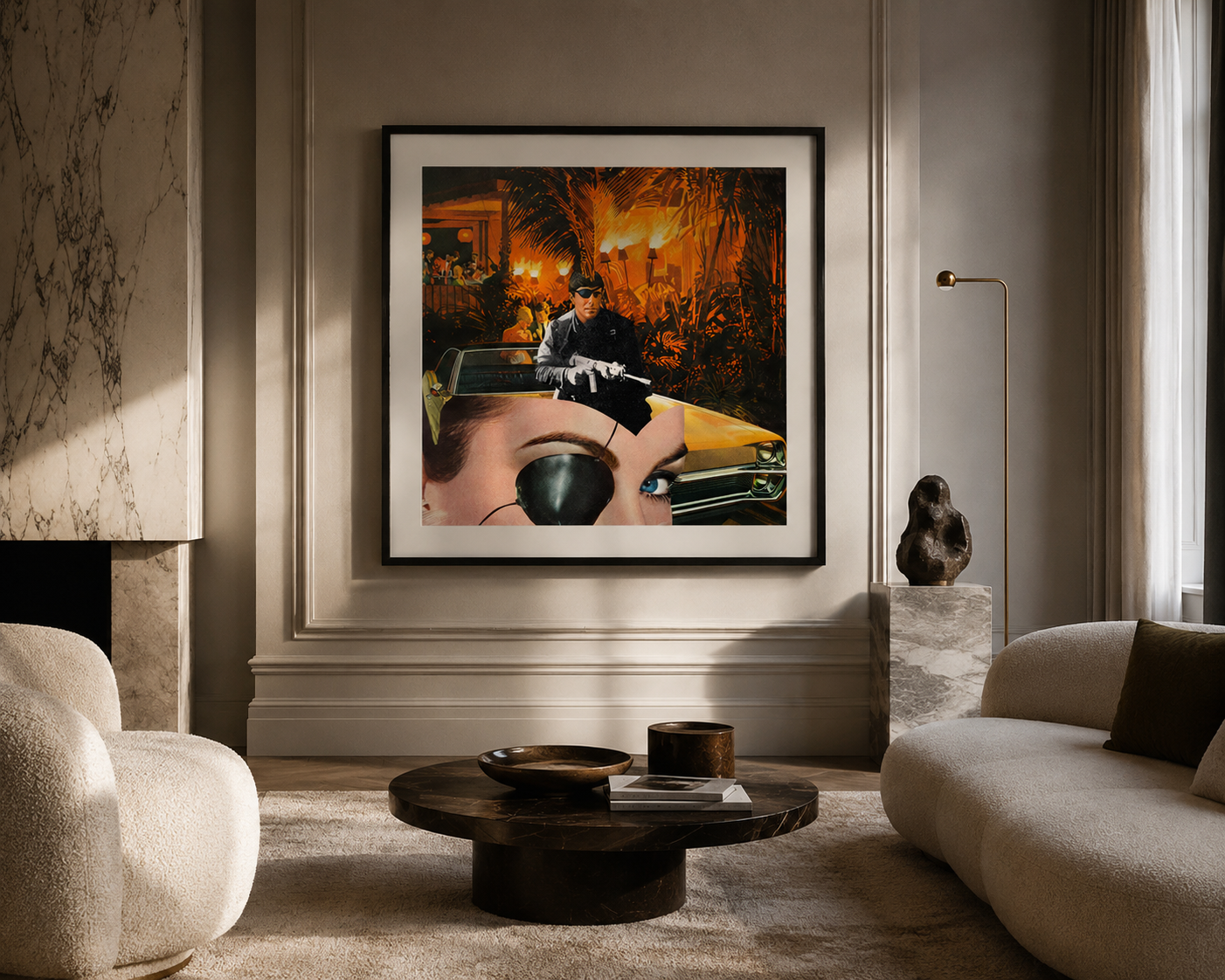
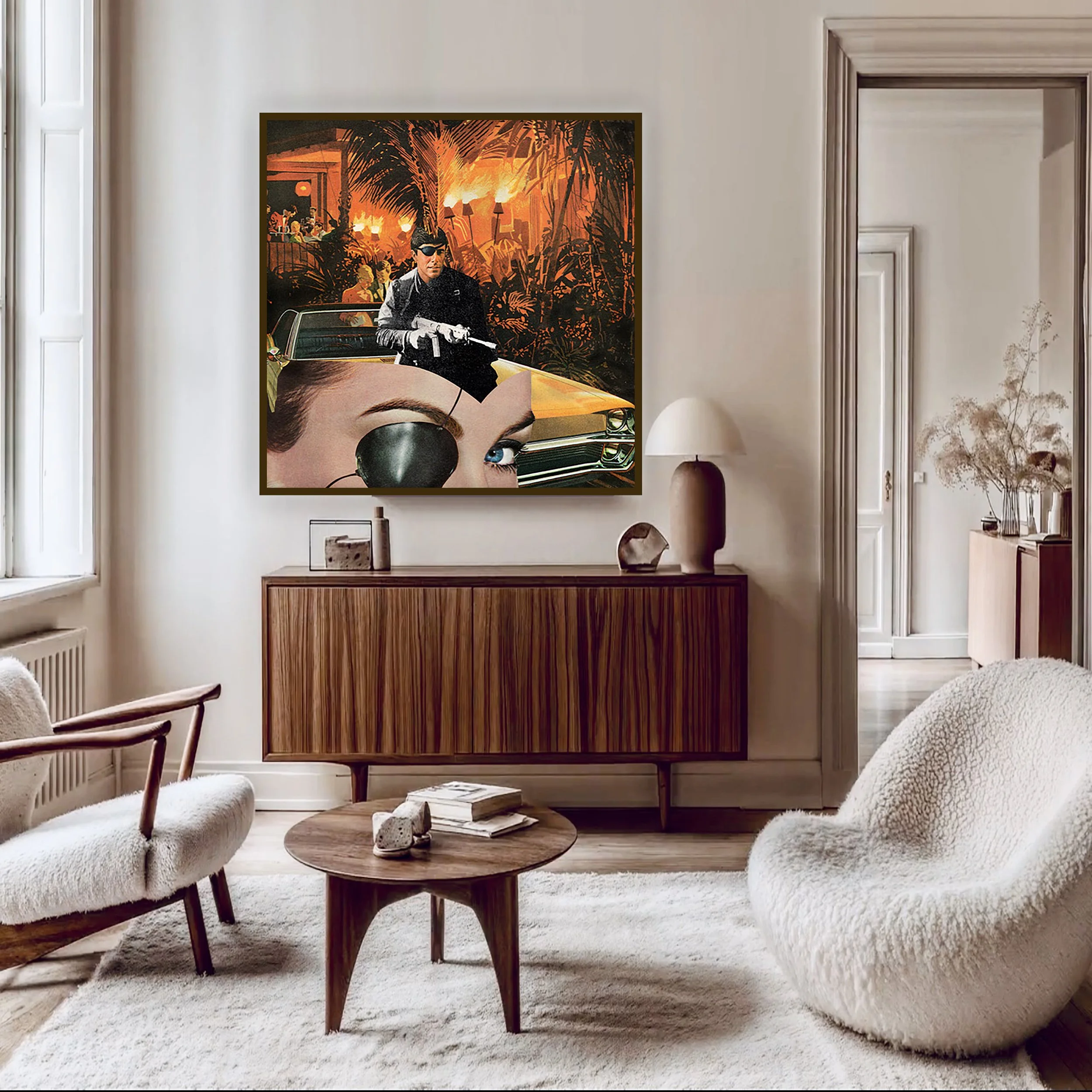
In Lola at the Copacabana, Joan Seed twists the visual language of film noir and 1960s glamour magazines into a scene where female power is no longer decorative.The collage borrows from the aesthetics of tropical luxury, with its palm trees, convertible car, and burning orange light, while an unsettling tension gradually permeates the scene. The American dream appears here as a stage set already on the verge of violence. At first, the armed male figure seems to dominate the composition. Yet the eye repeatedly returns to the fragmented female face looming in the foreground. Vast and almost unreal, it becomes a psychological presence haunting the entire image. The visible eye watches the chaos without panic. It refuses to look away. This distortion transforms Lola into a lingering consciousness within the scene, carrying both the memory of the tragedy and a force still resisting its own mythologizing.
The title inevitably recalls the famous Copacabana by Barry Manilow, with its dancer caught in a world where spectacle and masculine violence slowly bleed into one another. In the original song, a confrontation erupts inside the club, and a single gunshot is enough to send the story spiraling into tragedy. Lola remains trapped in the memory of that night long afterward. Joan Seed, however, seems to revisit the story after the collapse of the myth, as Lola continues to haunt the cabaret and its memories.
Once, she illuminated the club through sheer stage presence. That light now feels contaminated by something darker, more troubled, more sinister. She no longer appears as a passive figure imprisoned inside nostalgia, but as a lucid figure with incendiary undertones, still watching the scene unfold around her. The original song already leaves behind an unsettling ambiguity surrounding the violence that changes everything: “But just who shot who?” Seed extends that uncertainty rather than resolving it.
By revisiting this popular cultural figure, she refuses to reduce Lola to a mere victim of spectacle or masculine violence. The collage restores to her a more opaque and active presence. She ceases to be only the woman around whom the story happens. She also becomes someone who may have participated in the chaos she now contemplates.
The motif of the partially obscured eye, shared by both Lola and the armed male figure, introduces a strange feeling of mutual blindness. Read through the lens of Copacabana, this interrupted gaze may evoke a consciousness altered by spectacle, alcohol, fantasy, or violence itself.
The flames crossing the image become equally ambiguous. They participate in the theatrical aesthetics of the cabaret, while also extending the tension that permeates the entire composition. Their presence floods the scene with an incandescent and almost threatening light, as though the spectacle itself were always on the verge of losing control.
Context
Digital collage artwork inspired by film noir, American advertising aesthetics from the 1950s and 1960s, and the visual mythology of cabaret culture. In Lola at the Copacabana, Joan Seed revisits glamorous feminine archetypes through a composition charged with tension, spectacle, and latent violence. The work also dialogues with the cultural memory surrounding the song Copacabana by Barry Manilow and its tragic dancer figure. Through photomontage, archival imagery, and an intensely cinematic palette, Joan Seed explores the relationships between desire, power, and representation. Her work subverts symbols associated with the American dream in order to expose the instability, fantasy, and systems of control often embedded within popular images of femininity. The women inhabiting her collages rarely appear as passive witnesses to the narrative. They actively participate in the tensions, desires, and power dynamics structuring the image.
Artwork Details
Title:Lola at the Copacabana Artist: Joan Seed
Medium: Mixed Media Collage Edition: Limited edition prints, hand-signed and numbered
Material: Museum-grade giclée print on archival, textured cotton paper
Dimensions: 30 × 30 inches (76.2 × 76.2 cm) 60 × 60 inches (152.4 × 152.4 cm)
Shipping: Flat rate of $175 CAD per order Contact: joan@joanseed.ca
© 2026 Joan Seed. All rights reserved. This artwork and its images may not be reproduced, copied, distributed, or used in any form without the prior written permission of the artist.
A Love Letter from Joan:
Darling,
Lola walked into the Copacabana like a storm beneath the neon lights, scattering cocktails, certainty, and men with the flick of her hand. The boys in pressed jackets thought they were running the night, but she already knew the spectacle was slipping away from them. Power never belonged to the loudest voice in the room. It belongs to the women who can watch an entire world bend around them. They called her dangerous, scandalous, uncontrollable. Later, they tried to turn her into a sad memory, a fallen queen imprisoned inside the faded lights of the cabaret. It’s easier for them that way. Men adore flamboyant women as long as they eventually collapse in front of them. But something no longer fits the story. All it takes is one look at the flames to understand that Lola wasn’t finished yet.
With love, and a lighter tucked inside my handbag,
Joan
A Closer Look
In Lola at the Copacabana, Joan Seed twists the visual language of film noir and 1960s glamour magazines into a scene where female power is no longer decorative.The collage borrows from the aesthetics of tropical luxury, with its palm trees, convertible car, and burning orange light, while an unsettling tension gradually permeates the scene. The American dream appears here as a stage set already on the verge of violence. At first, the armed male figure seems to dominate the composition. Yet the eye repeatedly returns to the fragmented female face looming in the foreground. Vast and almost unreal, it becomes a psychological presence haunting the entire image. The visible eye watches the chaos without panic. It refuses to look away. This distortion transforms Lola into a lingering consciousness within the scene, carrying both the memory of the tragedy and a force still resisting its own mythologizing.
The title inevitably recalls the famous Copacabana by Barry Manilow, with its dancer caught in a world where spectacle and masculine violence slowly bleed into one another. In the original song, a confrontation erupts inside the club, and a single gunshot is enough to send the story spiraling into tragedy. Lola remains trapped in the memory of that night long afterward. Joan Seed, however, seems to revisit the story after the collapse of the myth, as Lola continues to haunt the cabaret and its memories.
Once, she illuminated the club through sheer stage presence. That light now feels contaminated by something darker, more troubled, more sinister. She no longer appears as a passive figure imprisoned inside nostalgia, but as a lucid figure with incendiary undertones, still watching the scene unfold around her. The original song already leaves behind an unsettling ambiguity surrounding the violence that changes everything: “But just who shot who?” Seed extends that uncertainty rather than resolving it.
By revisiting this popular cultural figure, she refuses to reduce Lola to a mere victim of spectacle or masculine violence. The collage restores to her a more opaque and active presence. She ceases to be only the woman around whom the story happens. She also becomes someone who may have participated in the chaos she now contemplates.
The motif of the partially obscured eye, shared by both Lola and the armed male figure, introduces a strange feeling of mutual blindness. Read through the lens of Copacabana, this interrupted gaze may evoke a consciousness altered by spectacle, alcohol, fantasy, or violence itself.
The flames crossing the image become equally ambiguous. They participate in the theatrical aesthetics of the cabaret, while also extending the tension that permeates the entire composition. Their presence floods the scene with an incandescent and almost threatening light, as though the spectacle itself were always on the verge of losing control.
Context
Digital collage artwork inspired by film noir, American advertising aesthetics from the 1950s and 1960s, and the visual mythology of cabaret culture. In Lola at the Copacabana, Joan Seed revisits glamorous feminine archetypes through a composition charged with tension, spectacle, and latent violence. The work also dialogues with the cultural memory surrounding the song Copacabana by Barry Manilow and its tragic dancer figure. Through photomontage, archival imagery, and an intensely cinematic palette, Joan Seed explores the relationships between desire, power, and representation. Her work subverts symbols associated with the American dream in order to expose the instability, fantasy, and systems of control often embedded within popular images of femininity. The women inhabiting her collages rarely appear as passive witnesses to the narrative. They actively participate in the tensions, desires, and power dynamics structuring the image.
Artwork Details
Title:Lola at the Copacabana Artist: Joan Seed
Medium: Mixed Media Collage Edition: Limited edition prints, hand-signed and numbered
Material: Museum-grade giclée print on archival, textured cotton paper
Dimensions: 30 × 30 inches (76.2 × 76.2 cm) 60 × 60 inches (152.4 × 152.4 cm)
Shipping: Flat rate of $175 CAD per order Contact: joan@joanseed.ca
© 2026 Joan Seed. All rights reserved. This artwork and its images may not be reproduced, copied, distributed, or used in any form without the prior written permission of the artist.