
“Niagara Falls Vacation”is a high-concept surrealist collage exploring themes of spiritual spectacle, religious authority, birth trauma, and cultural tourism through an irreverent feminist lens. This piece is ideal for art dealers and collectors of political collage, feminist surrealism, and postmodern religious commentary.
A standout in Joan Seed’s oeuvre, this work blends satirical photo montage with vintage religious iconography, making it a key acquisition for gallery exhibitions centered on faith, birth, gender, and spectacle. The use of absurd elements—like a nun with a camera mid-blessing and a baby dangling like a souvenir—provokes thought and conversation. It also visually stuns.







Waters of Passage
Between Inheritance, Birth, and Transformation
A Letter from Joan:
My dear,
Everyone loves a rite of passage.
Being born. Getting married. Growing up. Changing.
People find all that deeply moving.
Personally, I prefer watching that brief moment when they realize there’s no turning back. That’s when smiles and grimaces become almost impossible to tell apart.
A little advice: hide your vertigo—it ruins the photographs.
Joan
A Closer Look
Niagara Falls has long been one of those places where people come to mark life’s turning points. It is where unions are celebrated, journeys immortalized, and nature’s overwhelming force invites visitors to pause before something that seems untouched by time. That impression recalls an intuition of the ancient Greek philosopher Heraclitus: the landscape appears unchanged even as every passing moment carries away different waters.
Against this familiar backdrop, Joan Seed stages a quietly unsettling scene. A nun wears unexpected makeup and holds a camera. A black-gloved, sinister hand holds a newborn suspended above the roaring falls. The remaining umbilical cord reminds us that a separation has just occurred, even though the bond has not yet entirely disappeared. As for the nun’s gesture, it resists any definitive interpretation. Is she offering a blessing? Welcoming the child? Or simply witnessing the scene? Her unexpected makeup hints that she, too, may be undergoing the quiet transformation unfolding throughout the image.
Gradually, several rites of passage begin to overlap. Birth, of course. Marriage, so deeply associated with Niagara Falls. Travel, suggested by this iconic destination. Even the river itself becomes the image of an irreversible transformation: it remains unmistakably itself while crossing a threshold from which there is no return.
The nun and her camera begin to take on a broader significance. For centuries, religious institutions accompanied life’s major transitions. They offered comfort, meaning, and a sense of community, but they also exercised authority whose darker chapters continue to leave painful traces in collective memory. Here, the camera seems almost to have put on the nun’s habit, as though an old calling had simply found a new form. The ways we accompany these passages may change. The responsibility they carry—with all its promises and all its risks—does not.
That reading resonates particularly strongly in Québec, where Joan Seed grew up. During the Quiet Revolution of the 1960s, the role of the Catholic Church was profoundly redefined as many responsibilities gradually shifted toward public institutions. Yet although the work is rooted in that history, it ultimately raises a far more universal question: How do we grow without entirely severing ourselves from what shaped us? How do we welcome a new world without believing that everything which came before it must disappear?
Perhaps that is what this work quietly reminds us. Life’s great transitions are rarely accompanied by a single emotion. They almost always arrive carrying both confidence and vertigo. Joan Seed does not try to resolve that tension. She simply invites us to linger for a moment on the threshold, where every beginning still carries the memory of what it leaves behind.
-Louis Morency
Context
Waters of Passage explores rites of passage, personal transformation, and the ways societies navigate change. Through the imagery of birth, marriage, photography, Niagara Falls, and religious presence, Joan Seed reflects on how people seek meaning at the moments when a life, a community, or an era crosses an irreversible threshold.
For Joan Seed, these questions also resonate with the history of Québec, where the Quiet Revolution profoundly reshaped the place of the Catholic Church within society. While rooted in that historical experience, the work ultimately speaks to universal questions of transmission, memory, institutions, and the ways each generation reimagines the passages that shape human life.
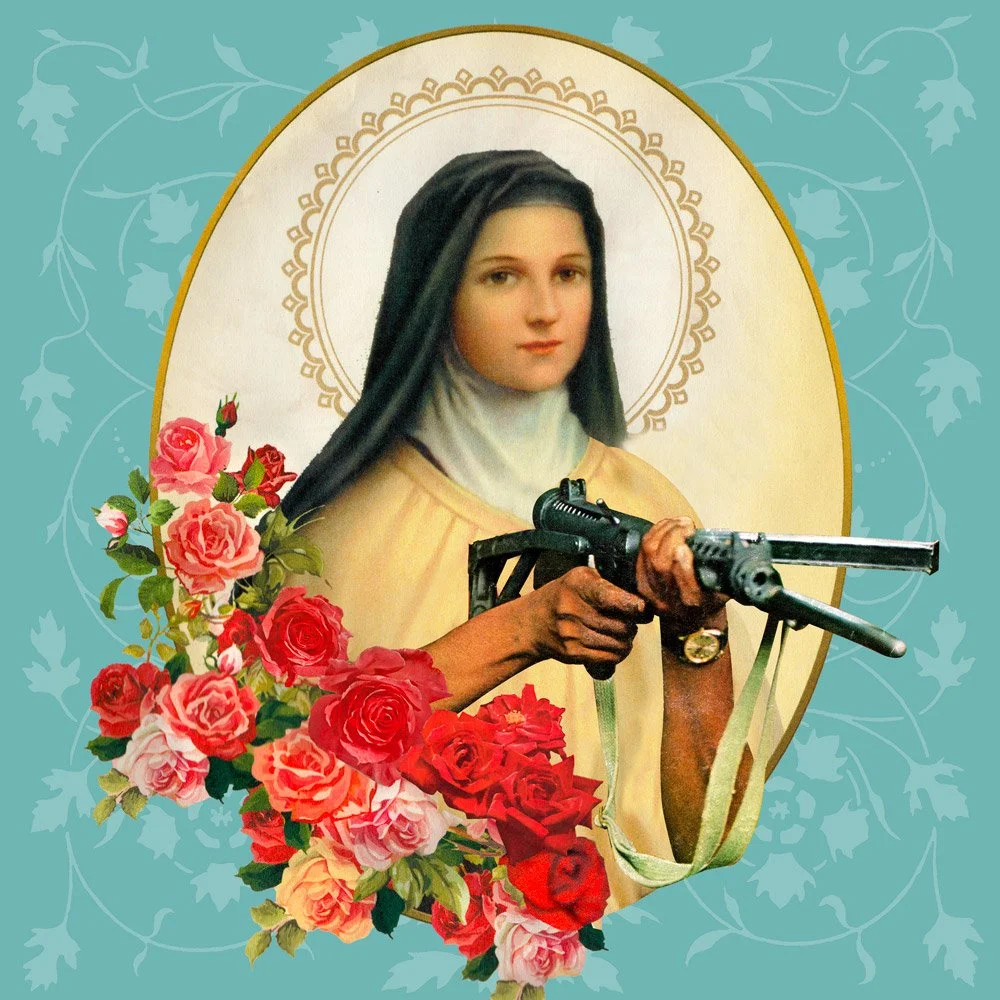
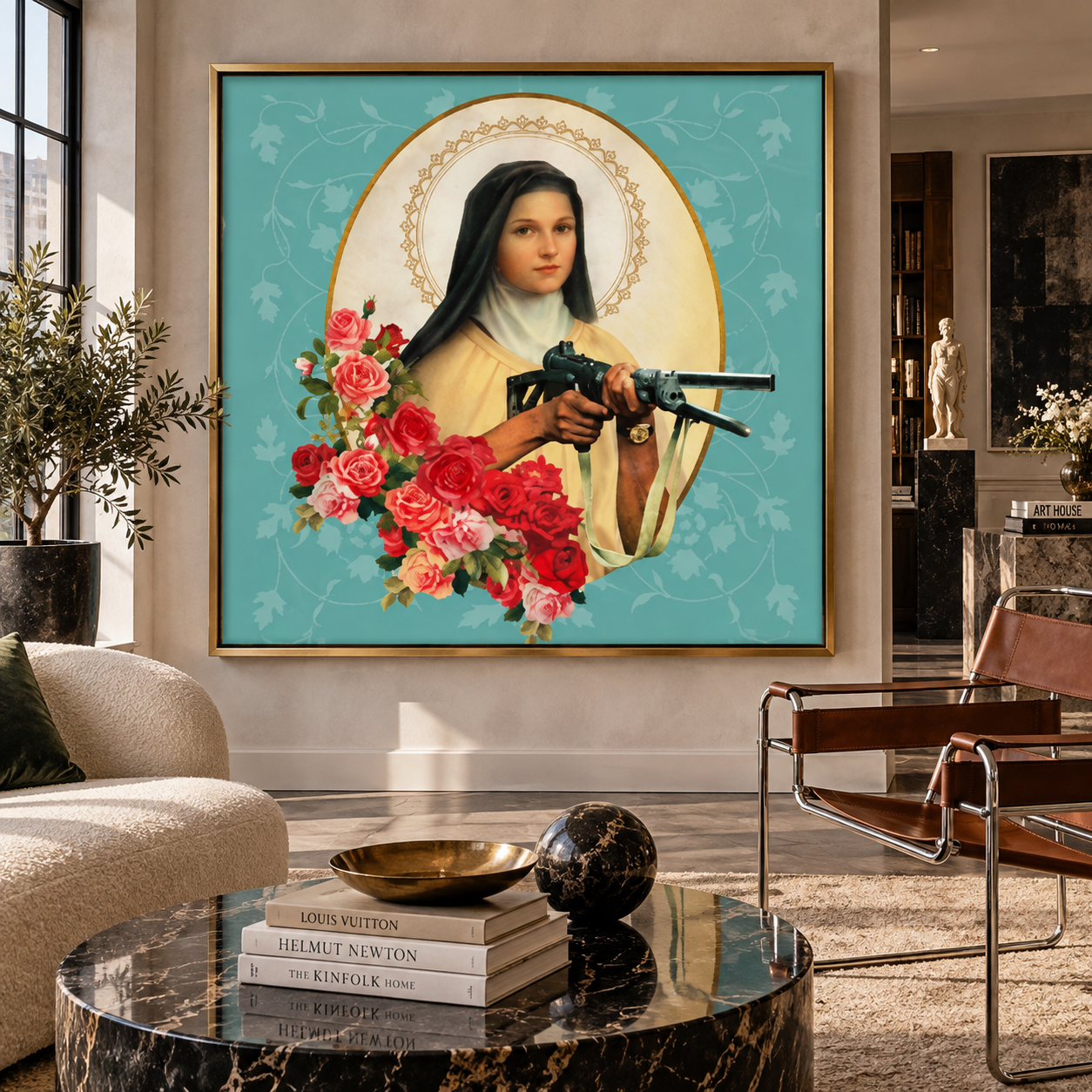
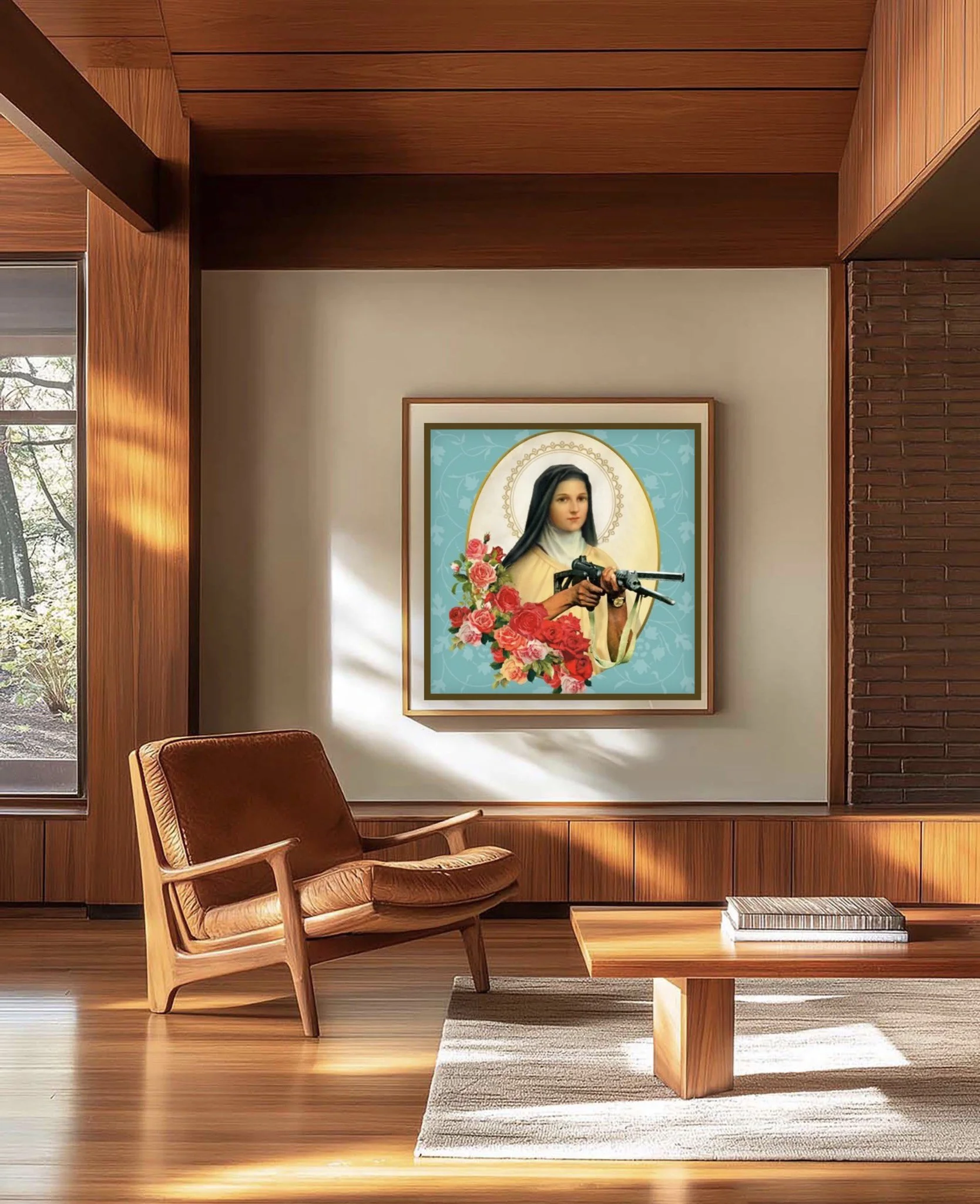
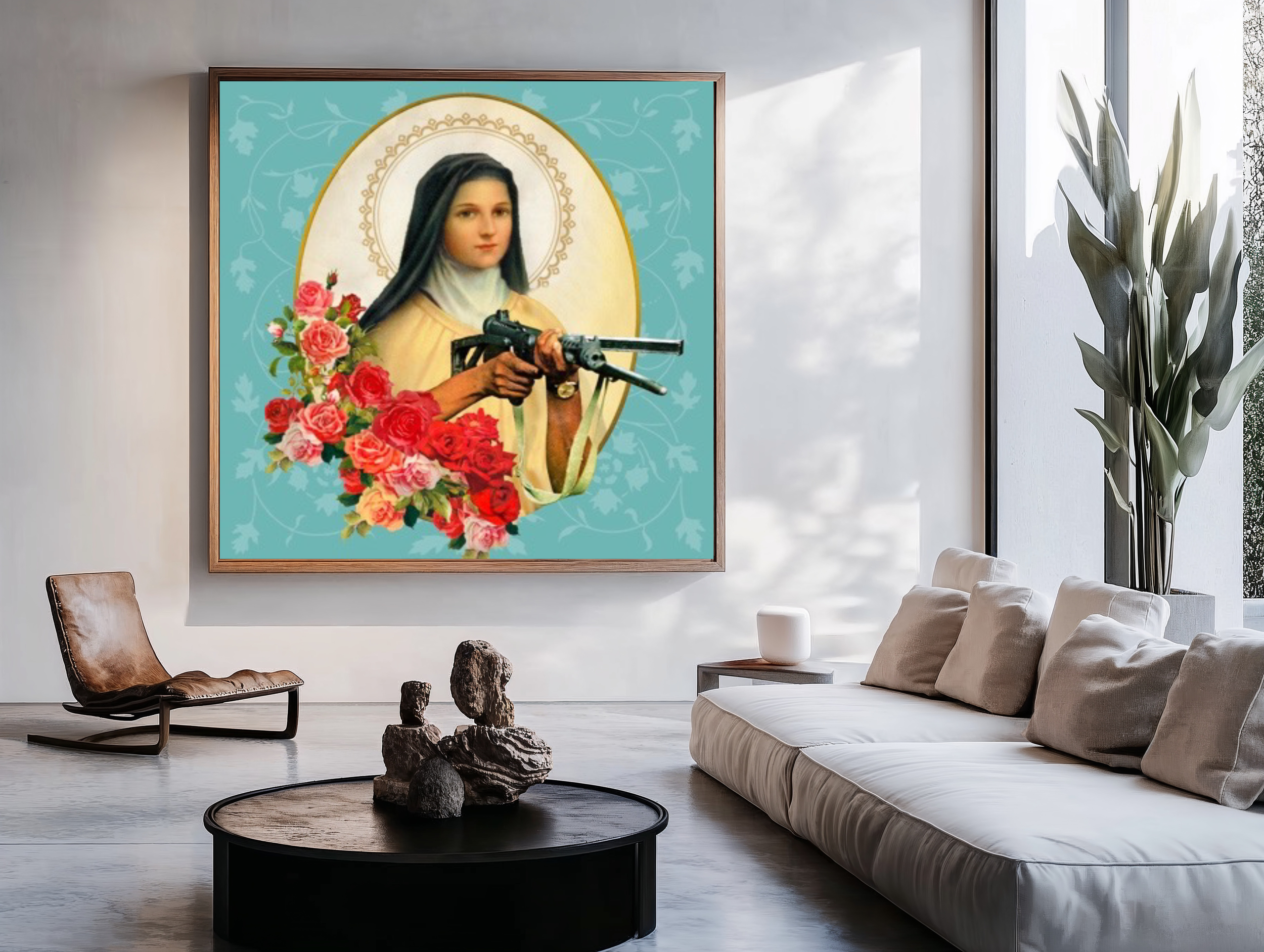
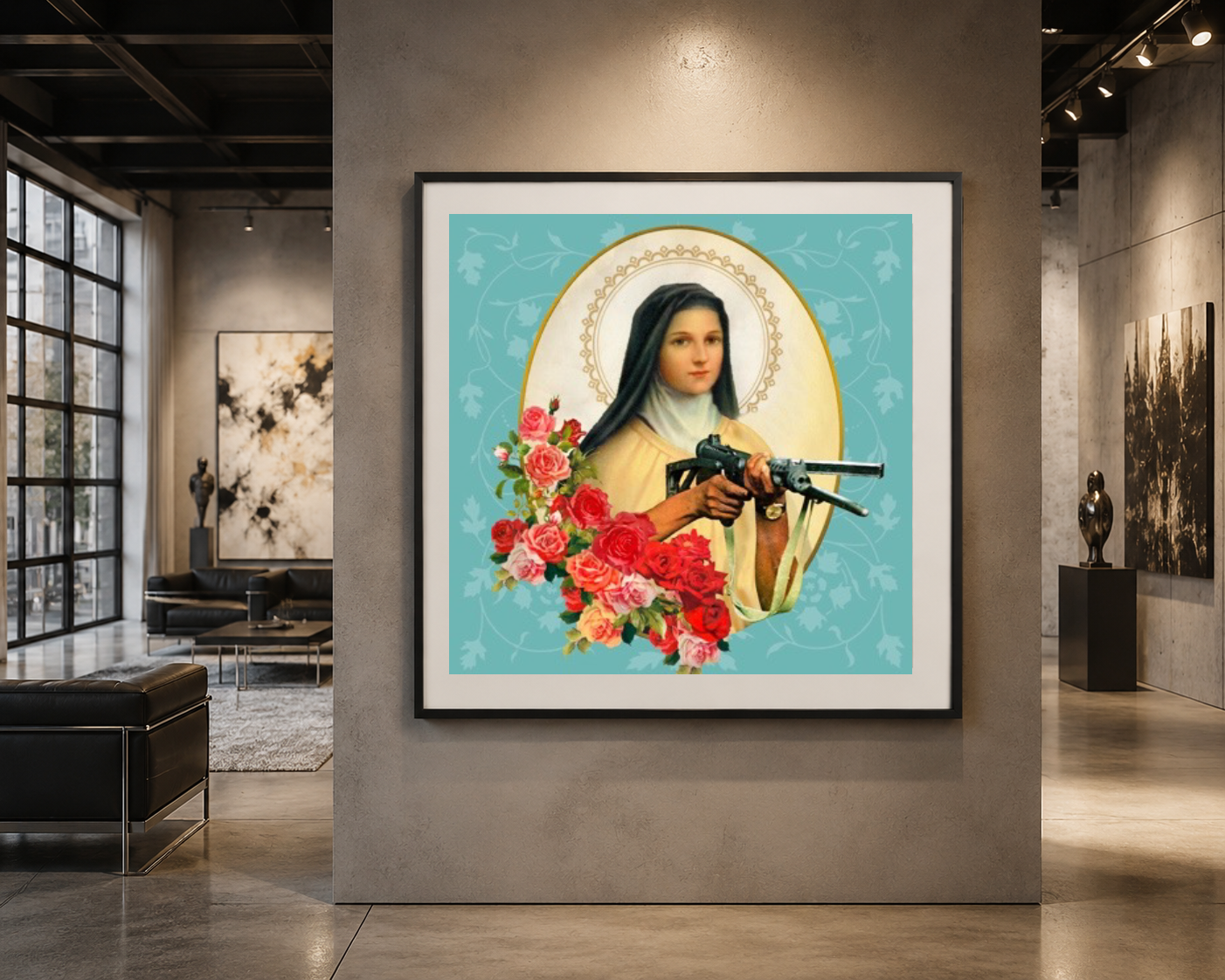
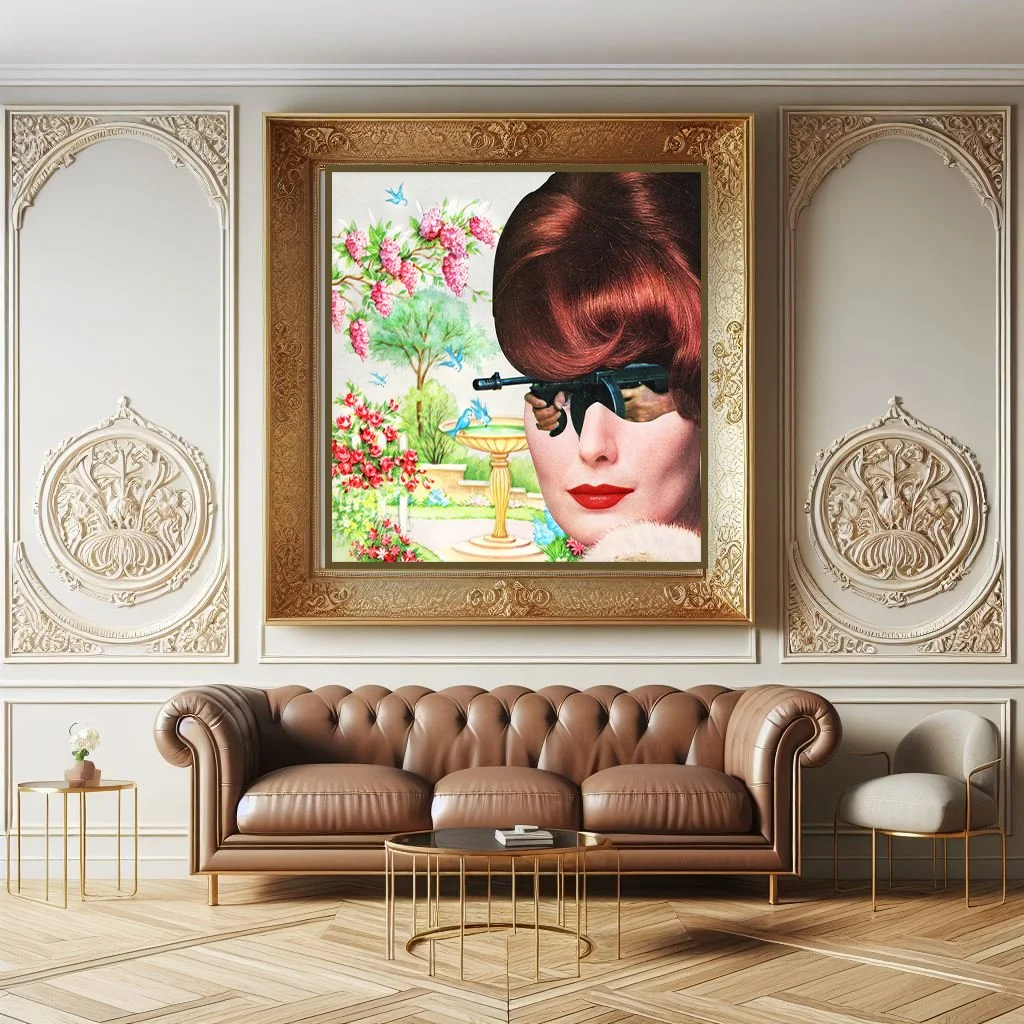
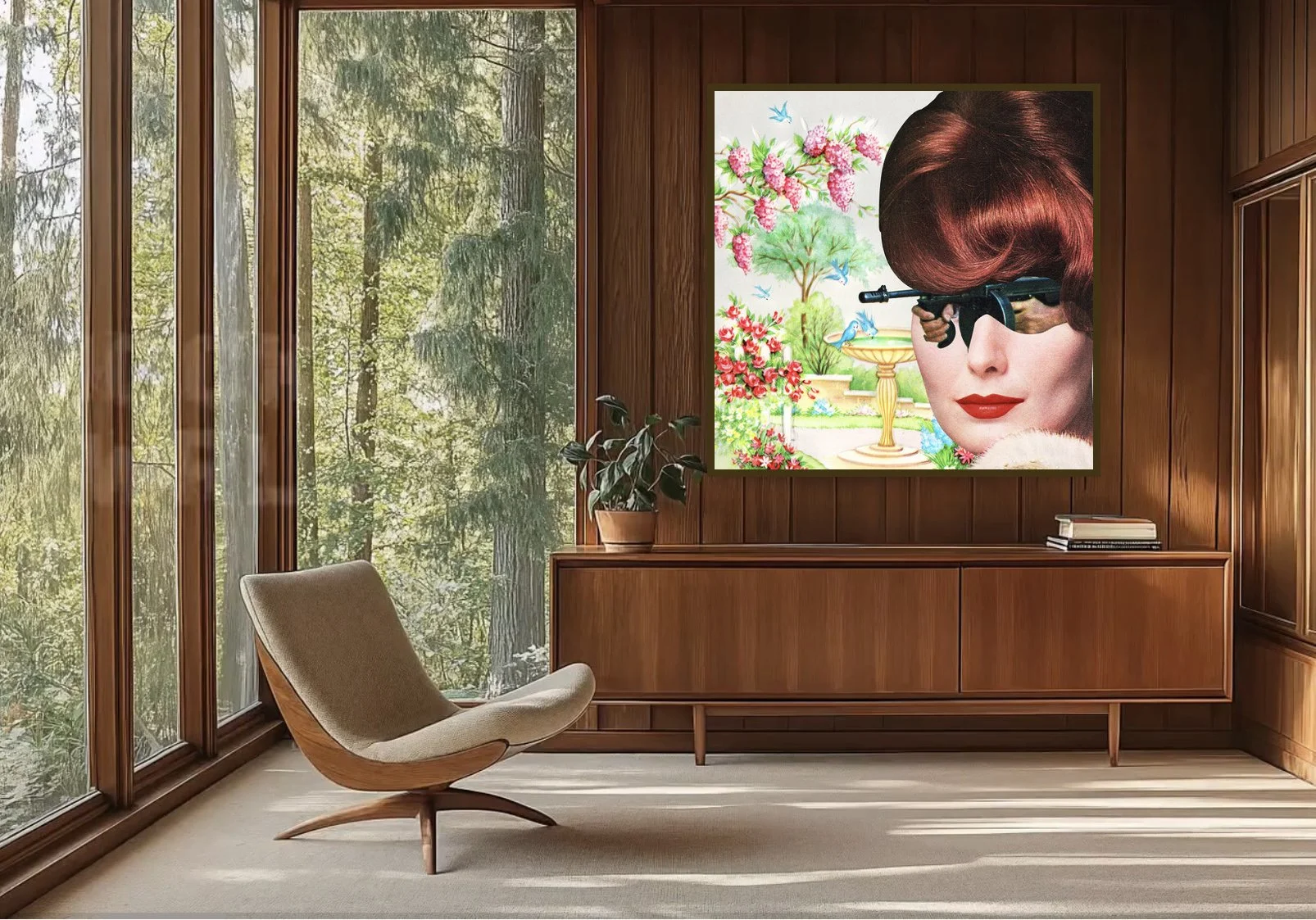
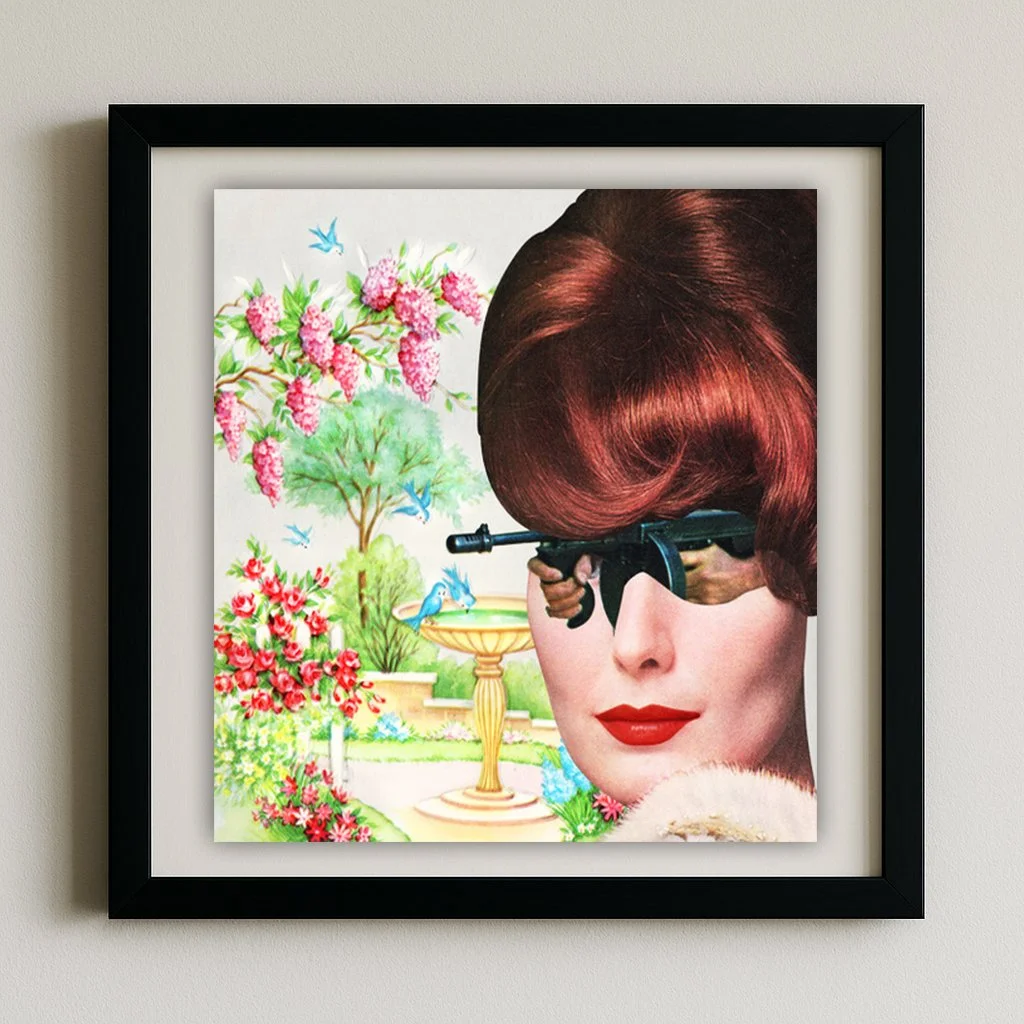
Artwork DetailsTitle: Semi-Automatic Virgin
Artist: Joan Seed
Medium: Mixed Media Collage
Limited edition prints, hand-signed and numbered
Material: Museum-grade giclée print on archival, textured cotton paper
Size Options:
• 30 × 30 inches (76.2 × 76.2 cm)
• 60 × 60 inches (152.4 × 152.4 cm)
Shipping: Flat rate of $175 CAD per order.
For acquisitions, inquiries, and commissions: joan@joanseed.ca
© 2026 Joan Seed. All rights reserved. This artwork and its images may not be reproduced, copied, distributed, or used in any form without the prior written permission of the artist.
Between Inheritance, Birth, and Transformation
A Letter from Joan:
My dear,
Everyone loves a rite of passage.
Being born. Getting married. Growing up. Changing.
People find all that deeply moving.
Personally, I prefer watching that brief moment when they realize there’s no turning back. That’s when smiles and grimaces become almost impossible to tell apart.
A little advice: hide your vertigo—it ruins the photographs.
Joan
A Closer Look
Niagara Falls has long been one of those places where people come to mark life’s turning points. It is where unions are celebrated, journeys immortalized, and nature’s overwhelming force invites visitors to pause before something that seems untouched by time. That impression recalls an intuition of the ancient Greek philosopher Heraclitus: the landscape appears unchanged even as every passing moment carries away different waters.
Against this familiar backdrop, Joan Seed stages a quietly unsettling scene. A nun wears unexpected makeup and holds a camera. A black-gloved, sinister hand holds a newborn suspended above the roaring falls. The remaining umbilical cord reminds us that a separation has just occurred, even though the bond has not yet entirely disappeared. As for the nun’s gesture, it resists any definitive interpretation. Is she offering a blessing? Welcoming the child? Or simply witnessing the scene? Her unexpected makeup hints that she, too, may be undergoing the quiet transformation unfolding throughout the image.
Gradually, several rites of passage begin to overlap. Birth, of course. Marriage, so deeply associated with Niagara Falls. Travel, suggested by this iconic destination. Even the river itself becomes the image of an irreversible transformation: it remains unmistakably itself while crossing a threshold from which there is no return.
The nun and her camera begin to take on a broader significance. For centuries, religious institutions accompanied life’s major transitions. They offered comfort, meaning, and a sense of community, but they also exercised authority whose darker chapters continue to leave painful traces in collective memory. Here, the camera seems almost to have put on the nun’s habit, as though an old calling had simply found a new form. The ways we accompany these passages may change. The responsibility they carry—with all its promises and all its risks—does not.
That reading resonates particularly strongly in Québec, where Joan Seed grew up. During the Quiet Revolution of the 1960s, the role of the Catholic Church was profoundly redefined as many responsibilities gradually shifted toward public institutions. Yet although the work is rooted in that history, it ultimately raises a far more universal question: How do we grow without entirely severing ourselves from what shaped us? How do we welcome a new world without believing that everything which came before it must disappear?
Perhaps that is what this work quietly reminds us. Life’s great transitions are rarely accompanied by a single emotion. They almost always arrive carrying both confidence and vertigo. Joan Seed does not try to resolve that tension. She simply invites us to linger for a moment on the threshold, where every beginning still carries the memory of what it leaves behind.
-Louis Morency
Context
Waters of Passage explores rites of passage, personal transformation, and the ways societies navigate change. Through the imagery of birth, marriage, photography, Niagara Falls, and religious presence, Joan Seed reflects on how people seek meaning at the moments when a life, a community, or an era crosses an irreversible threshold.
For Joan Seed, these questions also resonate with the history of Québec, where the Quiet Revolution profoundly reshaped the place of the Catholic Church within society. While rooted in that historical experience, the work ultimately speaks to universal questions of transmission, memory, institutions, and the ways each generation reimagines the passages that shape human life.
Artwork DetailsTitle: Semi-Automatic Virgin
Artist: Joan Seed
Medium: Mixed Media Collage
Limited edition prints, hand-signed and numbered
Material: Museum-grade giclée print on archival, textured cotton paper
Size Options:
• 30 × 30 inches (76.2 × 76.2 cm)
• 60 × 60 inches (152.4 × 152.4 cm)
Shipping: Flat rate of $175 CAD per order.
For acquisitions, inquiries, and commissions: joan@joanseed.ca
© 2026 Joan Seed. All rights reserved. This artwork and its images may not be reproduced, copied, distributed, or used in any form without the prior written permission of the artist.