A LETTER FROM JOAN
My dear,
I’ve just listened to Code Axel, the secret season of the podcast Hantées, and I’m still quite shaken. With that warm voice of his, Julien Morissette could have talked me out of a layer or two. But thank goodness I kept my sweater on, because his story chilled my blood.
Poor Émeric! To come back from the Arctic with your body still alive and everything else reported missing… And his girlfriend! There she is, an eternal Penelope, still waiting for a man who’s already come home. To be cheated on with an island, of all things! If Émeric was going to take a mistress, surely he could have chosen one a little less frigid.
To exorcise my fears, I made a collage. Your turn to shiver.
Kisses and shivers,
Joan
ARTISTIC CONTEXT
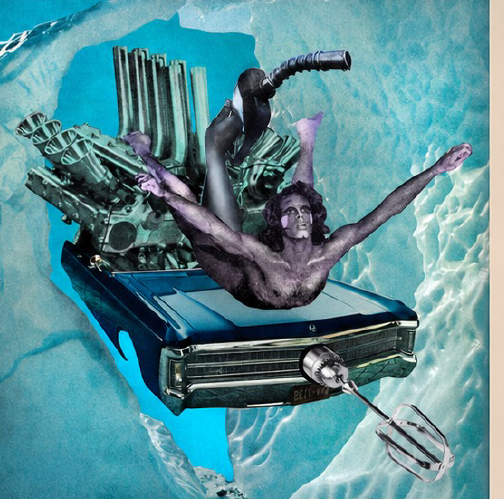
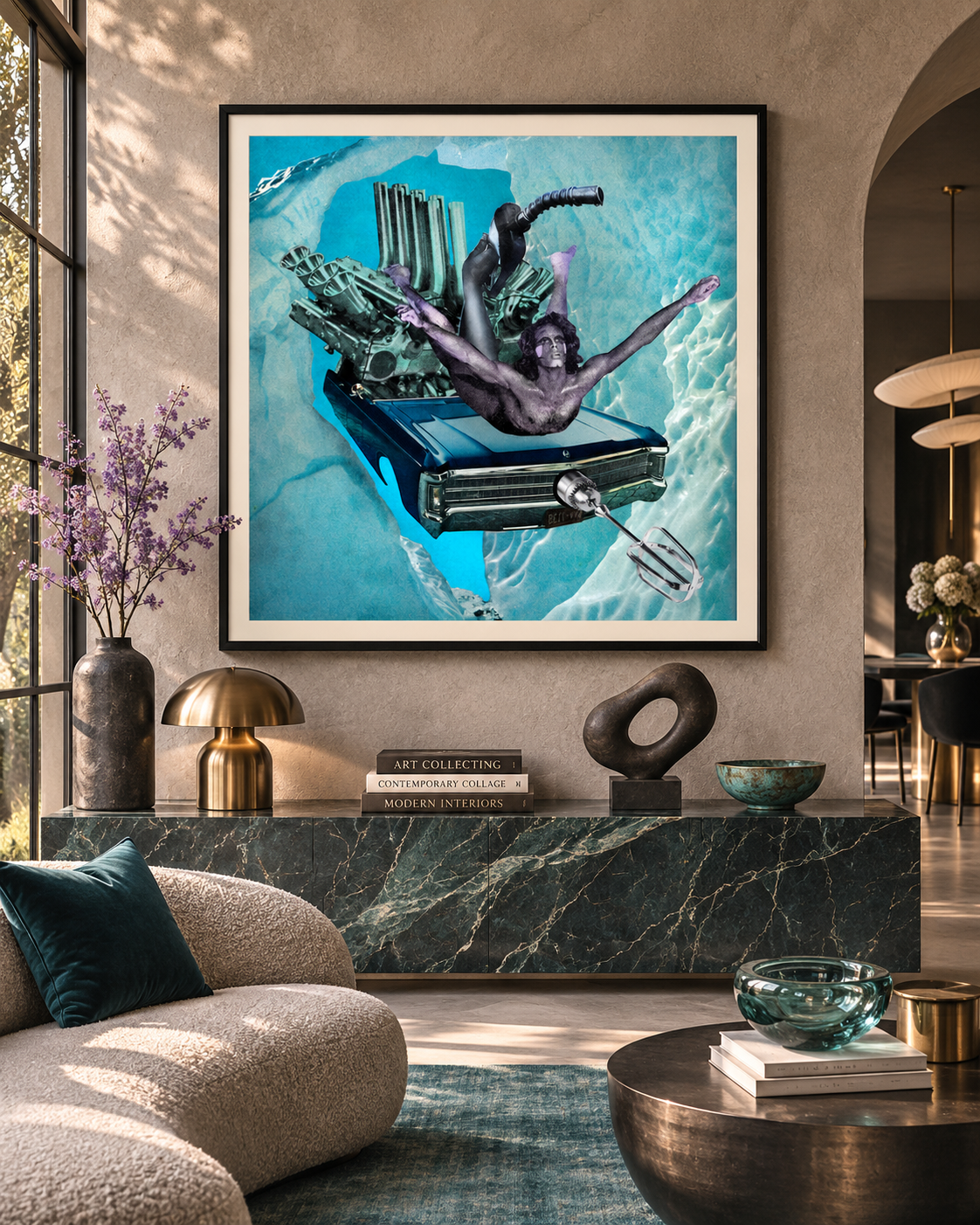
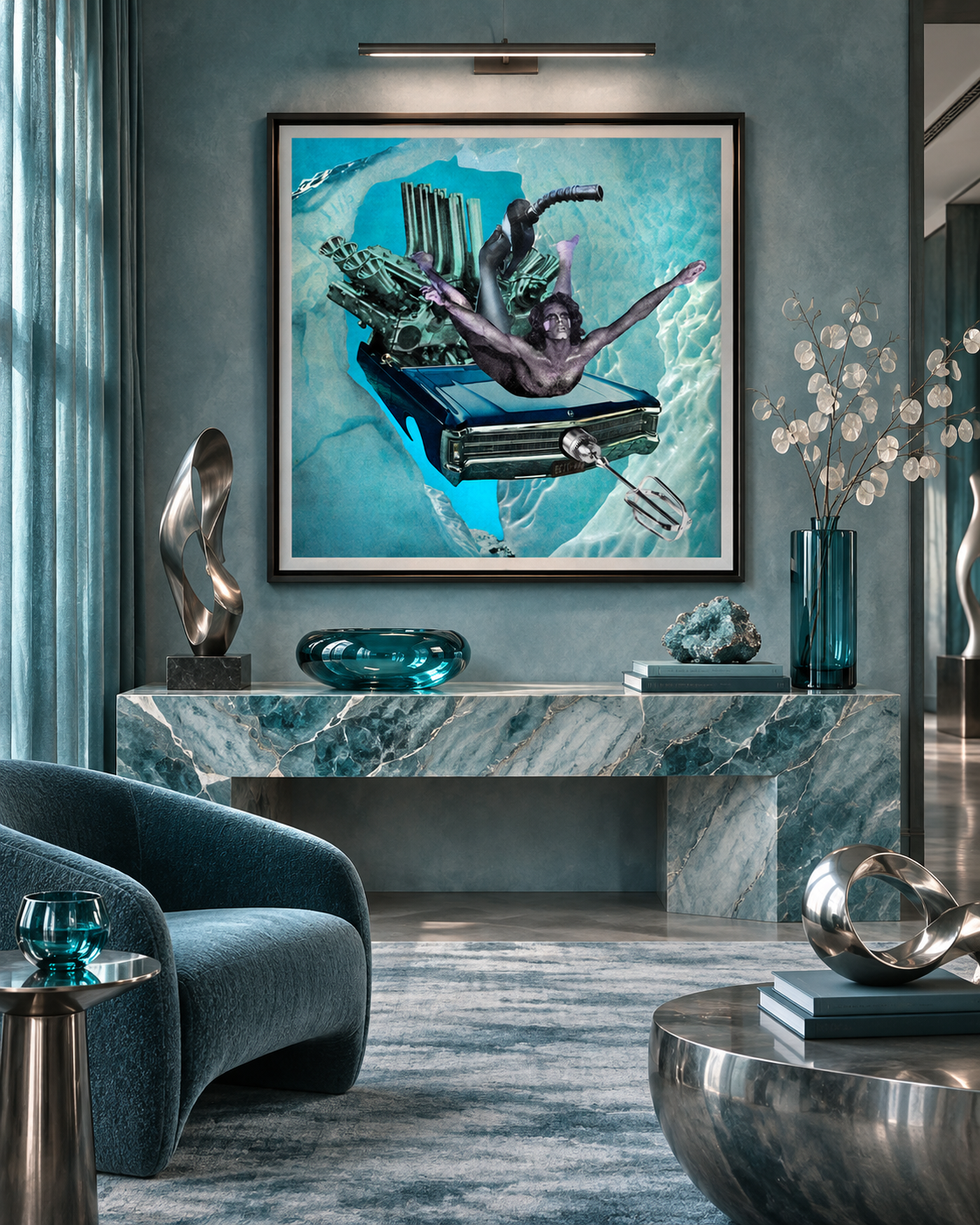
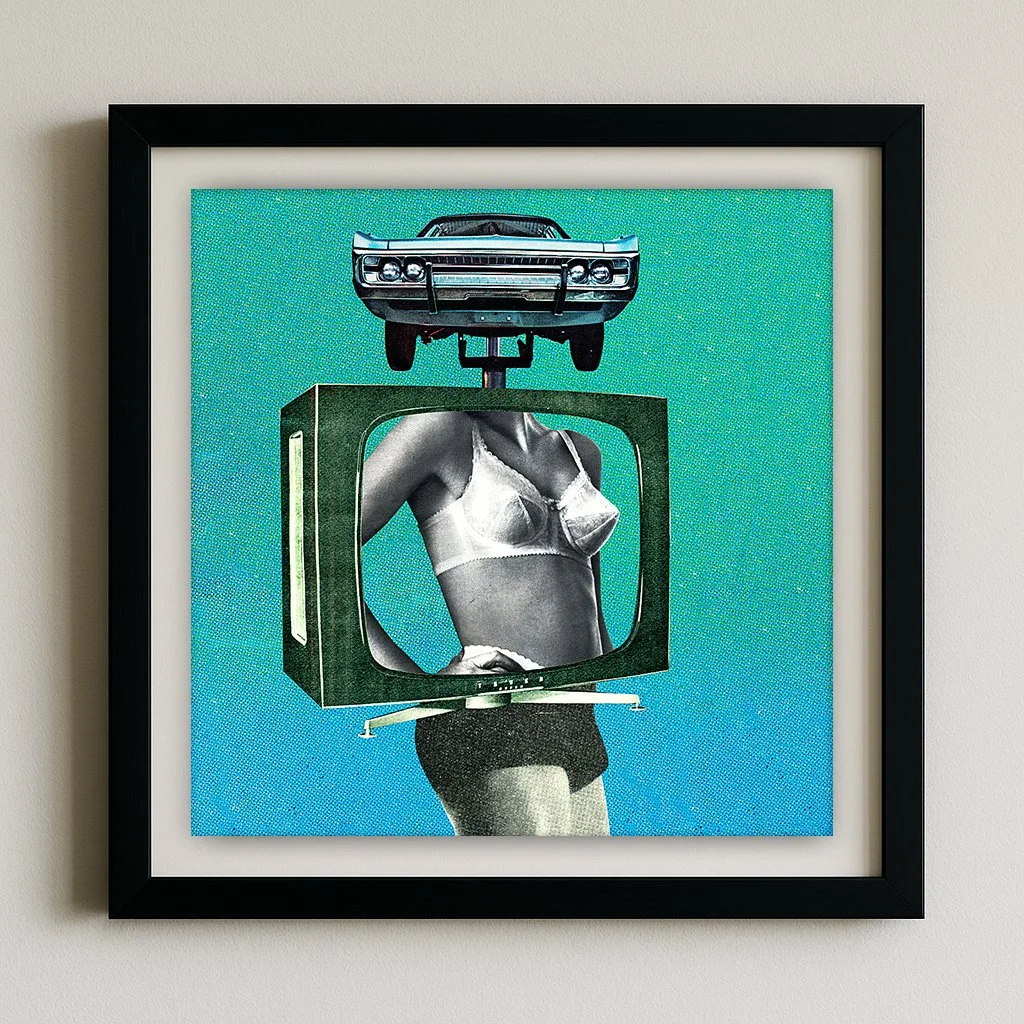
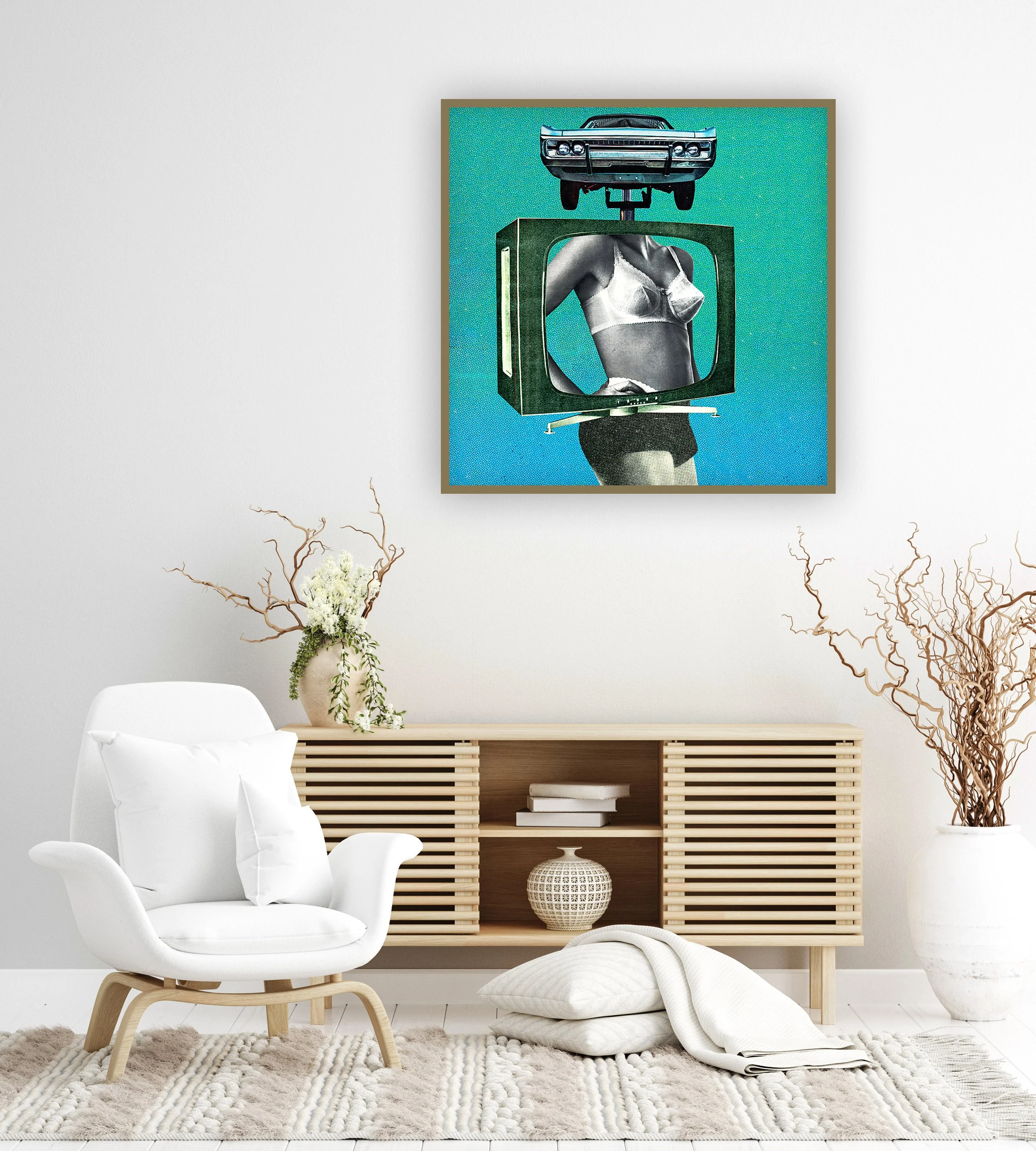
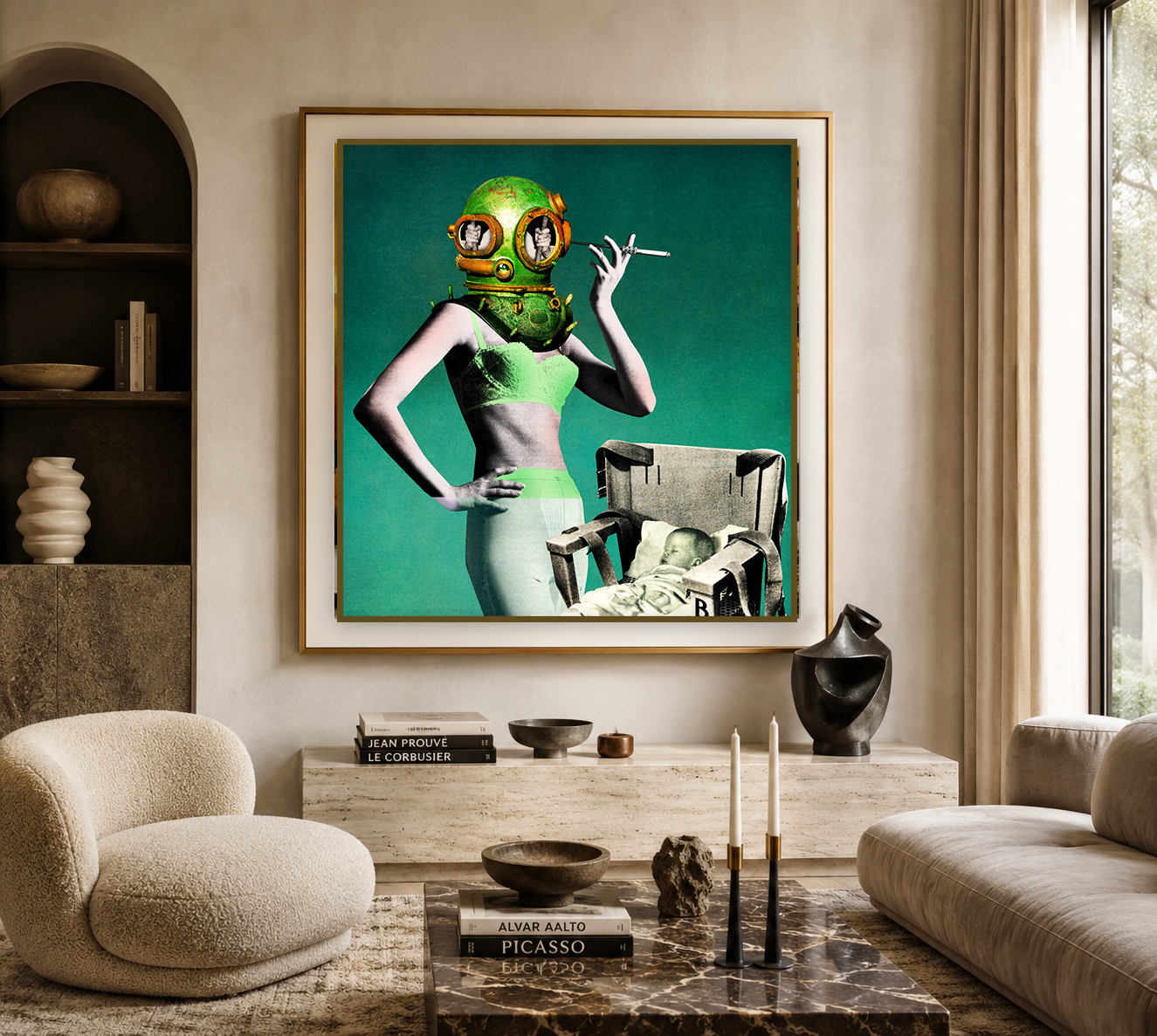
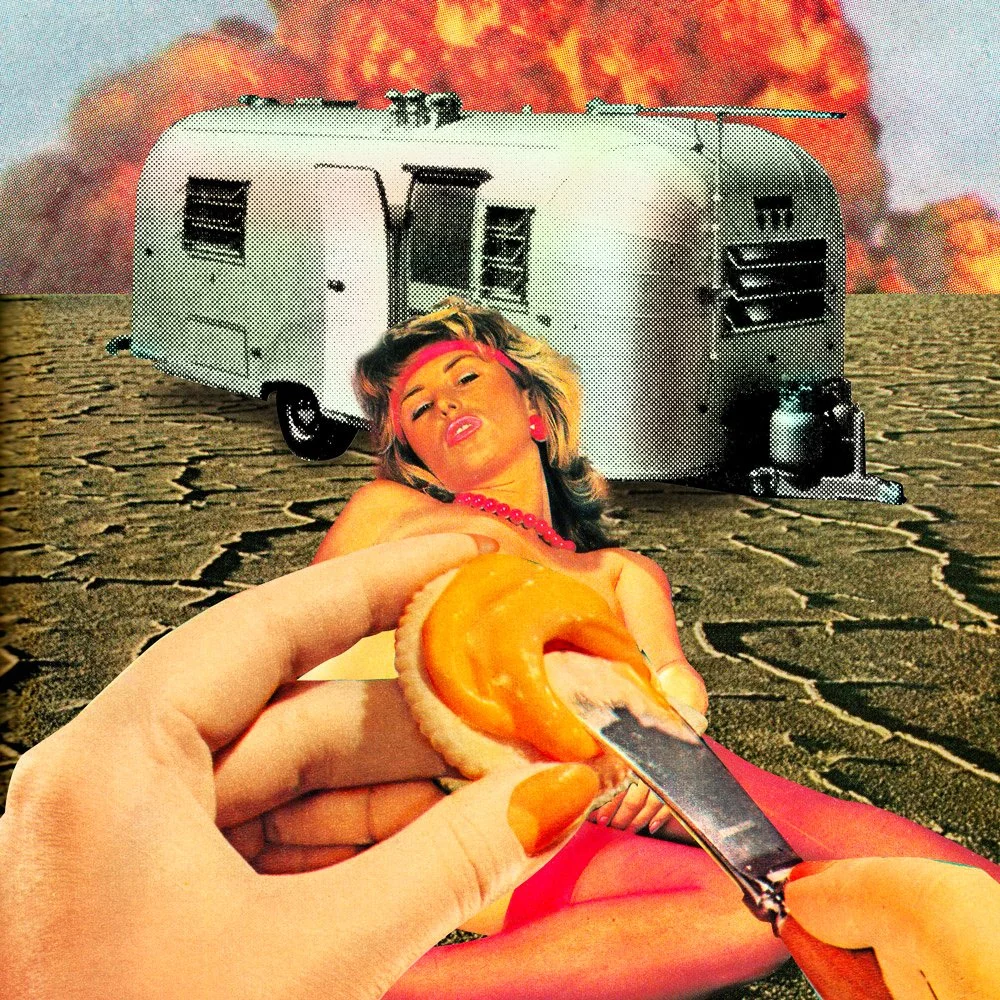
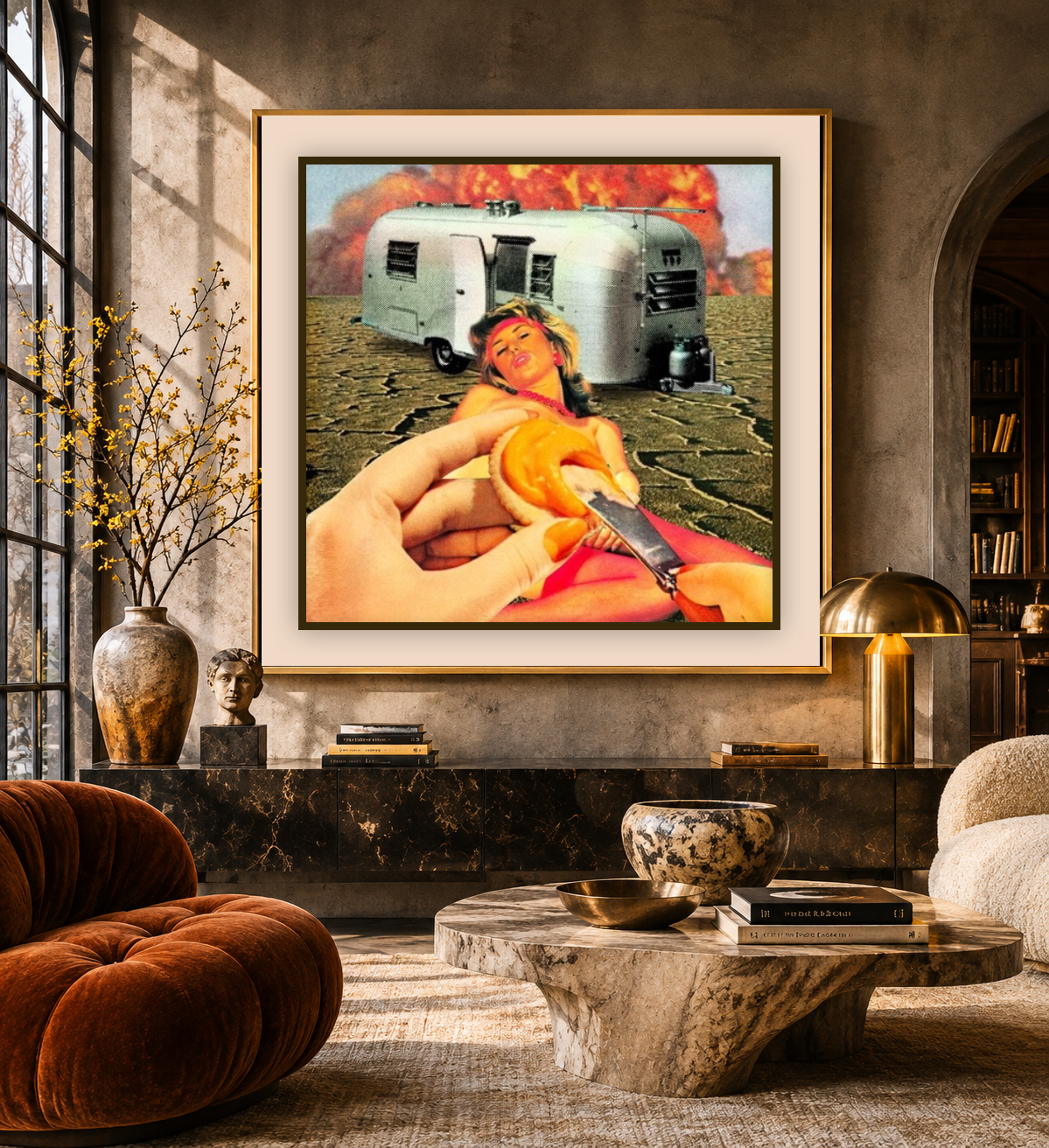
In Time Slip in the Arctic, Joan Seed combines a retro aesthetic with a fantastical vision. The car’s transformation into a flying vehicle gives the collage retrofuturistic overtones, while the assemblage of a human body, an engine, and a kitchen utensil lends the scene an uncanny, surreal quality. These transformations are part of Seed’s practice of giving familiar objects unexpected functions, bringing humor, eroticism, and unease together.
A CLOSER LOOK
An Odyssey to the Far Reaches of Reality
Having so often led us through scorching deserts, Joan now takes us into the desolation of Canada’s Far North. A bluish glacier surrounds a car suspended in midair, topped by a racing engine, a gas pump nozzle, and a man who seems to be falling into the void. With all four limbs flung upward, he is drawn into a strange aerial ballet with the engine’s exhaust pipes. At the prow, a mixer beater serves as a hand drill to bore a way through. The car resembles a flying carpet gone astray in unfamiliar latitudes. The desert of sand has become a desert of ice, and The Thousand and One Nights stretch endlessly into a single long polar night.
In her letter, Joan tells us at the outset that Time Slip in the Arctic is inspired by Code Axel, the secret season of the podcast Hantées, available on Radio-Canada OHdio. In this series, writer, host, and storyteller Julien Morissette borrows the conventions of investigative journalism to create fiction drawing sometimes on news stories, sometimes on local legends. In Code Axel, Émeric Samson, an influencer exploring remote and inhospitable Axel Heiberg Island with filmmaker Vincent Faucher, disappears into a crevasse. He reappears five weeks later in Resolute Bay, some 800 kilometers away, in the depths of the Arctic winter. Émeric seems empty, haggard, transformed, his survival as mysterious as his disappearance.
According to those close to him, especially his expedition companion, Émeric had underestimated the dangers ahead. In the podcast, tales of ill-fated expeditions give the island an ominous aura and should have served as a warning. Axel Heiberg’s actual history, too, includes journeys that ended in disaster or came close: Hans Krüger’s German expedition, which vanished in 1930; the Royal Canadian Mounted Police patrols sent to search for it in 1932; and a scientific journey undertaken by Ray Thorsteinsson in the 1950s. Yet the influencer turned adventurer believed his equipment and daring would protect him. In her collage, Seed turns this self-assurance into something approaching caricature: the handsome car proudly flaunts its racing engine and plunges into the glacier armed with a kitchen beater. This gleaming machinery is the traveler’s pride, although his resources are in fact pitifully inadequate against the implacable power of a place as bewitching as it is hostile. The contraption penetrating the opening in the glacier also gives this exploration an erotic charge, heightened by the resemblance between the male body and the engine. This dimension captures the island’s siren-like power over Émeric. Gradually transformed by its influence, he seems to enter a trance. As he descends into the crevasse, he appears to surrender body and soul to what draws him, to the point of losing himself in it.
Seed has chosen a clear, luminous blue sky, as bright as the explorer’s hopes. Polar night has not yet set in, and the prospect of plunging into the glacier’s depths can still fire his imagination, letting him believe he remains in control. His face, however, already suggests that he is no longer quite himself. The ice, meanwhile, seems to be gathering into an ominous swirl, recalling the phantasmagorical landscapes of British painter John Martin, particularly those of The Deluge (1834) and Manfred and the Alpine Witch (1837). In the former, tiny human figures are at the mercy of the raging elements; in the latter, a man summons the spirit of the place amid a majestic landscape that takes on the quality of a dream. In Seed’s work, the maelstrom of ice is about to close around the vehicle and its occupant. Like Charybdis swallowing ships in ancient myth, it reasserts the power of a natural world that our machines too often give us the illusion of controlling. A lesson in humility to temper our hubris, the excessive pride against which Greek tragedy warned long ago.
The sense of vertigo this scene provokes recalls At the Mountains of Madness by American author H. P. Lovecraft (1890–1937), a master of horror and the fantastic. In this novel, set in Antarctica, an expedition discovers the remains of a nonhuman civilization far older than our own. The explorers risk both their physical safety and their sanity. In his podcast, Julien Morissette suggests that the mountainous Canadian island may harbor an ancient entity, or itself be some kind of active presence, without offering a definitive answer. The idea that certain places have a life of their own transcends cultures and ages.
The island’s actual past adds another layer to this imagined world. During the Eocene, some forty million years ago, forests grew here. Mummified remains of trees still survive, their organic material still visible. The imprint of a vanished world thus remains very much present, strengthening the connection with Lovecraft’s universe. The traveler enters a place unaware that life there has roots stretching into the remotest past.
In Joan’s work, exploring the island also means exploring the boundaries of reality and normality. The artwork draws us into an unsettling realm where the paranormal, altered states of consciousness, and psychiatric disorders meet. A territory that attracts and terrifies us at once, feeding our fantasies and threatening our sanity. According to Vincent Faucher, Émeric was already changing before he disappeared. His behavior suggested hallucinations, trances, or some form of possession. His body was changing too: his skin was turning gray, his veins bulged, and marks appeared. At times, a stream of thick black liquid even poured from his mouth. The gas nozzle in the collage thus links the human body to the machine, down to the fluids flowing through them. Now back in the south, Émeric seems absent from himself in his partner’s eyes. Exploring these outer reaches is no trivial matter: we never return quite the same person… if, that is, we return at all.
Beyond this journey through the uncanny, the artwork pays tribute to Julien Morissette’s talent and, through him, to that of storytellers across the ages: epic singers, poets, bards, troubadours, trouvères, novelists, filmmakers, podcasters, artists… Their art stirs our imagination. It populates our dreams, but also haunts our nightmares. It captivates us and gives us a way to approach what frightens us. In The Thousand and One Nights, Scheherazade postpones her death by keeping her listener (King Shahryar, her new husband) enthralled and eager to hear how her stories unfold. Her words hold sway over the sovereign who threatens her, keeping danger at bay night after night until a different outcome becomes possible. In Lovecraft’s novel, the narrator uses his account to dissuade other explorers from following in his footsteps. With this collage, Seed in turn joins the long tradition in which words and images help us tame fear and, sometimes, ward off danger.
CONTINUING THE ODYSSEY
In Scheherazade and Shahryar, French artist Marie-Éléonore Godefroid (1778–1849) depicts the beautiful and alluring heroine of The Thousand and One Nights telling a story to her royal husband, whose fear of infidelity has turned him into a cruel misogynist. Housed in the Musée des Beaux-Arts de Rouen, this painting, imbued with sensuality, reflects the period’s taste for an imagined Orient. Drawing on her learning and quick wit, Scheherazade takes her destiny into her own hands, turning speech into a means of survival. The sort of audacity that, as you may have guessed, finds favor with Joan.
ARTWORK DETAILS
Title: Queen of the Desert
Artist: Joan Seed
Medium: Mixed Media Collage
Limited edition prints, hand-signed and numbered
Material: Museum-grade giclée print on archival, textured cotton paper
Size Options:
• 30 × 30 inches (76.2 × 76.2 cm)
• 60 × 60 inches (152.4 × 152.4 cm)
Shipping: Flat rate of $175 CAD per order.
For acquisitions, inquiries, and commissions: joan@joanseed.ca
© 2026 Joan Seed. All rights reserved. This artwork and its images may not be reproduced, copied, distributed, or used in any form without the prior written permission of the artist.