


If Walls Could Talk
A LETTER FROM JOAN
My dear,
Did you go to the Pride parade? I hope so. Propriety needs someone to step on its train at least once a year.
I was there, naturally. And as it does every year, all that freedom parading and flaunting itself in broad daylight reminded me of a man who approached me one evening at a hotel bar. He wanted to know if I could keep a secret, and I told him that went without saying, as long as the vodka showed up. He ordered a whole bottle, and I understood at once: the man needed to spill; his secret needed to stay sealed.
I never learned the whole story. He seemed to tell it in fragments: a rented room, drawn curtains, a young man whose name was quickly forgotten but whose body proved unforgettable. I nodded with all the ritual solemnity a full glass inspires in me. Everyone has their own form of worship, don’t they?
I may sound as though I’m making light of it, but that kind of secret troubles me far more than I let on. Too often, it becomes a pet monster that must be fed, year after year, with pieces of oneself. Keep it behind closed doors long enough, and eventually you discover that its cage has become your own.
So, my dear, when someone entrusts you with a secret, remember that discretion should shelter desire, never imprison it.
The man from the bar? I never saw him again. I’ve always kept his secret, but I hope he has freed himself from it.
The vodka, however, was freed from its bottle that very night. I regret to inform you that it did not survive the operation.
Joan
A CLOSER LOOK
A Provisional Composition
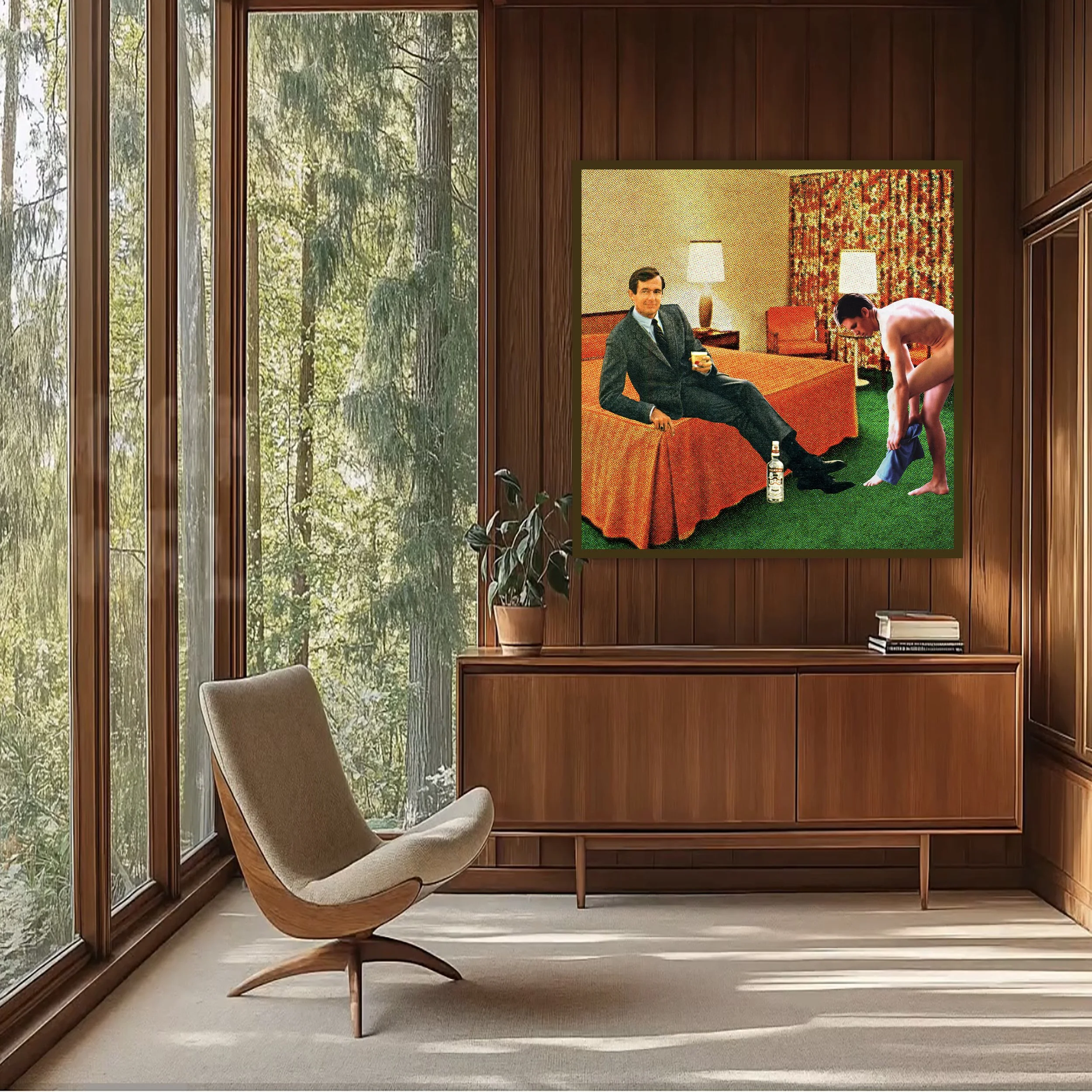
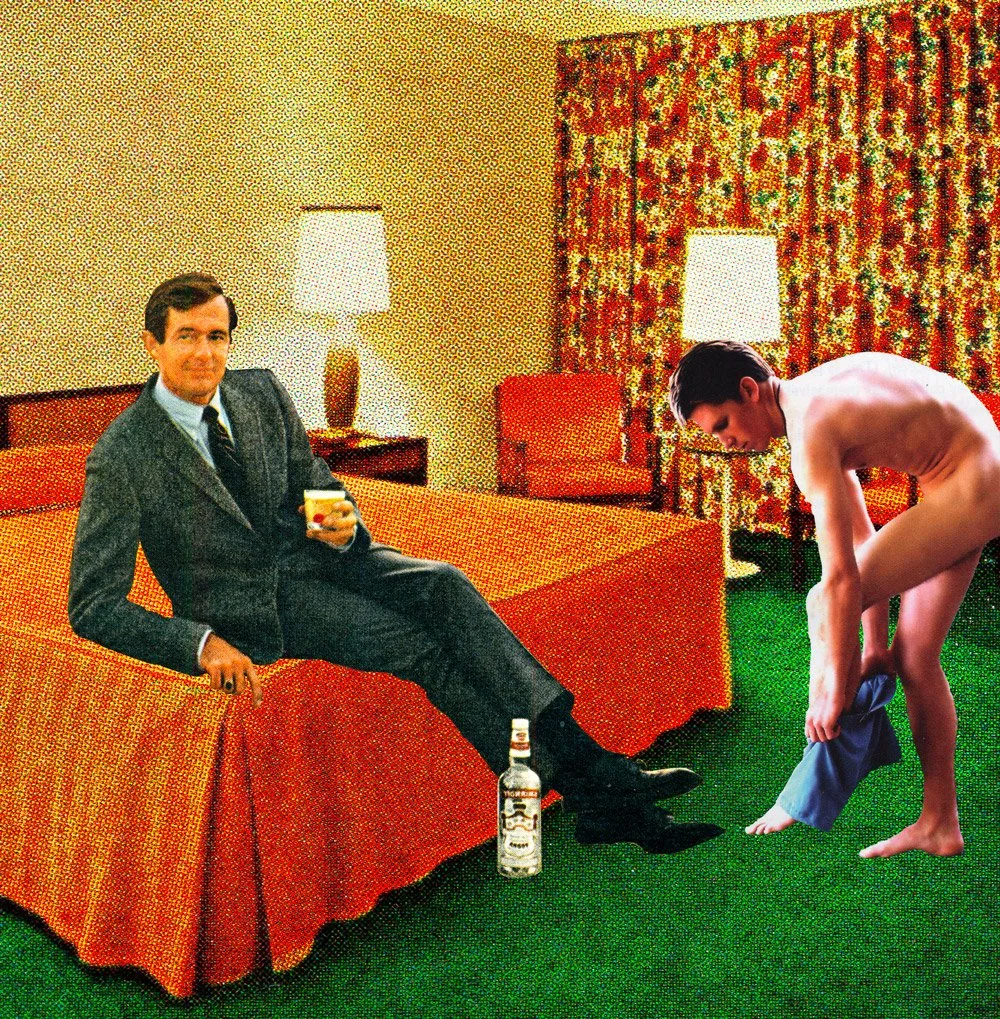
In If Walls Could Talk, Joan Seed invites us into the privacy of a hotel room where two men meet. The forthright décor contrasts with the ambiguity of what is unfolding between them. An orange bedspread cuts across a saturated green carpet; curtains thick with flowers shield the room from outside eyes.
The older of the two men, dressed in a dark suit, lounges on the bed with a drink in hand. His pose suggests a carefully controlled sensuality. He looks to the left, almost in our direction, without quite meeting our gaze. That slight displacement gives his confidence a studied quality. Is he half-engaging us, or looking away to preserve his composure? At his feet, the vodka bottle does its duty in silence.
The younger man, almost naked, appears to be pulling his trousers back on. Seen in profile, he focuses on the gesture. If the encounter is drawing to a close, has he just been looked over? The suited man remains fully dressed, apparently in command. The younger man’s body displays a physical freedom his companion does not allow himself. The hierarchy begins to blur.
American realist painter Patrick Angus (1953-1992) devoted much of his work to gay life in 1980s New York. In Red Red Wine, A Gaiety Scene, a nude dancer offers himself to the gaze of a seated spectator. In Angus’s work, money often belongs to the observer, while desire gathers around the one on display. A similar dynamic runs through Seed’s hotel room, where something appears to be negotiated, though it remains unclear what exactly is being used as currency.
A leading figure of the German Renaissance and head of a prolific workshop, Lucas Cranach the Elder (1472-1553) made ill-matched couples a recurring motif. Cranach and his workshop produced numerous variants beginning in the 1520s (see, for example, The Ill-Matched Couple: Old Woman and Young Man). In each, an older person embraces a far younger partner; jewelry or coins make the bargain visible. This visual tradition echoes our suspicion. In Seed’s work, the imbalance suggests a power dynamic without automatically ruling out some measure of reciprocity or tenderness.
In If Walls Could Talk, this tension is staged in an interior that seems lifted from a mid-twentieth-century advertisement. The scene also evokes the world of the television series Mad Men, where image-makers carefully construct their social personas while other parts of their lives remain in shadow. Collage becomes a way of thinking about such lives. Seed brings together fragments from distinct realities and places them in the same space. A public identity and a secret life can likewise coexist within one person, even when they are confined to separate contexts. Neither is any less real than the other.
Seed presents us with a provisional assemblage, since a hotel or motel room is first and foremost a rented interval, a place that demands neither a revealed past nor a guaranteed future. When the different parts of a life must remain separate, life itself can take the form of an in-between. Such compartmentalization sometimes produces a singular kind of loneliness: the inability to be whole anywhere. In Hotel Room, American painter Edward Hopper (1882-1967), known for his isolated figures in the spaces of modern life, places a lone woman in a similar setting, between two destinations. In Seed’s work, two trajectories meet. They may soon separate and be recomposed elsewhere, in different roles. Yet the same fragments could return here and form another variation on this secret image. Collage fixes a fleeting moment within a cycle whose beginning and end it does not reveal.
Sharing the same space does not always end loneliness, as British painter Lucian Freud (1922-2011) shows in Hotel Bedroom. Known for the striking psychological intensity of his portraits, Freud places a man near a window and a woman reclining on a bed, each seemingly withdrawn into a world of their own. In Seed’s work, the suited man’s oblique gaze introduces a similar distance and sustains the character’s ambiguity. This show of detachment may serve as a screen for what he truly feels.
The work of David Hockney (1937-2026) suggests a form of male intimacy in which desire is mutual and closeness creates, for the duration of an encounter, a space of freedom. A major figure in British Pop art, Hockney gave gay desire and the male body a visible place early in his career. In Domestic Scene, Los Angeles, one man washes another’s back in the shower. The everyday gesture hints at affection between them. Peter Getting Out of Nick’s Pool gives the male body the luminous freedom to occupy the center of the image, far from closed curtains and hidden spaces. Seed’s young man might likewise embody, in his companion’s eyes, a freedom both desired and feared. Tenderness may have a place in this room as well, even if it must still arrive by way of secrecy.
Seed’s work opens onto a reflection that extends far beyond this room: how many similar places, across the world and through the ages, have served and still serve as refuges for loves forced into secrecy? Social prohibitions create an entire clandestine ecosystem around these encounters, made up of places of retreat and tacit agreements. These refuges remain precarious because secrecy heightens the vulnerability of those who meet there and can make power imbalances harder to challenge. Love may take shelter there, while raw desire may also find satisfaction. This room thus takes its place in an old story that remains unfinished. If walls could talk, they would surely tell of the encounters they protected, and of the world that forced so many people to choose them as their only witnesses.
CONTEXT
In If Walls Could Talk, Joan Seed brings two men together in a room that belongs to a much larger history. Associated with travel, hotel and motel rooms also offer a more private form of escape. For many people forced to conceal same-sex love, they have served and continue to serve as refuges for the duration of an encounter, away from social roles and familiar eyes. Their anonymity can protect desire and tenderness, but that protection remains fragile because secrecy heightens the vulnerability of those who depend on it.
Through collage, Seed gives visual form to the resulting fragmentation of lives. Her practice belongs to a social and emotional context explored by other artists as well, one shaped by temporary solitude and fleeting joy, by lives kept in shadow and the refuges that shelter them.
ARTWORK DETAILS
Title: If Walls Could Talk
French Title: Si les murs pouvaient parler
Artist: Joan Seed
Medium: Mixed Media Collage
Limited edition prints, hand-signed and numbered
Material: Museum-grade giclée print on archival, textured cotton paper
Size Options:
• 30 × 30 inches (76.2 × 76.2 cm)
• 60 × 60 inches (152.4 × 152.4 cm)
Shipping: Flat rate of $175 CAD per order.
For acquisitions, inquiries, and commissions: joan@joanseed.ca
© 2026 Joan Seed. All rights reserved. This artwork and its images may not be reproduced, copied, distributed, or used in any form without the prior written permission of the artist.
A LETTER FROM JOAN
My dear,
Did you go to the Pride parade? I hope so. Propriety needs someone to step on its train at least once a year.
I was there, naturally. And as it does every year, all that freedom parading and flaunting itself in broad daylight reminded me of a man who approached me one evening at a hotel bar. He wanted to know if I could keep a secret, and I told him that went without saying, as long as the vodka showed up. He ordered a whole bottle, and I understood at once: the man needed to spill; his secret needed to stay sealed.
I never learned the whole story. He seemed to tell it in fragments: a rented room, drawn curtains, a young man whose name was quickly forgotten but whose body proved unforgettable. I nodded with all the ritual solemnity a full glass inspires in me. Everyone has their own form of worship, don’t they?
I may sound as though I’m making light of it, but that kind of secret troubles me far more than I let on. Too often, it becomes a pet monster that must be fed, year after year, with pieces of oneself. Keep it behind closed doors long enough, and eventually you discover that its cage has become your own.
So, my dear, when someone entrusts you with a secret, remember that discretion should shelter desire, never imprison it.
The man from the bar? I never saw him again. I’ve always kept his secret, but I hope he has freed himself from it.
The vodka, however, was freed from its bottle that very night. I regret to inform you that it did not survive the operation.
Joan
A CLOSER LOOK
A Provisional Composition
In If Walls Could Talk, Joan Seed invites us into the privacy of a hotel room where two men meet. The forthright décor contrasts with the ambiguity of what is unfolding between them. An orange bedspread cuts across a saturated green carpet; curtains thick with flowers shield the room from outside eyes.
The older of the two men, dressed in a dark suit, lounges on the bed with a drink in hand. His pose suggests a carefully controlled sensuality. He looks to the left, almost in our direction, without quite meeting our gaze. That slight displacement gives his confidence a studied quality. Is he half-engaging us, or looking away to preserve his composure? At his feet, the vodka bottle does its duty in silence.
The younger man, almost naked, appears to be pulling his trousers back on. Seen in profile, he focuses on the gesture. If the encounter is drawing to a close, has he just been looked over? The suited man remains fully dressed, apparently in command. The younger man’s body displays a physical freedom his companion does not allow himself. The hierarchy begins to blur.
American realist painter Patrick Angus (1953-1992) devoted much of his work to gay life in 1980s New York. In Red Red Wine, A Gaiety Scene, a nude dancer offers himself to the gaze of a seated spectator. In Angus’s work, money often belongs to the observer, while desire gathers around the one on display. A similar dynamic runs through Seed’s hotel room, where something appears to be negotiated, though it remains unclear what exactly is being used as currency.
A leading figure of the German Renaissance and head of a prolific workshop, Lucas Cranach the Elder (1472-1553) made ill-matched couples a recurring motif. Cranach and his workshop produced numerous variants beginning in the 1520s (see, for example, The Ill-Matched Couple: Old Woman and Young Man). In each, an older person embraces a far younger partner; jewelry or coins make the bargain visible. This visual tradition echoes our suspicion. In Seed’s work, the imbalance suggests a power dynamic without automatically ruling out some measure of reciprocity or tenderness.
In If Walls Could Talk, this tension is staged in an interior that seems lifted from a mid-twentieth-century advertisement. The scene also evokes the world of the television series Mad Men, where image-makers carefully construct their social personas while other parts of their lives remain in shadow. Collage becomes a way of thinking about such lives. Seed brings together fragments from distinct realities and places them in the same space. A public identity and a secret life can likewise coexist within one person, even when they are confined to separate contexts. Neither is any less real than the other.
Seed presents us with a provisional assemblage, since a hotel or motel room is first and foremost a rented interval, a place that demands neither a revealed past nor a guaranteed future. When the different parts of a life must remain separate, life itself can take the form of an in-between. Such compartmentalization sometimes produces a singular kind of loneliness: the inability to be whole anywhere. In Hotel Room, American painter Edward Hopper (1882-1967), known for his isolated figures in the spaces of modern life, places a lone woman in a similar setting, between two destinations. In Seed’s work, two trajectories meet. They may soon separate and be recomposed elsewhere, in different roles. Yet the same fragments could return here and form another variation on this secret image. Collage fixes a fleeting moment within a cycle whose beginning and end it does not reveal.
Sharing the same space does not always end loneliness, as British painter Lucian Freud (1922-2011) shows in Hotel Bedroom. Known for the striking psychological intensity of his portraits, Freud places a man near a window and a woman reclining on a bed, each seemingly withdrawn into a world of their own. In Seed’s work, the suited man’s oblique gaze introduces a similar distance and sustains the character’s ambiguity. This show of detachment may serve as a screen for what he truly feels.
The work of David Hockney (1937-2026) suggests a form of male intimacy in which desire is mutual and closeness creates, for the duration of an encounter, a space of freedom. A major figure in British Pop art, Hockney gave gay desire and the male body a visible place early in his career. In Domestic Scene, Los Angeles, one man washes another’s back in the shower. The everyday gesture hints at affection between them. Peter Getting Out of Nick’s Pool gives the male body the luminous freedom to occupy the center of the image, far from closed curtains and hidden spaces. Seed’s young man might likewise embody, in his companion’s eyes, a freedom both desired and feared. Tenderness may have a place in this room as well, even if it must still arrive by way of secrecy.
Seed’s work opens onto a reflection that extends far beyond this room: how many similar places, across the world and through the ages, have served and still serve as refuges for loves forced into secrecy? Social prohibitions create an entire clandestine ecosystem around these encounters, made up of places of retreat and tacit agreements. These refuges remain precarious because secrecy heightens the vulnerability of those who meet there and can make power imbalances harder to challenge. Love may take shelter there, while raw desire may also find satisfaction. This room thus takes its place in an old story that remains unfinished. If walls could talk, they would surely tell of the encounters they protected, and of the world that forced so many people to choose them as their only witnesses.
CONTEXT
In If Walls Could Talk, Joan Seed brings two men together in a room that belongs to a much larger history. Associated with travel, hotel and motel rooms also offer a more private form of escape. For many people forced to conceal same-sex love, they have served and continue to serve as refuges for the duration of an encounter, away from social roles and familiar eyes. Their anonymity can protect desire and tenderness, but that protection remains fragile because secrecy heightens the vulnerability of those who depend on it.
Through collage, Seed gives visual form to the resulting fragmentation of lives. Her practice belongs to a social and emotional context explored by other artists as well, one shaped by temporary solitude and fleeting joy, by lives kept in shadow and the refuges that shelter them.
ARTWORK DETAILS
Title: If Walls Could Talk
French Title: Si les murs pouvaient parler
Artist: Joan Seed
Medium: Mixed Media Collage
Limited edition prints, hand-signed and numbered
Material: Museum-grade giclée print on archival, textured cotton paper
Size Options:
• 30 × 30 inches (76.2 × 76.2 cm)
• 60 × 60 inches (152.4 × 152.4 cm)
Shipping: Flat rate of $175 CAD per order.
For acquisitions, inquiries, and commissions: joan@joanseed.ca
© 2026 Joan Seed. All rights reserved. This artwork and its images may not be reproduced, copied, distributed, or used in any form without the prior written permission of the artist.
Retro sociopolitical homosexual in denial artwork.