What’s Cooking? | Between Family Transmission and Programmed Drift
A Love Letter from Joan
Darling,
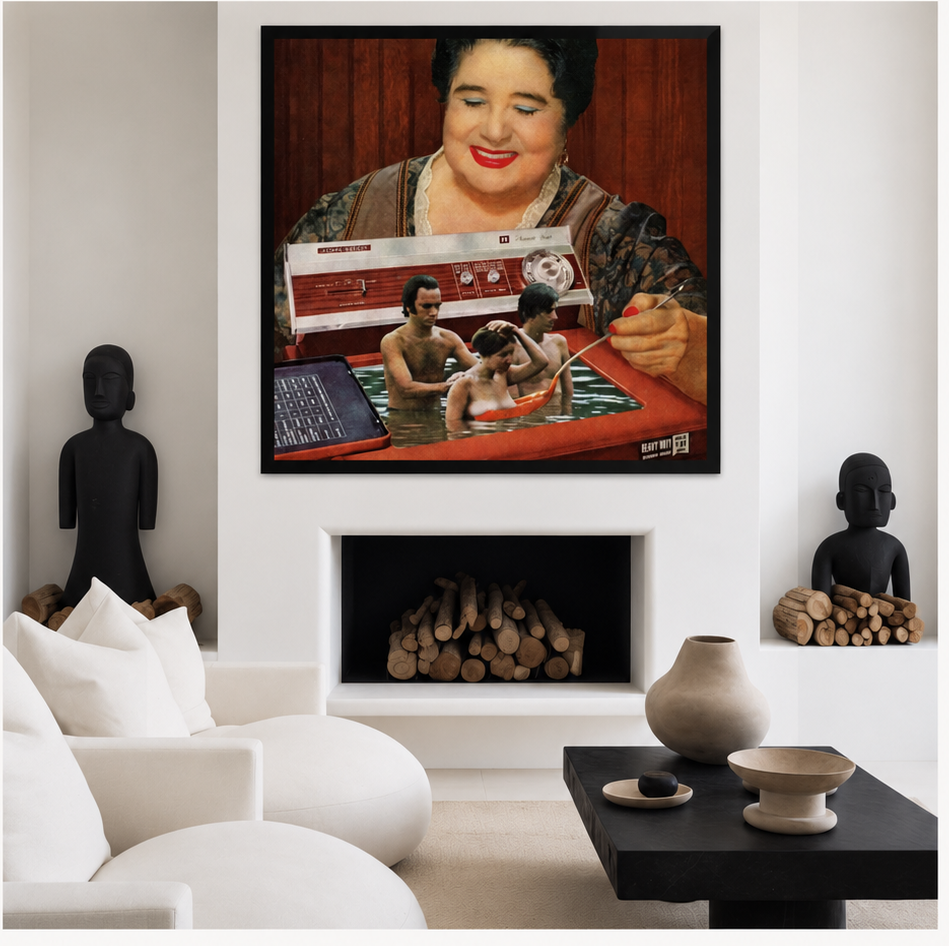
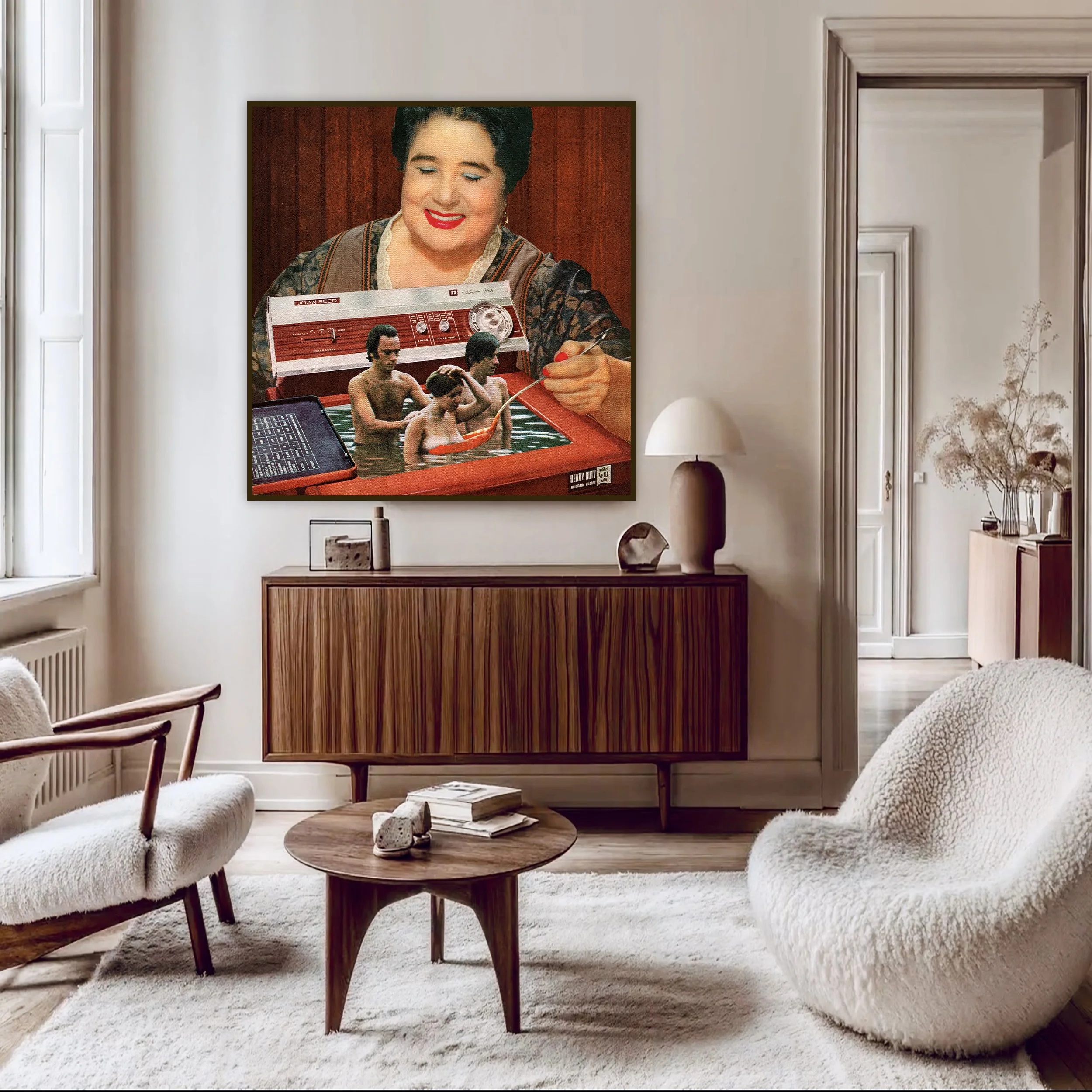
A good sauce takes time. You let it simmer slowly and try not to stir too much at the beginning.The same is true for children. Look at them floating around in there with their lovely ideas, their new desires, and their bodies displayed as if they had never been taught shame. The mother gently lifts the girl’s chest with her spoon like a woman proud to have finally produced something no one feels the need to hide anymore.Most mothers try to give better than what they themselves received, darling. The problem is that machines eventually follow their program too.Soaking is always the pleasant part. The water stays warm, the bodies keep floating gently, and everyone thinks there’s still time.Then comes the spin cycle.Kissing you before the rinse,
Joan
A Closer Look
With What’s Cooking?, Joan Seed transforms a familiar domestic scene into a strange ritual of transmission. A smiling mother gently stirs the contents of a washing machine where several relaxed, almost carefree young bodies float together.
At first, everything appears to unfold with surprising serenity. The work suggests a form of affectionate continuity between generations. The woman stirs the contents of the machine as though repeating a familiar gesture passed down over time. The scene recalls both the idealized family kitchens of the 1950s and 1960s and the promises of happiness associated with postwar domestic modernity.
Yet a subtle shift gradually takes place. The young bodies are not soaking in a traditional cooking pot, but inside a machine designed to process, clean, and standardize. Cooking, motherhood, and mechanization slowly begin to merge. Placed directly in front of the mother’s abdomen, the drum of the washing machine eventually evokes a kind of modern womb where future generations continue to float. The water begins to resemble amniotic fluid suspended somewhere between protection, gestation, and transformation. The young figures remain calm, seemingly carried by the promise of a freer and more hedonistic future than that of their parents.
The gesture of the spoon introduces another layer of ambiguity to the scene. By almost lifting the young woman’s breast, the mother oscillates between admiration, pride, and a more troubling form of emotional possession. It becomes impossible to know whether she is presenting her offspring with tenderness or preparing, like a smiling domestic Cronos, to reabsorb them into the very cycle that brought them into being.
Maternal love and the instinct to consume seem impossible to fully separate here. Beneath the warmth of the colors and the image’s apparent humor, however, a deeper unease persists. The machine operates in cycles. The calmness of the soak already contains the possibility of spinning, wringing, and expulsion. As is often the case in Joan Seed’s work, danger does not appear through spectacular catastrophe, but through ordinary mechanisms that gradually begin to feel natural.
The piece ultimately opens onto a broader reflection on modern progress, domestic comfort, and systems built with the best of intentions. Behind promises of abundance and efficiency, contradictions slowly emerge within a world where bodies, desires, and even differences risk being absorbed by the very structures they inhabit.
L. M.
Context
In this digital collage inspired by the domestic and advertising aesthetics of the 1950s and 1960s, Joan Seed explores the connections between family transmission, motherhood, technological progress, and social transformation. Its warm retro atmosphere gradually gives way to a more unsettling reflection on the modern systems that shape generations and redefine relationships between bodies, comfort, and freedom.
Through imagery that is at once tender, absurd, and quietly disturbing, the artist continues her exploration of the tensions between intimacy, consumption, mechanization, and identity. Blending distorted nostalgia, social satire, and pop surrealism, What’s Cooking? offers an ambiguous vision of the modern family and the often contradictory promises of progress.
Artwork Details
Title: What’s Cooking?
Artist: Joan Seed
Medium: Mixed Media CollageLimited edition prints, hand-signed and numbered.
Material: Museum-grade giclée print on archival textured cotton paper.
Size Options:
• 30 × 30 inches (76.2 × 76.2 cm)
• 60 × 60 inches (152.4 × 152.4 cm)
Shipping: Flat rate of $175 CAD per order.
For acquisitions, inquiries, and commissions: joan@joanseed.ca
© 2026 Joan Seed. All rights reserved. This artwork and its images may not be reproduced, copied, distributed, or used in any form without the prior written permission of the artist.
What’s Cooking? | Between Family Transmission and Programmed Drift
A Love Letter from Joan
Darling,
A good sauce takes time. You let it simmer slowly and try not to stir too much at the beginning.The same is true for children. Look at them floating around in there with their lovely ideas, their new desires, and their bodies displayed as if they had never been taught shame. The mother gently lifts the girl’s chest with her spoon like a woman proud to have finally produced something no one feels the need to hide anymore.Most mothers try to give better than what they themselves received, darling. The problem is that machines eventually follow their program too.Soaking is always the pleasant part. The water stays warm, the bodies keep floating gently, and everyone thinks there’s still time.Then comes the spin cycle.Kissing you before the rinse,
Joan
A Closer Look
With What’s Cooking?, Joan Seed transforms a familiar domestic scene into a strange ritual of transmission. A smiling mother gently stirs the contents of a washing machine where several relaxed, almost carefree young bodies float together.
At first, everything appears to unfold with surprising serenity. The work suggests a form of affectionate continuity between generations. The woman stirs the contents of the machine as though repeating a familiar gesture passed down over time. The scene recalls both the idealized family kitchens of the 1950s and 1960s and the promises of happiness associated with postwar domestic modernity.
Yet a subtle shift gradually takes place. The young bodies are not soaking in a traditional cooking pot, but inside a machine designed to process, clean, and standardize. Cooking, motherhood, and mechanization slowly begin to merge. Placed directly in front of the mother’s abdomen, the drum of the washing machine eventually evokes a kind of modern womb where future generations continue to float. The water begins to resemble amniotic fluid suspended somewhere between protection, gestation, and transformation. The young figures remain calm, seemingly carried by the promise of a freer and more hedonistic future than that of their parents.
The gesture of the spoon introduces another layer of ambiguity to the scene. By almost lifting the young woman’s breast, the mother oscillates between admiration, pride, and a more troubling form of emotional possession. It becomes impossible to know whether she is presenting her offspring with tenderness or preparing, like a smiling domestic Cronos, to reabsorb them into the very cycle that brought them into being.
Maternal love and the instinct to consume seem impossible to fully separate here. Beneath the warmth of the colors and the image’s apparent humor, however, a deeper unease persists. The machine operates in cycles. The calmness of the soak already contains the possibility of spinning, wringing, and expulsion. As is often the case in Joan Seed’s work, danger does not appear through spectacular catastrophe, but through ordinary mechanisms that gradually begin to feel natural.
The piece ultimately opens onto a broader reflection on modern progress, domestic comfort, and systems built with the best of intentions. Behind promises of abundance and efficiency, contradictions slowly emerge within a world where bodies, desires, and even differences risk being absorbed by the very structures they inhabit.
L. M.
Context
In this digital collage inspired by the domestic and advertising aesthetics of the 1950s and 1960s, Joan Seed explores the connections between family transmission, motherhood, technological progress, and social transformation. Its warm retro atmosphere gradually gives way to a more unsettling reflection on the modern systems that shape generations and redefine relationships between bodies, comfort, and freedom.
Through imagery that is at once tender, absurd, and quietly disturbing, the artist continues her exploration of the tensions between intimacy, consumption, mechanization, and identity. Blending distorted nostalgia, social satire, and pop surrealism, What’s Cooking? offers an ambiguous vision of the modern family and the often contradictory promises of progress.
Artwork Details
Title: What’s Cooking?
Artist: Joan Seed
Medium: Mixed Media CollageLimited edition prints, hand-signed and numbered.
Material: Museum-grade giclée print on archival textured cotton paper.
Size Options:
• 30 × 30 inches (76.2 × 76.2 cm)
• 60 × 60 inches (152.4 × 152.4 cm)
Shipping: Flat rate of $175 CAD per order.
For acquisitions, inquiries, and commissions: joan@joanseed.ca
© 2026 Joan Seed. All rights reserved. This artwork and its images may not be reproduced, copied, distributed, or used in any form without the prior written permission of the artist.