A LETTER FROM JOAN
My dear,
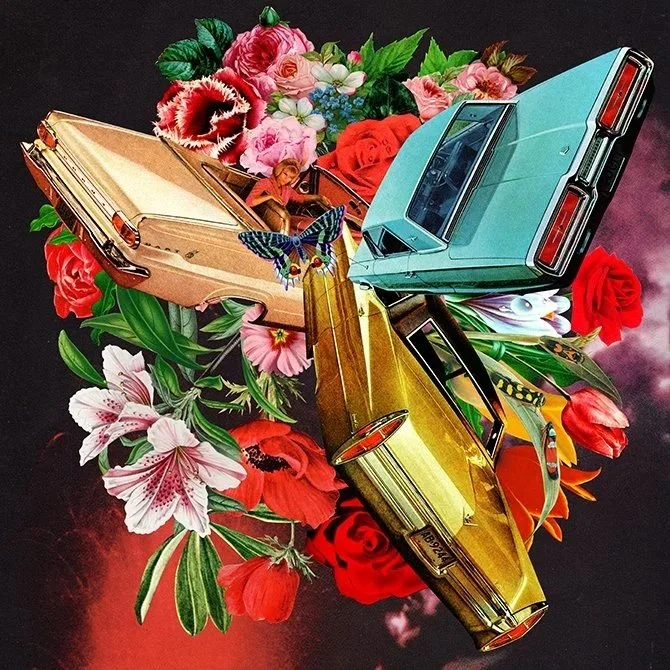
They say love will take you anywhere… and sometimes straight into a wall. This time, three souls are hurtling toward the same point of impact. Everyone wants to be chosen, no one is willing to yield, and the woman at the wheel is so serene it borders on insolence. Perhaps she knows exactly what she’s doing. I almost hope she does.
The bouquet has already arrived. Roses, lilies, tulips, and anemones have piled onto the scene with the indecent enthusiasm of bridesmaids who no longer know which ceremony they were invited to. The butterfly, wiser than the lovers, has already gained altitude.
With certain passions, everything hinges on the brake and the accelerator. Which one will have the last word remains to be seen. But what panache, don’t you think? That reminds me: someone will have to tell us what color to wear to the ceremony.
Until then, kisses.
Joan
A CLOSER LOOK
Where Wings Grow
Beauty from One World to Another
To the one who has crossed the threshold—may his journey continue beyond our sight.
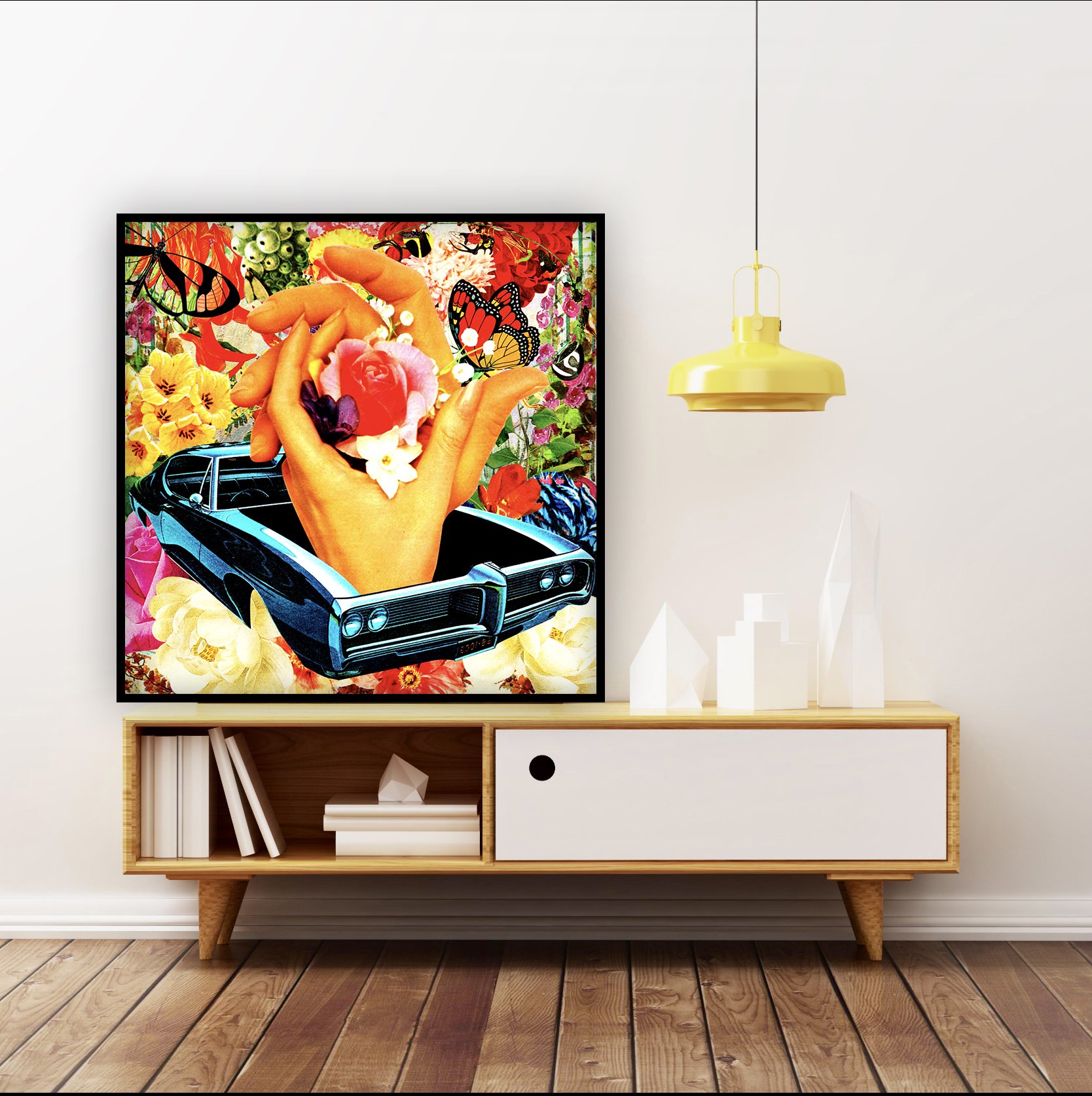
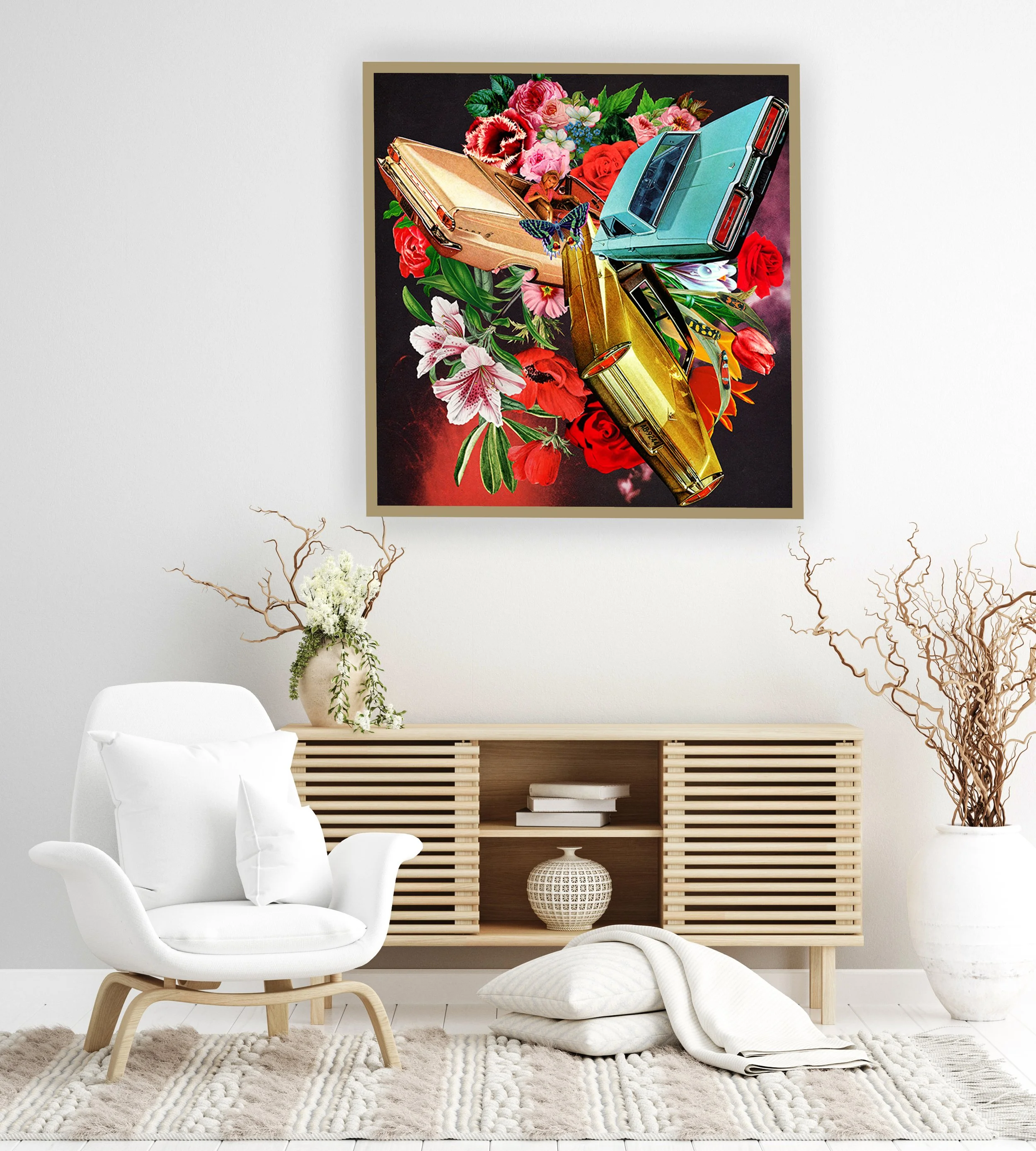
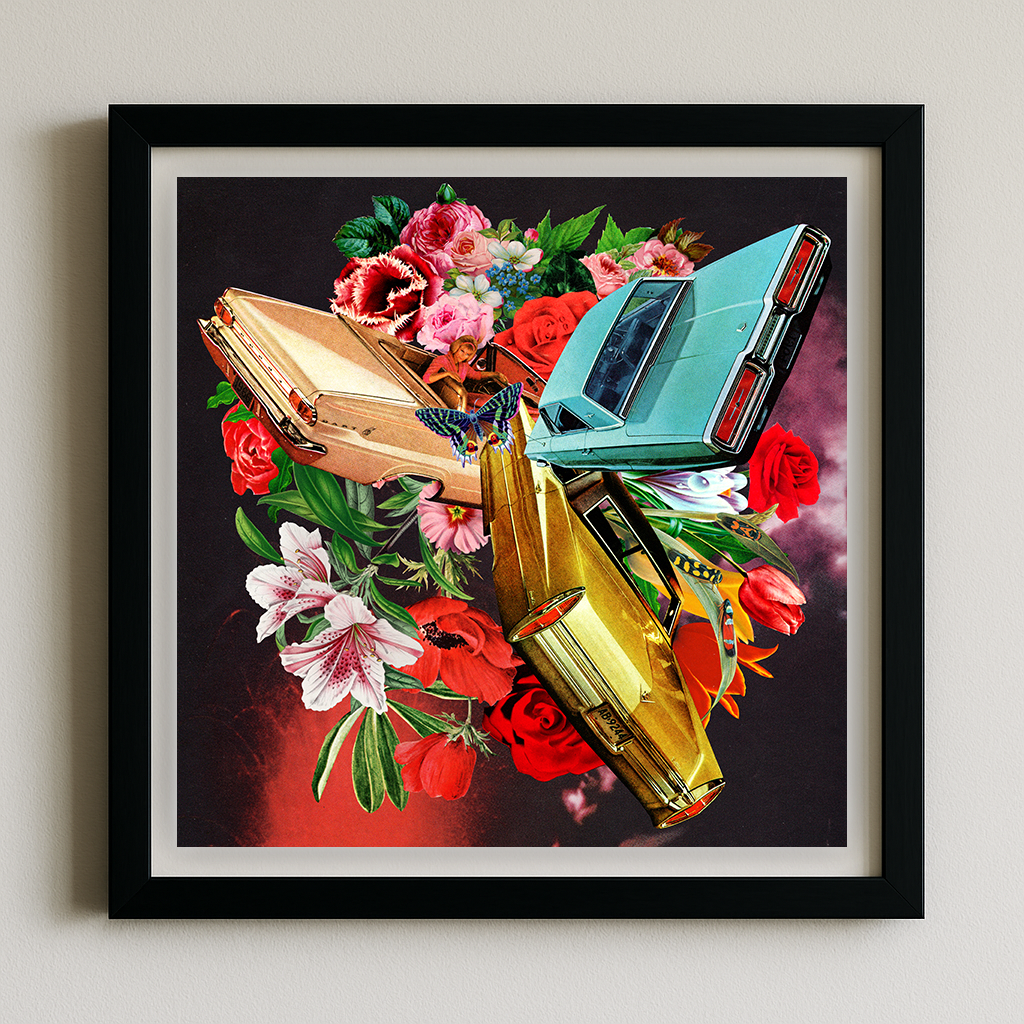
Three vintage cars converge on a single point. Their gleaming bodies fan outward, suggesting a head-on crash whose violence the image withholds. Where crumpled metal and smoke should erupt, a profusion of flowers fills the space. One large butterfly with outstretched wings occupies the foreground; to the right, three others, less conspicuous, keep their wings folded. At the wheel of one car, a woman displays an unnerving calm.
In her letter, Joan reads this convergence as a love triangle whose outcome remains uncertain. At the same time, the collage broadens the scope of this encounter. For Seed, collision seems to function as both a compositional device and an event. In Airplane Collision, the impending crash was suspended as a constellation. Here, the bouquet has the volume of an explosion: petals have taken the place of debris. Brought into contact, objects and symbols produce a third reality that belonged to none of them before. The impact thus becomes the starting point for a transformation.
The cars carry with them the mythology of postwar North America. The automobile promised independence and prosperity, while industrial abundance presented itself as something newly within reach of most people. The built environment and everyday life were reorganized around it. Chrome and imposing lines turned mobility into spectacle, while material beauty became an object of desire. Joan allows this world to retain its seductive power. It is precisely because the promise still gleams that the collision strikes us.
When freedom is reduced to acceleration and abundance to accumulation, however, a model eventually runs up against its own limits. Danger arises from trajectories set against one another, each following its own momentum. Plant life seems to proliferate from the very site of the disaster. It allows us to imagine that a society shaped by rampant consumption and car dependency might still change state.
The flowers themselves carry this possibility. They celebrate unions and accompany the dead, even as they enable life to reproduce. They honor what ends and prepare what begins. Their beauty gives tangible form to this passage.
Then the woman and the butterflies invite us to take a detour through Psyche. Apuleius, a second-century Latin writer, places the story of Psyche at the heart of the Metamorphoses, also known as The Golden Ass. It is, in fact, a tale embedded within the novel: Lucius, the novel’s protagonist, transformed into a donkey, hears an old woman tell the story to comfort a young captive. The story of the soul thus enters the novel through the ear of a man who has himself been transformed.
Psyche is a mortal whose beauty arouses Venus’s jealousy. The goddess then orders her son Eros (Cupid in Apuleius) to punish her, but he falls in love with her. After a series of trials that takes her as far as the Underworld, she is given ambrosia and becomes immortal. The Greek word psychē means “soul,” but can also mean “butterfly” or “moth.” Neoclassical sculptor Antonio Canova gives this association delicate expression in Cupid and Psyche Standing: Psyche hands Eros a butterfly, as though entrusting him with her soul. Apuleius grants her immortality; iconography gives her wings.
French poet Charles Baudelaire accompanies this movement. The title of his collection Les Fleurs du mal (The Flowers of Evil) links blossoming to what wounds, corrupts, or drives us to despair. His work gives the terrible a form capable of producing beauty. Here, the gaze performs a similar operation: it casts the crash in a different light and discovers, in what had seemed to be nothing but an ending, the raw material for a possible new beginning. From the gleam of the car bodies to Psyche’s wings, beauty becomes a force of passage.
In Collision of Blossoms, what comes next remains open. The metamorphosis may encompass an entire society or narrow to the driver, who has reached the point of collision in her own trajectory and may be standing on the threshold of another form of existence. On the horizon remains a more mysterious possibility: that death, too, may be a passage. At the heart of the crash, something may already be growing wings.
CONTEXT
Anatomical Garden is a surreal digital collage in which vintage anatomical illustrations mingle with lush plant life. A heart, a brain and branching blood vessels appear among the flowers, while dissected hands rise like stems. To the right, a woman with a retro look stands with her eyes closed, absorbed in an organic landscape where the human body seems to extend into nature.
At the intersection of anatomical art and botanical collage, the work embraces the visual abundance of maximalism. It recalls Leonardo da Vinci’s studies of the human body as well as the paper mosaics of Mary Delany, the eighteenth-century English artist known for her remarkably precise floral compositions. By transforming the body into a landscape, Joan Seed draws on a surrealist tradition that brings ordinarily separate images together. The collage also resonates with contemporary approaches to human health that emphasize its connections with the natural world.
ARTWORK DETAILS
Title: Collision of Blossoms
French Title: Collision florale
Artist: Joan Seed
Medium: Mixed Media CollageLimited edition prints, hand-signed and numbered
Material: Museum-grade giclée print on archival, textured cotton paper
Size Options:
• 30 × 30 inches (76.2 × 76.2 cm)
• 60 × 60 inches (152.4 × 152.4 cm)
Shipping: Flat rate of $175 CAD per order.
For acquisitions, inquiries, and commissions: joan@joanseed.ca
© 2026 Joan Seed. All rights reserved. This artwork and its images may not be reproduced, copied, distributed, or used in any form without the prior written permission of the artist.
A LETTER FROM JOAN
My dear,
They say love will take you anywhere… and sometimes straight into a wall. This time, three souls are hurtling toward the same point of impact. Everyone wants to be chosen, no one is willing to yield, and the woman at the wheel is so serene it borders on insolence. Perhaps she knows exactly what she’s doing. I almost hope she does.
The bouquet has already arrived. Roses, lilies, tulips, and anemones have piled onto the scene with the indecent enthusiasm of bridesmaids who no longer know which ceremony they were invited to. The butterfly, wiser than the lovers, has already gained altitude.
With certain passions, everything hinges on the brake and the accelerator. Which one will have the last word remains to be seen. But what panache, don’t you think? That reminds me: someone will have to tell us what color to wear to the ceremony.
Until then, kisses.
Joan
A CLOSER LOOK
Where Wings Grow
Beauty from One World to Another
To the one who has crossed the threshold—may his journey continue beyond our sight.
Three vintage cars converge on a single point. Their gleaming bodies fan outward, suggesting a head-on crash whose violence the image withholds. Where crumpled metal and smoke should erupt, a profusion of flowers fills the space. One large butterfly with outstretched wings occupies the foreground; to the right, three others, less conspicuous, keep their wings folded. At the wheel of one car, a woman displays an unnerving calm.
In her letter, Joan reads this convergence as a love triangle whose outcome remains uncertain. At the same time, the collage broadens the scope of this encounter. For Seed, collision seems to function as both a compositional device and an event. In Airplane Collision, the impending crash was suspended as a constellation. Here, the bouquet has the volume of an explosion: petals have taken the place of debris. Brought into contact, objects and symbols produce a third reality that belonged to none of them before. The impact thus becomes the starting point for a transformation.
The cars carry with them the mythology of postwar North America. The automobile promised independence and prosperity, while industrial abundance presented itself as something newly within reach of most people. The built environment and everyday life were reorganized around it. Chrome and imposing lines turned mobility into spectacle, while material beauty became an object of desire. Joan allows this world to retain its seductive power. It is precisely because the promise still gleams that the collision strikes us.
When freedom is reduced to acceleration and abundance to accumulation, however, a model eventually runs up against its own limits. Danger arises from trajectories set against one another, each following its own momentum. Plant life seems to proliferate from the very site of the disaster. It allows us to imagine that a society shaped by rampant consumption and car dependency might still change state.
The flowers themselves carry this possibility. They celebrate unions and accompany the dead, even as they enable life to reproduce. They honor what ends and prepare what begins. Their beauty gives tangible form to this passage.
Then the woman and the butterflies invite us to take a detour through Psyche. Apuleius, a second-century Latin writer, places the story of Psyche at the heart of the Metamorphoses, also known as The Golden Ass. It is, in fact, a tale embedded within the novel: Lucius, the novel’s protagonist, transformed into a donkey, hears an old woman tell the story to comfort a young captive. The story of the soul thus enters the novel through the ear of a man who has himself been transformed.
Psyche is a mortal whose beauty arouses Venus’s jealousy. The goddess then orders her son Eros (Cupid in Apuleius) to punish her, but he falls in love with her. After a series of trials that takes her as far as the Underworld, she is given ambrosia and becomes immortal. The Greek word psychē means “soul,” but can also mean “butterfly” or “moth.” Neoclassical sculptor Antonio Canova gives this association delicate expression in Cupid and Psyche Standing: Psyche hands Eros a butterfly, as though entrusting him with her soul. Apuleius grants her immortality; iconography gives her wings.
French poet Charles Baudelaire accompanies this movement. The title of his collection Les Fleurs du mal (The Flowers of Evil) links blossoming to what wounds, corrupts, or drives us to despair. His work gives the terrible a form capable of producing beauty. Here, the gaze performs a similar operation: it casts the crash in a different light and discovers, in what had seemed to be nothing but an ending, the raw material for a possible new beginning. From the gleam of the car bodies to Psyche’s wings, beauty becomes a force of passage.
In Collision of Blossoms, what comes next remains open. The metamorphosis may encompass an entire society or narrow to the driver, who has reached the point of collision in her own trajectory and may be standing on the threshold of another form of existence. On the horizon remains a more mysterious possibility: that death, too, may be a passage. At the heart of the crash, something may already be growing wings.
CONTEXT
Anatomical Garden is a surreal digital collage in which vintage anatomical illustrations mingle with lush plant life. A heart, a brain and branching blood vessels appear among the flowers, while dissected hands rise like stems. To the right, a woman with a retro look stands with her eyes closed, absorbed in an organic landscape where the human body seems to extend into nature.
At the intersection of anatomical art and botanical collage, the work embraces the visual abundance of maximalism. It recalls Leonardo da Vinci’s studies of the human body as well as the paper mosaics of Mary Delany, the eighteenth-century English artist known for her remarkably precise floral compositions. By transforming the body into a landscape, Joan Seed draws on a surrealist tradition that brings ordinarily separate images together. The collage also resonates with contemporary approaches to human health that emphasize its connections with the natural world.
ARTWORK DETAILS
Title: Collision of Blossoms
French Title: Collision florale
Artist: Joan Seed
Medium: Mixed Media CollageLimited edition prints, hand-signed and numbered
Material: Museum-grade giclée print on archival, textured cotton paper
Size Options:
• 30 × 30 inches (76.2 × 76.2 cm)
• 60 × 60 inches (152.4 × 152.4 cm)
Shipping: Flat rate of $175 CAD per order.
For acquisitions, inquiries, and commissions: joan@joanseed.ca
© 2026 Joan Seed. All rights reserved. This artwork and its images may not be reproduced, copied, distributed, or used in any form without the prior written permission of the artist.